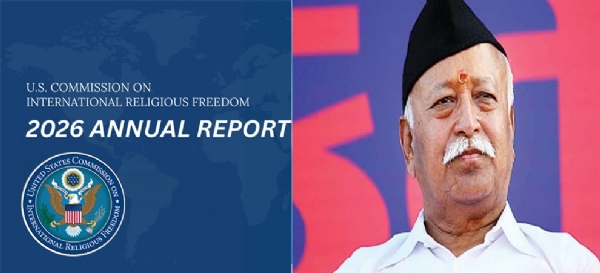
The nexus between USCIRF’s anti-India agenda and global lobbying stands exposed once again; the body has become agitated over RSS Sarsanghchalak Dr. Bhagwat’s upcoming US visit!
Every nation possesses the inherent right to determine its own sovereignty, laws, social fabric, cultural identity and policies for its citizens; this constitutes the very guarantee of sovereignty. Naturally, questions arise when a foreign entity persistently campaigns to influence a country's internal policies, laws, or social institutions. In the context of India, the United States Commission on International Religious Freedom (USCIRF) has been observed engaging in precisely this kind of activity for years. What is particularly significant is how the political opposition seizes upon such issues to play politics and allegedly mislead the general public.
The USCIRF’s activities regarding India have been a constant topic of discussion in recent years; now, with the proposed visit of Rashtriya Swayamsevak Sangh (RSS) Sarsanghchalak Dr. Mohanrao Bhagwat to the US on August 29, 2026, the commission has once again openly spewed venom. It has demanded a ban on the RSS, even though New Delhi has previously registered strong objections to USCIRF’s comments concerning India.
https://x.com/USCIRF/status/2090125836468769074?s=20
Since the Modi government assumed power at the Centre, the United States Commission on International Religious Freedom (USCIRF) has progressively sharpened its criticism year after year, making negative remarks about India and recommending that it be designated a Country of Particular Concern (CPC).
Although the commission had previously made negative comments about India and occasionally placed the country on its Watch List, its stance has become markedly aggressive since the Modi government took office. Its most stringent and consistently negative stance against India began in 2020 and continues to this day (2026). Following the events surrounding the CAA, NRC, and other developments in recent years, the Commission has remained adamant in its push to blacklist India.
Questions regarding USCIRF’s composition and alleged ideological leanings
While USCIRF presents itself as an independent and impartial US advisory body, questions have frequently been raised regarding its composition, appointments and the ideological backgrounds of its various members. Regarding India, the Commission's reporting often reflects a one-sided perspective and fails to adequately consider the country's social and constitutional context.
Questions have also been raised in Indian diplomatic and analytical circles concerning the background of the Commission's Chair, Asif Mahmood. As a Pakistani-American, his views on the Indian subcontinent appear to be influenced by the complexities of India-Pakistan relations. His aggressive stance, particularly surfacing just before the proposed US visit of the Sangh chief, has further intensified this debate.
USCIRF’s nine commissioners are appointed by the US President and the leadership of both houses of Congress. Another aspect of the debate surrounding the Commission's composition concerns the role of influential US conservative and evangelical groups. The Commission has included several commissioners and members linked to conservative or evangelical church groups in the US; their primary agenda involves advancing their policies under the guise of advocating for the rights of Christian minorities globally. These groups are active on issues of religious proselytization and Christian conversion and their interests are affected when countries like India take legal measures to regulate foreign funding and curb forced or fraudulent conversions.
India's Ministry of External Affairs (MEA) has officially stated that USCIRF relies entirely on selective sources and ideological narratives. According to Indian thinkers, this 'ideological narrative' is nothing more than an agenda crafted by anti-India and religious lobbying groups (including evangelical forces).
Mohan Bhagwat’s US Visit and the Politics of Timing
It is noteworthy that the Rashtriya Swayamsevak Sangh (RSS) has completed its centenary year. Against this backdrop, RSS chief Mohan Bhagwat’s participation in the ‘Universal Oneness Celebrations’ in New York on August 29, 2026, carries significant political and social resonance for the Indian diaspora. A large number of people of Indian origin in the US are associated with various social, cultural, and community organizations. Such events also provide an opportunity for dialogue within the global Indian community regarding India’s cultural identity and the ideology of the Sangh.
It is in this context that the demand for a ban by the USCIRF, made just prior to the visit, appears to be a form of ‘pre-emptive strike.’ Many in India believe the objective may be to limit the political and social impact of the visit while simultaneously fostering a negative perception of the Sangh among the US administration, think tanks and civil society. On the other hand, the fact that over 100 local Hindu and Indian-American civic organizations across the US and Canada have expressed support for the visit suggests that the Indian diaspora has largely disregarded the USCIRF.
USCIRF Displeased with India’s Crackdown on Foreign Funding Networks
In India, the Foreign Contribution (Regulation) Act (FCRA) has long served as the primary legal mechanism for regulating the activities of non-governmental organizations (NGOs) that receive foreign funds. Following the government's tightening of its provisions, oversight regarding the utilization of foreign funds, administrative expenses, and the transfer of money has intensified. Consequently, the FCRA licenses of numerous NGOs, whose activities and financial transactions had raised government objections, were either cancelled or denied renewal.
Legal and administrative actions were also taken against the operations of US-based Christian organizations like Compassion International in India. The heightened scrutiny of foreign religious entities and associated interest groups has fueled lobbying efforts against India in the US. In this context, reports and statements from the USCIRF raise the question of whether the issue of religious freedom is sometimes intertwined with interests related to foreign funding and religious proselytization.
Controversy Surrounding Anti-Conversion Laws
Several Indian states, notably Uttar Pradesh, Madhya Pradesh, Gujarat, Karnataka, Uttarakhand and Himachal Pradesh, have enacted laws to curb religious conversions achieved through force, fraud, or inducement. The constitutional context of these laws is also significant. In the 1977 case of ‘Rev. Stanislaus v. State of Madhya Pradesh’, the Supreme Court held that the right to propagate religion under Article 25 of the Constitution does not equate to the right to forcibly convert another person. This judicial stance has remained a cornerstone of the legal debate regarding conversion in India.
Despite this, the USCIRF has consistently characterized these Indian laws in its reports as a threat to religious freedom and as instruments used against minorities. This is because India's stringent anti-conversion laws pose a major legal obstacle to the proselytization and conversion activities of Western evangelical groups; consequently, pressure is exerted against these laws on international platforms.
This also raises the question of American double standards. The United States itself enforces laws like the Foreign Agents Registration Act (FARA) to monitor foreign political influence and the activities of foreign agents. In this context, how can India’s move to tighten the FCRA to regulate foreign funding, or to enact state-level laws to curb forced conversions, be considered contrary to the democratic system?
The Rashtriya Swayamsevak Sangh (RSS) is a social movement spanning over a century, with roots embedded in service, cultural self-confidence and national reconstruction. Undoubtedly, under the American system, any commission there has the full authority to make recommendations; however, such recommendations must be honest, principled and fair.
It is unacceptable for the USCIRF to overlook the vandalism and attacks on Hindu temples in the United States, showing no apparent effort to ensure the perpetrators face strict legal punishment, while repeatedly stepping forward to selectively target India. The USCIRF’s silence regarding the rising intolerance and intimidation faced by members of the Indian diaspora in the US is, in reality, extremely dangerous for American democracy itself.
It is worth noting that Dr. Mohan Bhagwat, the Sarsanghchalak of the Sangh, has not yet visited the United States. Debates have already begun regarding who will meet him and who will evaluate the organization he leads. The USCIRF is shaping a narrative; it has published the comments made by Mahmood and Mills. “Chair @DrMahmood40: 'Indian Prime Minister Modi is a member of the Rashtriya Swayamsevak Sangh (RSS), an Indian organization whose affiliates have carried out attacks on religious minorities, including Christians and Muslims. Now, RSS leader Mohan Bhagwat is planning a visit to the US.'”
In another post, USCIRF wrote, “Commissioner @Jean_Mills: 'RSS leaders, even if affiliated with the Indian government, should not be accorded the honor of high-level meetings or diplomatic courtesies. Instead, the US government should focus on imposing sanctions on RSS members found responsible for violations.' ” This is certainly the height of duplicity, to which the Indian government should also give a stern response.
https://x.com/DrMahmood40/status/2083577560521453706?s=20
One can see the extent of the depravity of USCIRF Chair Dr. Asif Mahmood, who is of Pakistani origin, in the fact that, on August 1st, he targeted the Indian government over the issue of Jammu and Kashmir on his X (formerly Twitter) platform and leveled various allegations that are simply untrue.
---------------
Hindusthan Samachar / Mayank Chaturvedi