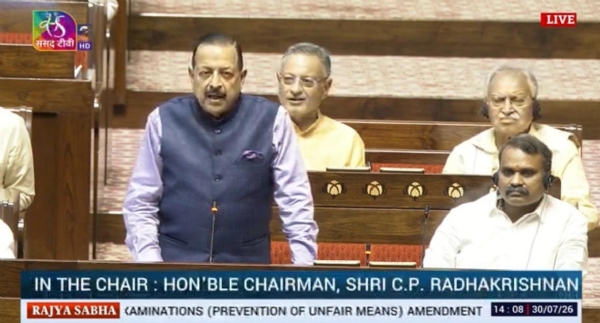
New Delhi, 30 July (H.S.): A heated debate broke out between the ruling party and the Opposition in the Rajya Sabha on Thursday during discussions on the Public Examinations (Prevention of Unfair Means) Amendment Bill, 2026, aimed at preventing paper leaks.
Leader of Opposition in the Rajya Sabha Mallikarjun Kharge questioned the government on why the Bill was not introduced earlier to curb paper leaks. He alleged that instead of safeguarding the future of students, the government had remained focused on political issues. Kharge said, “You have brought this Bill not for reforms, but to stop the protests taking place in Delhi.”
Kharge further said that despite investigation agencies being under the control of the government and the presence of BJP-led “double-engine” governments in several states, incidents of paper leaks continued to occur. He added that such situations could have been avoided if agencies like the Central Bureau of Investigation (CBI), National Testing Agency (NTA), and Enforcement Directorate (ED) had functioned with complete independence.
Earlier, while introducing the Public Examinations (Prevention of Unfair Means) Amendment Bill in the Rajya Sabha, Minister of State in the Prime Minister’s Office Dr. Jitendra Singh said that four major recruitment agencies in the country — the Union Public Service Commission (UPSC), Railway Recruitment Board (RRB), Institute of Banking Personnel Selection (IBPS), and National Testing Agency (NTA) for higher education entrance examinations — conduct various examinations.
He said the idea of establishing the National Testing Agency was first proposed in 1992 when the Congress government was in power at the Centre. Several committees later also recommended the creation of such an agency, but the proposal was not implemented. Jitendra Singh said that Prime Minister Narendra Modi completed the long-pending task and the Opposition should acknowledge this achievement.
Jitendra Singh said that the government had introduced amendments based on the experience gained from the implementation of the 2024 law. He said the move reflected the government’s “willingness to learn from experience”.
The amended Bill proposes that investigations into paper leak cases must be completed within two months. It also empowers states and Union Territories to designate sessions courts as special fast-track courts, allowing daily hearings and disposal of cases within three months of filing the charge sheet.
The Bill has also proposed stricter punishment for offenders. Those found guilty of paper leaks or other unfair practices in public examinations may face imprisonment ranging from five to ten years along with a fine of up to Rs 50 lakh. In cases involving organised gangs, the provision includes a minimum sentence of seven years and a fine of up to Rs 10 crore. The Central Government may also constitute a Special Task Force whenever required.
Jitendra Singh informed the House that 52 FIRs have been registered so far after the implementation of the 2024 law and that incidents of suicides linked to paper leak cases have declined. He also mentioned several previous paper leak incidents in the country, following which protests and disruptions were witnessed from Opposition members in the House.
---------------
Hindusthan Samachar / Jun Sarkar
30 Jul 2026