New Delhi, 28 July (H.S.):
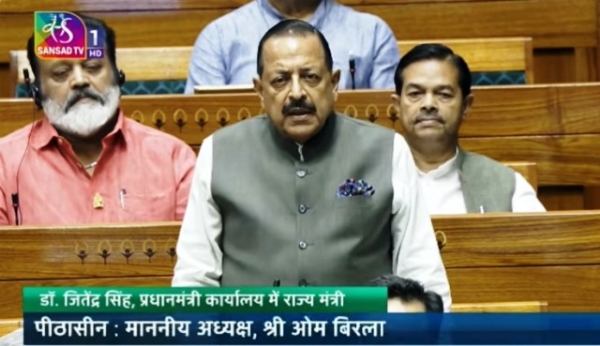
The Central government on Tuesday introduced the Public Examinations (Prevention of Unfair Means) Amendment Bill, 2026 in the Lok Sabha with the objective of effectively curbing paper leaks and other unfair practices in public examinations. Minister of State in the Prime Minister’s Office, Dr Jitendra Singh, moved the motion for consideration of the Bill, stating that it seeks to make the law enacted in 2024 more effective and stringent to safeguard the future of students and young aspirants.
Dr Singh said that incidents of paper leaks and examination irregularities have not been limited to any particular state or government. Referring to several cases, including those related to Railway Recruitment Board examinations, the All India Engineering Entrance Examination, AIIMS, the Tamil Nadu Public Service Commission, the Uttar Pradesh B.Ed entrance examination and the West Bengal Joint Entrance Examination, he said these experiences led to the formulation of a comprehensive law in 2024.
He informed the House that the 2024 law was applicable to examinations conducted by institutions such as the Union Public Service Commission (UPSC), Staff Selection Commission (SSC), Railway Recruitment Board, Institute of Banking Personnel Selection (IBPS) and the National Testing Agency (NTA). Under the law, offences related to examination malpractice were classified as cognisable, non-bailable and non-compoundable.
The minister said the proposed amendment seeks to increase the minimum punishment for those using unfair means in examinations from three years to five years, while the maximum imprisonment term would remain up to 10 years. The maximum penalty amount has also been proposed to be increased from ₹10 lakh to ₹50 lakh.
Dr Singh said the amendment expands the definition of service providers by bringing institutions, companies, partnership firms, contractors and technical service providers involved in examination-related activities under the ambit of the law. If found guilty, such service providers may face a maximum penalty of ₹5 crore, and the period of debarment from conducting examinations is proposed to be increased from four years to eight years. The expenses incurred in conducting the examination would also be recovered from the concerned organisation.
He emphasised that punishing only lower-level employees would not be sufficient. Therefore, directors and senior management officials of companies and institutions have also been made accountable under the proposed law. They may face imprisonment ranging from five to 10 years and a fine of up to ₹5 crore. In cases involving organised crime groups or examination mafias, the penalty may be increased up to ₹10 crore.
Dr Singh said provisions have been made for special fast-track courts to ensure speedy disposal of cases. Investigations will have to be completed within two months, followed by an objective to conclude trials within three months. Appeals will be allowed only before a division bench of the High Court within the prescribed time limit.
The minister said the government has constituted a high-level task force to make the examination system completely secure and leak-proof. The panel includes experts from the education and technology sectors, including Nandan Nilekani, former ISRO chairman S. Somanath, former Intelligence Bureau director Tapan Deka and IIT Madras Director V. Kamakoti.
He added that around 35 of the 46 key recommendations made by the Radhakrishnan Committee have already been implemented. Dr Singh appealed to all political parties to support the important amendment legislation in the interest of students and the future of young aspirants.
---------------
Hindusthan Samachar / Jun Sarkar
28 Jul 2026