New Delhi, 02 July (H.S.): Prime Minister Narendra Modi on Thursday outlined an ambitious roadmap for the future of India-Japan relations, describing mutual trust as the greatest strategic asset underpinning the bilateral partnership and announcing a series of landmark initiatives spanning defence, artificial intelligence, investment, energy security, advanced technologies and next-generation mobility.
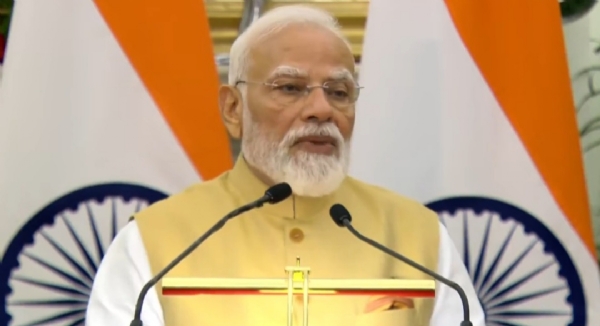
Speaking during a joint press statement with Japanese Prime Minister Sanae Takaichi after the 16th India-Japan Annual Summit at Hyderabad House in New Delhi, Modi warmly welcomed Takaichi on her first visit to India as Prime Minister. He described her as Japan's first woman Prime Minister, a visionary and widely respected leader, and affectionately referred to her as his younger sister. He also noted that she hails from Japan's Nara Prefecture, an important centre of the shared Buddhist heritage linking India and Japan.
PM Modi said the visit marked the beginning of a new chapter in the India-Japan Special Strategic and Global Partnership, built upon decades of trust and cooperation.
Recalling his remarks at the recent G7 Summit,PM Modi said that in an era marked by global uncertainty and geopolitical turbulence, mutual trust has become the world's most valuable strategic asset. He said India and Japan have successfully built a partnership that exemplifies this principle.
The Prime Minister highlighted Japan's long-standing contribution to India's economic development, noting that Japanese industries, ranging from automobiles to electronics, have played a significant role in India's growth story while creating a foundation of enduring friendship and confidence between the two countries.
PM Modi said India and Japan, as two of the world's largest economies and the leading democratic and market-oriented economies in the Indo-Pacific, share a commitment to a free, prosperous and rules-based Indo-Pacific. He said the initiatives announced during the summit would jointly promote peace, stability and sustainable development across the region.
Technology, he said, will emerge as the strongest pillar of future cooperation. To advance this vision, both countries issued a Joint Statement on Artificial Intelligence and witnessed agreements between leading Indian AI institutions and their Japanese counterparts.PM Modi said the combination of Japan's precision engineering and India's software capabilities would accelerate global innovation in artificial intelligence.
In a major strategic development, the Prime Minister announced that India and Japan had signed their first-ever defence co-development agreement. The inaugural project focuses on the joint development of a Naval Radio Antenna system and represents a significant milestone in bilateral defence cooperation.PM Modi said both countries would jointly develop advanced defence technologies that would strengthen regional peace, maritime security and the rules-based international order.
The Prime Minister also highlighted agreements signed in pharmaceuticals, medical devices and biotechnology, saying the collaboration would contribute to strengthening global health security. By combining India's manufacturing scale with Japan's technological excellence, the two countries aim to develop affordable, reliable and advanced healthcare solutions for global markets.
Emphasising the growing economic partnership,PM Modi said India and Japan had concluded more than 100 new business agreements during the past year, which are expected to bring over US$10 billion in fresh Japanese investment into India. He also announced an agreement between the two countries' financial regulatory agencies to facilitate smoother capital flows and investment.
Setting an ambitious long-term objective,PM Modi said India and Japan have agreed to target Japanese investment of 10 trillion yen approximately Rs.5.9 lakh crore in India over the next decade while also seeking to double the number of Japanese companies operating in the country. He said India's continuing economic reforms and improving ease of doing business provide significant opportunities for Japanese enterprises.
Addressing global economic uncertainties,PM Modi said both nations have prepared a Joint Roadmap on Economic Security that will strengthen resilient supply chains in strategically important sectors including semiconductors, quantum technologies and advanced materials.
The Prime Minister also announced several important decisions on energy security. Under the newly launched India-Japan Biogas Initiative, Japan will support the establishment of 1,000 biogas and organic fertiliser plants across India. He said the initiative would reinforce India's GOBAR-Dhan programme while promoting sustainability, rural prosperity and livelihood generation in villages.
PM Modi said both countries have also initiated cooperation on energy resilience to better prepare for disruptions such as global oil shocks. Collaboration in battery technologies, green hydrogen and nuclear energy, he added, would contribute significantly to the world's clean energy transition. He stressed that India and Japan regard economic security as shared security and energy transition as a shared opportunity for future growth.
Another major outcome of the summit was the launch of the India-Japan Next Generation Mobility Partnership Framework. Modi said the framework aims to replicate the success achieved in the automotive sector across new areas such as shipbuilding, aviation and logistics.
Highlighting the importance of people-to-people ties, the Prime Minister said both countries would expand cooperation in talent mobility, skill development, technical internship programmes, higher education, scientific research and start-up ecosystems to deepen long-term collaboration.
PM Modi also noted that India and Japan will celebrate the 75th anniversary of diplomatic relations next year. He said both governments would commemorate the milestone by expanding cooperation in culture, tourism and the creative economy, thereby strengthening people-to-people connections.
Concluding his remarks, the Prime Minister said the economies of India and Japan are highly complementary and that the two nations share common values, similar approaches to modern technology and a relationship founded on unwavering mutual trust. He expressed confidence that the strengthened strategic partnership would advance Japan's vision of a strong and prosperous nation, support India's goal of becoming a developed country, and contribute meaningfully to global peace, stability and prosperity.
---------------
Hindusthan Samachar / Jun Sarkar

02 Jul 2026