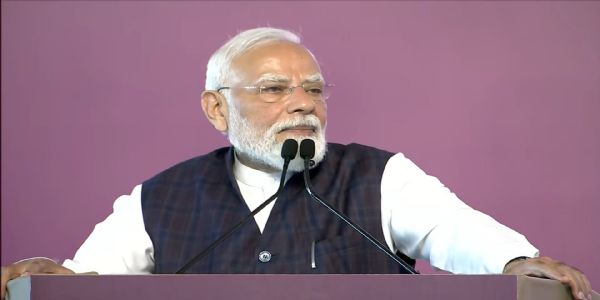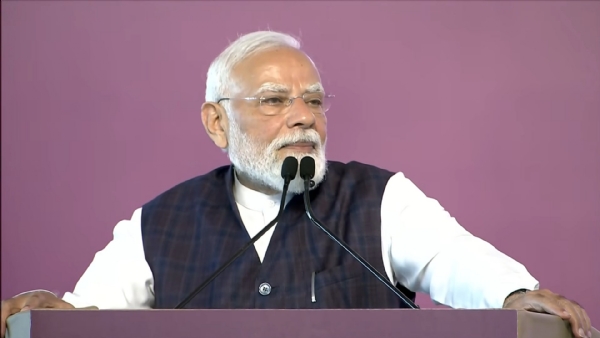
Chandigarh, 17 July (H.S.): Prime Minister Narendra Modi on Friday said that India must move forward with a vision centred on future technologies, innovation and modern healthcare to realise the goal of a Viksit Bharat (Developed India). Addressing the inauguration and foundation stone-laying ceremony of development projects worth over ₹4,700 crore in Chandigarh, the Prime Minister said that during the COVID-19 pandemic, India emerged not as a nation seeking assistance from the world, but as one extending help to other countries.
The Prime Minister said Chandigarh is not merely a city but a model of planned urban development, quality living and advanced healthcare infrastructure. He noted that the city serves as a major healthcare hub for the people of Haryana, Punjab, Himachal Pradesh and Jammu & Kashmir, adding that the NDA government has consistently prioritised its development.
He said India's healthcare infrastructure has witnessed unprecedented expansion over the past 12 years. Since 2014, the government has approved 15 new All India Institutes of Medical Sciences (AIIMS), established hundreds of new medical colleges and expanded specialised hospitals for the treatment of critical illnesses such as cancer. He stated that the number of medical colleges in the country has nearly doubled, while MBBS and postgraduate medical seats have recorded historic growth. He also announced that approval has been granted for an MBBS college at the Postgraduate Institute of Medical Education and Research (PGIMER), Chandigarh, and admissions will commence shortly.
Highlighting the Ayushman Bharat Health Infrastructure Mission, the Prime Minister said nearly 1.75 lakh Ayushman Arogya Mandirs are now operational across the country, providing treatment along with 12 categories of healthcare services. He added that more than 480 million online medical consultations have been delivered through the eSanjeevani telemedicine platform, enabling people in remote areas to access specialist medical care.
The Prime Minister said the government is also accelerating the TB Mukt Bharat Abhiyan. Owing to timely diagnosis and treatment, the treatment coverage for tuberculosis has exceeded 90 per cent. Citing the World Health Organization, he said India has recorded a 21 per cent decline in tuberculosis incidence over the past decade.
Recalling the COVID-19 pandemic, Prime Minister Modi said there was a time when the world expressed concern over India's healthcare system, but the country's response to the pandemic transformed global perceptions.
During the COVID-19 pandemic, India was not asking for help; instead, it was supplying medicines and assistance to countries around the world, he said.
The Prime Minister added that people from across the globe are now travelling to India for medical treatment, reflecting the significant reforms carried out in the healthcare sector over the past 12 years.
He further said Chandigarh is home to several premier institutions in education, engineering, medical science and research, which have the potential to emerge as major centres for future technologies, healthcare innovation, startups and research. He emphasised that giving special attention to future technologies and modern healthcare is essential for India's journey towards becoming a developed nation.
Referring to his earlier visit to Haryana, the Prime Minister said the launch of the country's first hydrogen-powered train on the Jind–Sonipat rail section symbolises India's technological advancement and marks a significant step towards clean energy-based transportation.
On the occasion, Prime Minister Modi inaugurated and laid the foundation stones for development projects worth more than ₹4,700 crore. These include the inauguration of the Advanced Mother and Child Centre and the Advanced Neurosciences Centre at PGIMER, the foundation stone for a 150-bed Critical Care Block, hostel projects at Punjab Engineering College and Government College, Sector 46, and major road infrastructure projects including the IT City–Kurali six-lane Greenfield Highway, the Zirakpur Greenfield Bypass and the PR-7 Spur Corridor.
---------------
Hindusthan Samachar / Jun Sarkar
17 Jul 2026