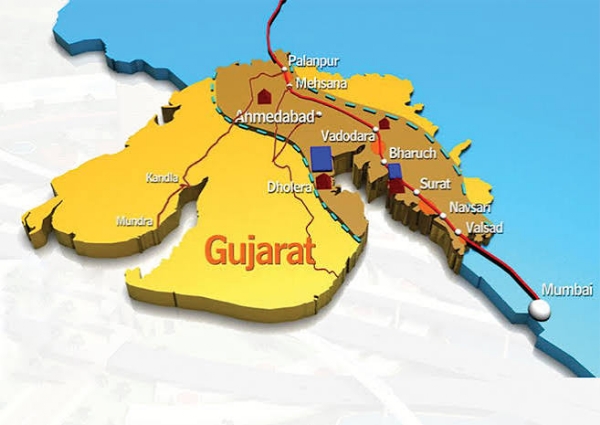
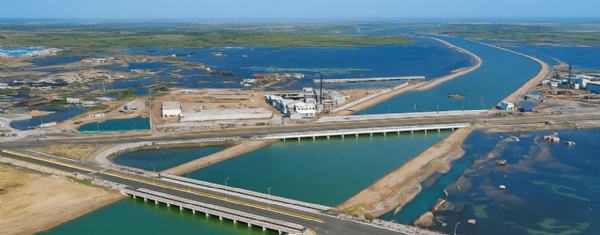
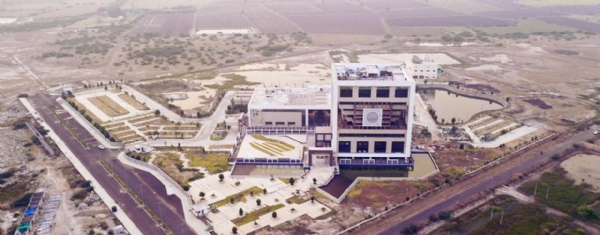
New Delhi, July 1 (HS): What if a city could be designed from the ground up to manufacture the technologies that will shape the next generation of the global economy? That is the experiment unfolding at Dholera in Gujarat, where India is building an integrated industrial ecosystem centred on semiconductors, aerospace, artificial intelligence, renewable energy and advanced manufacturing.
Once envisioned as a futuristic smart city, Dholera is now emerging as one of India's most ambitious industrial projects, attracting global investors, cutting-edge technology partners and infrastructure developers. Rather than growing organically over decades, the city is being developed as a purpose-built manufacturing ecosystem designed to strengthen India's role in global supply chains and high-value technology industries.
At the heart of this transformation is Tata Electronics' ₹91,000-crore semiconductor fabrication facility being established in partnership with Taiwan's Powerchip Semiconductor Manufacturing Corporation (PSMC). Located within a dedicated Special Economic Zone, the facility will manufacture mature-node semiconductor chips used in automobiles, telecommunications, consumer electronics, industrial automation and defence systems—marking a significant milestone in India's effort to develop domestic chip manufacturing.
The semiconductor ecosystem is expanding rapidly beyond a single fabrication plant. Global technology leaders such as ASML of the Netherlands, Tokyo Electron of Japan and ROHM have begun establishing operations to support equipment, materials and technology requirements. NextGen Semiconductors has also launched its ₹8,800-crore commercial chip fabrication project, further strengthening Dholera's ambition to become India's semiconductor manufacturing hub.
Beyond semiconductors, Dholera is preparing to enter the global aerospace industry through a planned partnership between Adani Defence & Aerospace and Brazilian aircraft manufacturer Embraer to establish a regional aircraft final assembly line. The project is expected to create an ecosystem of precision engineering companies supplying components for both civilian and defence aviation, strengthening India's presence in the global aerospace value chain.
Artificial intelligence and digital infrastructure are also becoming integral to Dholera's industrial identity. Technology developers, including Tillman Global and L&T Vyom, are establishing hyperscale data centres designed to support AI-driven computing, cloud services and digital platforms. These facilities are expected to benefit from integrated infrastructure and abundant clean energy, strengthening India's digital economy.
Infrastructure development has kept pace with industrial expansion. The 109-km Ahmedabad-Dholera Access-Controlled Expressway has reduced travel time between Ahmedabad and Dholera to under an hour, while the Dholera International Airport has completed its initial phase and successful runway trials, moving closer to becoming a major cargo and logistics hub. The Union Cabinet has also approved a semi-high-speed rail corridor linking Ahmedabad with Dholera, improving connectivity between the emerging industrial city and western India's commercial centres.
One of Dholera's biggest competitive advantages is its 22.5-square-kilometre Activation Area, where industries receive ready-to-use underground utility infrastructure, including electricity, water, gas, fibre connectivity and drainage systems. This plug-and-play model significantly reduces project implementation time, enabling manufacturers to focus on production rather than basic infrastructure development.
Sustainability has also been embedded into Dholera's industrial vision. The city is expected to draw power from the 4,400 MW Dholera Solar Park, enabling industries to increasingly rely on renewable energy. As environmental standards tighten and carbon-related trade regulations gain prominence, access to cleaner energy could provide manufacturers operating in Dholera with a competitive advantage in global markets.
Beyond industrial development, Dholera reflects a broader strategic shift in India's economic ambitions. For decades, global semiconductor production has remained concentrated in a handful of East Asian economies. By establishing domestic fabrication capacity alongside world-class infrastructure, India is seeking to diversify global supply chains, reduce dependence on imported critical technologies and strengthen its technological resilience.
The implications extend far beyond Gujarat. Dholera is being developed as an integrated ecosystem where semiconductors, aerospace, renewable energy, logistics and digital infrastructure evolve together. The city is expected to attract substantial foreign investment while creating thousands of high-skilled jobs in engineering, electronics, aerospace, automation and advanced manufacturing.
For India, Dholera represents more than another industrial township. It is an attempt to build the manufacturing city of the future—one capable of competing in an era increasingly defined by semiconductors, artificial intelligence, clean energy and resilient supply chains.
If the twentieth century belonged to industrial cities built around ports, mines and heavy engineering, the next generation may be defined by cities centred on advanced technologies and sustainable manufacturing. Dholera represents India's attempt to build such a city from the ground up. If successful, it could redefine India's position in global manufacturing, strengthen supply-chain resilience and provide a new model of industrial urbanisation for emerging economies.
---------------
Hindusthan Samachar / Indrani Sarkar

01 Jul 2026
On Chartered Accountants' Day, PM Modi Applauds CA Community's Role in Building a Stronger Economy

01 Jul 2026