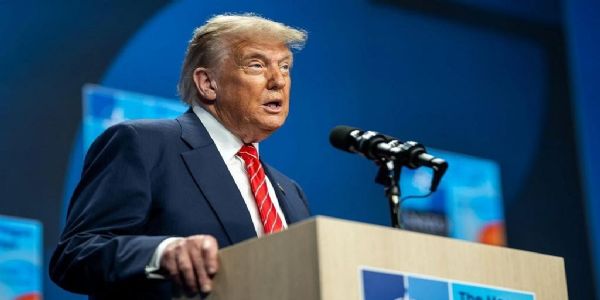
Washington, 25 June (H.S.): l US President Donald Trump faced growing resistance from within his own Republican Party on Wednesday as disagreements over the Iran conflict and proposed election reforms exposed divisions among congressional Republicans.
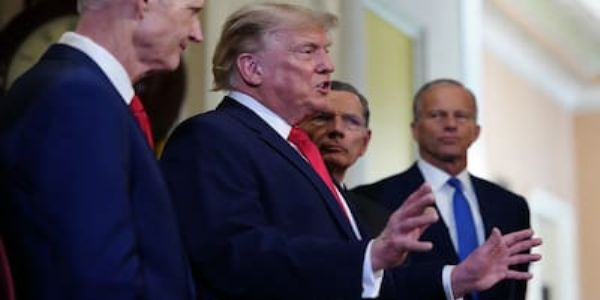
The tensions became evident during Trump's visit to Capitol Hill, where he held meetings with Republican senators and lawmakers. The president also unexpectedly postponed the signing of a bipartisan housing affordability bill, linking its approval to the passage of the SAVE America Act, a controversial election measure that has faced opposition in the Senate.
Trump announced that he would withhold signing the housing legislation until Congress advances the SAVE America Act, which seeks to introduce stricter voting requirements, including proof of citizenship for voter registration and mandatory photo identification for casting ballots. Supporters argue the proposal would strengthen election security, while critics contend it could create barriers for eligible voters.
The housing package, which had received broad bipartisan backing, was designed to address affordability concerns by increasing housing supply, easing construction regulations and expanding opportunities for home ownership. The legislation had been viewed as a significant effort to tackle rising housing costs and limited housing availability across the United States.
During a closed-door meeting with Senate Republicans on Wednesday, Trump reportedly confronted lawmakers who had supported a recent Senate resolution related to US military actions involving Iran. The measure, backed by Democrats and four Republican senators, called on the administration to either end military hostilities with Iran or seek formal congressional authorization for continued operations.
According to lawmakers present at the meeting, discussions became heated as Trump questioned why members of his own party had supported the resolution. Some senators expressed concerns about the duration and objectives of the military engagement, arguing that Congress and the public deserved greater clarity regarding the administration's strategy.
The dispute highlighted broader debates in Washington over presidential war powers and congressional oversight. While the resolution carries largely symbolic significance, it reflects growing scrutiny of US involvement in the Middle East following months of tensions with Iran.
Despite the criticism, Trump defended his administration's approach, stating that developments in the region were progressing positively and suggesting that negotiations with Iran were moving in a constructive direction.
The president's remarks came as efforts continue to transform a preliminary understanding with Iran into a more comprehensive agreement aimed at reducing regional tensions and stabilizing global energy markets.
Political analysts noted that the disagreements underscore emerging fractures within the Republican Party ahead of upcoming elections, particularly on issues related to foreign policy and election administration. While Trump retains strong influence within the party, recent debates suggest that some Republican lawmakers are increasingly willing to challenge the administration on key policy matters.
The developments mark one of the most visible internal disputes among Republicans in recent months, highlighting the complex political landscape facing the White House as it seeks support for both its domestic and international priorities.
---------------
Hindusthan Samachar / Jun Sarkar