By Charvi Arora, U.S. Embassy - New Delhi
Behind every faster sprint, safer recovery, and smarter game-day decision is a growing network of technologies that is reshaping the sports industry. Yet technology alone does not explain why the United States has become a leading market for sports innovation.
According to David Steele, director of Plug and Play Tech Center ’s Sportstech vertical in Frisco, Texas, the country’s advantage lies in the connections it has built among teams, start-ups, healthcare providers, investors, and global brands. Those relationships help new ideas move from testing and pilot programs to commercial products and businesses.
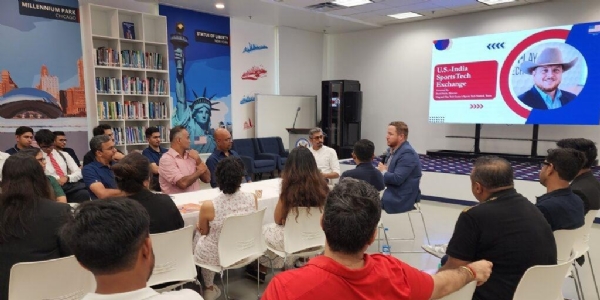
Under the U.S. State Department’s Speaker Program, Steele recently visited Delhi, Chandigarh, and Mumbai to discuss how sports-tech ecosystems create opportunities for innovation, investment, and growth. His message was that the strength of the U.S. model comes not from any single technology, but from the scale of its market and the partnerships that help innovations reach users.
Market scale as a catalyst for sports innovation
For Steele, one of the biggest strengths of the U.S. sports-tech ecosystem is the sheer size of the market.
“When you look at the U.S. market as a whole, the size and the scope of it is massive,” he notes. “When you look at everything from youth sports, which we consider grassroots sports involving 30 to 40 million kids, all the way up to our professional, high-level elite athletes, that is a tremendous span.”
That breadth creates opportunities for companies to develop products for athletes at different levels of participation and competition. Some companies begin with elite athletes and adapt technologies for broader markets. Others start at the grassroots level and scale upward.
The result is a large testing environment where technologies can be refined across multiple sports and levels of competition.
Technologies such as artificial intelligence (AI) are helping sports organizations take advantage of that scale. Teams, coaches, and governing bodies increasingly use AI-enabled systems to identify talent, analyze performance, and support athlete development.
Steele also points to efforts by organizations such as U.S. Soccer to identify and develop athletes earlier in their careers through tools such as field cameras and performance data collected during practices, games, and post-game analysis.
These systems allow organizations to evaluate athletes at a much larger scale than traditional scouting methods.
David Steele is the director of Plug and Play Tech Center’s Sportstech vertical in Frisco, Texas, which helps connect sports organizations
with start-ups to test, validate, and commercialize new sports technologies. (Photograph courtesy David Steele)
Corporate partnerships and commercialization strategies
While scale creates opportunities, Steele says partnerships are what help technologies move into the marketplace.
At Plug and Play, that process begins by identifying challenges faced by teams, brands, and other organizations. Drawing on its network of 70 offices worldwide, Plug and Play connects organizations with start-ups working on relevant solutions.
Steele says the process involves identifying specific challenges, evaluating potential solutions through a structured review process, and connecting selected companies with organizations for pilot projects. Successful pilots can validate technologies, opening the door to commercialization, investment, and broader market adoption.
For sports organizations, many of the technologies attracting investment focus on athlete health, performance, and recovery.
These include innovations in playing surfaces, protective equipment, hydration systems, wearable monitoring devices, and tools that track performance during training and competition.
Validating athlete health and performance technologies
Partnerships with organizations such as Gatorade Sports Science and healthcare providers also help companies develop and validate new technologies.
“Working with brands like Gatorade Sports Science to understand how hydration and recovery matter for athletes and then working with healthcare systems like Baylor Scott & White Health in Texas allows us to understand if there is an injury, what is the return-to-play process, and what start-up technologies are available to help increase the likelihood of a favorable return at a faster timeline,” Steele explains.
For emerging companies, validation can be as important as innovation. Steele notes that partnerships with major sports organizations and global brands help demonstrate that technologies can perform in demanding, real-world environments.
That credibility can accelerate adoption, attract investment, and help companies scale far more quickly than they might through grassroots growth alone. “Once you break that barrier of those Fortune 1000 or Fortune 500 companies, the scalability of a start-up technology grows tremendously,” he says.
Scaling opportunities for India’s sports market
Steele believes the same factor that has helped drive the U.S. sports-tech market—scale—also creates significant opportunities for India.
Like the United States, India offers a large potential user base for new technologies, creating opportunities for companies to test, refine, and expand solutions across different levels of sport.
“The biggest trends that I’m seeing right now are going to be AI generation, anything that drives fan engagement or player performance,” he says.
In India, Steele sees those opportunities intersecting with the country’s large and highly engaged sports audience. He identifies cricket as a uniquely important opportunity for sports innovation in India because of its scale, audience engagement, and commercial reach.
Athlete health is another area with growing potential, particularly in regions with extreme heat.
Technologies and tools that address heat-related challenges, including dietary ingestibles, wearable devices, cooling materials, and heat-illness monitoring systems, are areas Steele predicts will see significant traction.
As sports organizations, start-ups, and investors look for new ways to improve performance, engage fans, and support athlete health, Steele believes the greatest opportunities will come from building stronger connections between innovators and the organizations that can help them scale.
The lesson from the U.S. sports-tech ecosystem is not simply about adopting new technologies. It is about creating networks that connect innovators with teams, healthcare providers, brands, and investors. Those partnerships help ideas move from pilot projects to widespread adoption, turning innovation into commercial opportunities.
---------------
Hindusthan Samachar / Indrani Sarkar

13 Jul 2026