New Delhi, 21 June (H.S.):
India achieved a major milestone in strengthening its maritime forces on Sunday with the simultaneous induction of three indigenous naval vessels into the Indian Navy, significantly enhancing the country's operational capabilities at sea. Among the newly commissioned platforms, one has been specially designed for deep-sea and coastal hydrographic surveys, enabling faster and more effective search and rescue operations. The induction of INS Dunagiri, equipped with BrahMos supersonic cruise missiles, torpedoes and advanced stealth technologies, will substantially reinforce the Navy's combat capability. INS Agray, an advanced anti-submarine warfare vessel, will further strengthen the Navy's ability to detect and neutralise enemy submarines in coastal waters.
Prime Minister Narendra Modi formally dedicated the three state-of-the-art indigenous naval platforms—INS Agray, INS Dunagiri and INS Sanshodhak—to the nation at Syama Prasad Mookerjee Port in Kolkata, West Bengal, on Sunday. The formal commissioning of all three vessels marks another significant milestone in India's growing maritime strength. Built entirely in India using indigenous materials, the vessels are expected to considerably enhance the country's maritime surveillance, security and research capabilities across the Indian Ocean Region.
INS Sanshodhak is the Indian Navy's latest indigenously built survey vessel and the fourth and final ship of the Sandhayak-class survey vessels. It has been specifically designed to conduct hydrographic surveys in deep-sea and coastal waters. Constructed by Garden Reach Shipbuilders and Engineers (GRSE) in Kolkata, the vessel incorporates more than 75 per cent indigenous content. It is equipped with advanced survey systems, including digital side-scan sonar and autonomous underwater vehicles. With a displacement of approximately 3,400 tonnes, INS Sanshodhak is capable of undertaking hydrographic surveys, supporting search and rescue missions during emergencies, and collecting critical coastal and oceanographic data for the Navy. The vessel is expected to significantly strengthen India's maritime surveillance, security and research capabilities in the Indian Ocean Region.
INS Dunagiri is the fifth stealth frigate of the Indian Navy's Project 17A (Nilgiri-class). Equipped with BrahMos supersonic cruise missiles, torpedoes and advanced stealth features designed to minimise radar detection, the warship has been designed and built by Garden Reach Shipbuilders and Engineers Limited in Kolkata. Approximately 75 per cent of its equipment and materials are of indigenous origin. The vessel has been named after the Dunagiri mountain peak in Uttarakhand and represents the successor to the original INS Dunagiri, which served the Indian Navy for 33 years from 1977 until its decommissioning in 2010. The frigate is capable of countering threats in the air, on the surface and underwater. It is also equipped with medium-range surface-to-air missiles and anti-submarine rocket systems.
INS Agray is an advanced indigenous anti-submarine warfare shallow water craft designed specifically to detect and destroy enemy submarines operating in shallow coastal waters. Built by Garden Reach Shipbuilders and Engineers using more than 80 per cent indigenous content, the vessel measures approximately 77 metres in length and is propelled by waterjet propulsion, providing exceptional speed and manoeuvrability in coastal environments. It is equipped with state-of-the-art lightweight torpedoes, indigenous rocket launchers and advanced shallow-water sonar systems. The vessel is operated by a crew of approximately 57 personnel, including seven officers and 50 sailors. INS Agray has been named to carry forward the legacy of the Abhay-class patrol vessel commissioned in 1991 and decommissioned in 2017.
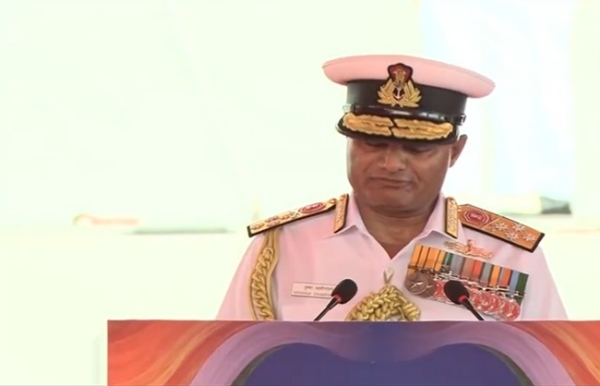
Speaking on the occasion, Chief of the Naval Staff Admiral Krishna Swaminathan congratulated the teams involved in the successful commissioning of the three vessels.
I extend my heartfelt congratulations to the dedicated teams on the successful commissioning of these three ships. I also express my sincere gratitude to our industry partners and MSMEs, whose invaluable support made this achievement possible. The Naval Headquarters, Command Headquarters, warship project teams and trial agencies all deserve appreciation for their unwavering dedication and hard work throughout the construction process.
Exactly 17 months after independent India's first tri-commissioning ceremony in Mumbai, today's second tri-commissioning in Kolkata marks another significant milestone. It will further strengthen India's warship-building capabilities by accelerating modernisation, self-reliance and national confidence. These three projects have also established several new benchmarks in indigenous naval shipbuilding, Admiral Swaminathan said.
---------------
Hindusthan Samachar / Jun Sarkar

21 Jun 2026
Healthy Citizens Are the Greatest Strength of a Strong Democracy, Says Lok Sabha Speaker Om Birla
21 Jun 2026