Drones emerged as the preferred weapon for the first time in India–Pakistan conflict under ‘Operation Sindoor’
New Delhi, May 15 (HS):The battlefield is changing, so future wars will increasingly be fought in the air, commanders said. That is why, for the first time during an India–Pakistan conflict, drones became the preferred weapon under ‘Operation Sindoor’. Drones are only the beginning of robotic warfare. In the coming years, the three arms of the armed forces will essentially operate as one air‑centric force. For this, coordination must also extend into outer space. Fighting in the air reduces the risk to human lives during operations and allows wars to be conducted at a relatively lower cost.
Senior military leaders expressed such views at an aerospace power seminar held at the Air Force Auditorium in New Delhi. The joint colloquium was organised in association with the autonomous defence think tank, the Centre for Air Power and Strategic Studies.
The event brought together senior military figures, regional experts, and distinguished participants to discuss the critical role of maintenance efficiency and self‑reliance in enhancing aerospace capabilities. Panel discussions at the seminar focused on policy‑level frameworks designed to strengthen the Indian Air Force. Experts shared their views on adopting maintenance strategies in line with the nationwide vision of achieving self‑reliance in defence production.
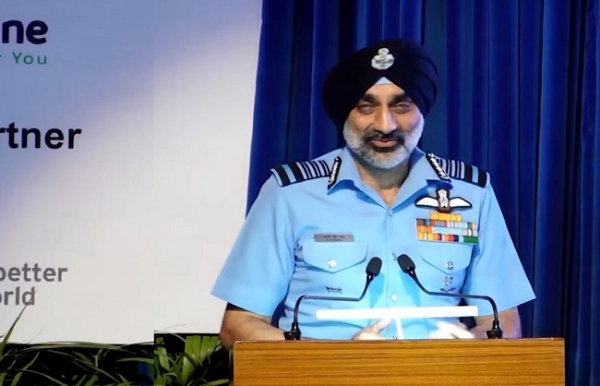
Air Chief Marshal A.P. Singh, Chief of the Air Staff, said, “The topic of drones and unmanned aerial (UAS) systems is highly relevant; it is a reality. Therefore, one cannot deny that the nature of the battlefield has changed. We are shifting from centralised air power to a more decentralised and autonomous structure. We must understand that UAS platforms are merely an extension of air power.
During such operations, the risk to human life is also reduced. As I have said, these are an extension of air power, so when you employ UAS, all the rules and principles of air power apply. When we talk about counter‑UAS systems, it is like a cat‑and‑mouse game.”
He added, “When you develop a technology in one domain, the corresponding counter‑technology has to evolve alongside it, because that is how the game is played. I feel we did very well in ‘Operation Sindoor’, and this was possible because the services coordinated with each other. This would not have been possible without the collaboration of a central agency. We now have a framework in place so that we can deal with such challenges whenever they arise.”
The Air Chief went on, “It cannot be denied that the battlefield has changed, so we must understand that drones, counter‑UAS systems, and unmanned aerial systems are all part of air power. They are succeeding precisely because they embody all the inherent strengths of air power.”
Lieutenant General Vinod Nambiar, Director General of the Army Aviation Corps and Commandant, said, “This event is not just a seminar; its purpose is clear and necessary, because it provides a platform where industry and the armed forces can engage in dialogue, where Indian and global companies can showcase their latest technologies. It will also help identify ways to work together on indigenisation and the joint development of systems. Tomorrow’s battlefield will be decided by how effectively we employ unmanned systems and how robustly we defend against them. Unmanned aerial vehicles have already transformed military practices worldwide. UAVs are now multi‑dimensional, supporting logistics, communications, electronic warfare, search and rescue, maritime patrol, and defence operations.”
Air Marshal Ashutosh Dixit stressed that creating integration across the tri‑service energy domain and within UAVs, UAS, and counter‑UAS is not only essential but a strategic necessity for the operational independence of the three services in safeguarding the country. No single service can fight the next war alone. Only collective leadership, integrated systems, and shared situational awareness can secure decisive victory in future conflicts. He said that India recently marked the first anniversary of ‘Operation Sindoor’, in which speed, strength, and precision together delivered a decisive outcome.
---------------
Hindusthan Samachar / Jun Sarkar