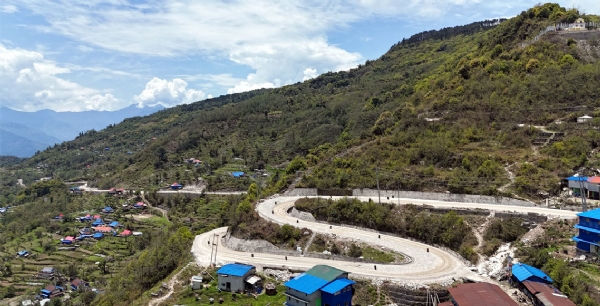
Kathmandu, 12 May (H.S.): The Nepal Army has completed construction of the 10.81‑kilometre road section between Chyamthang and Ghongppa—one of the most difficult stretches under the north–south Koshi highway linking India, Nepal and China—and formally handed it over to Nepal’s Road Department. This road forms part of the shortest trilateral trade route connecting Jogbani in India with Biratnagar and then up to Kimathangka on the Nepal–China border. The Koshi highway project, described as a matter of national pride, will span a total of 390 kilometres when completed.
Due to hard rock formations and extremely rugged terrain, opening and upgrading the Chyamthang–Ghongppa track was considered one of the most technically challenging tasks in the entire Koshi road project. After completing both track‑opening and road‑upgrading work, the Nepal Army has transferred this section to the Koshi Road Construction Office. The handover ceremony was held on Tuesday at the project site, in the presence of Defence Ministry Under‑Secretaries Rameshwar Pokhrel and Prem Prasad Newopane, along with Ram Bahadur Gurung, chief of the North–South Koshi Road Office.
Project chief Singh said the army has completed and handed over the 10.81‑km section after nearly five years of construction work, which began on Poush 24, 2077 BS (roughly early 2021 in the Gregorian calendar). Speaking at the handover event, Chief Engineer Ram Bahadur Gurung of the North–South Koshi Road Office praised the Nepal Army for successfully fulfilling its responsibilities despite difficult topography, harsh environmental conditions and technical challenges. He stated that the army completed the road construction on time and to the required quality standards.
The Khadnbari–Kimathangka road section is 165 kilometres long and is widely regarded as the most difficult terrain in the entire Koshi highway project. Of this, the army was entrusted with constructing 10.81 kilometres. Because of hard rock, steep slopes and inaccessibility, the army resorted to helicopter transportation of construction materials to carry out the road work. High‑explosive blasting was required to break the tough rock, which is why the Council of Ministers six years ago delegated this particularly hazardous stretch to the Nepal Army.
Kimathangka, located on the Nepal–China border, is considered one of the most remote and difficult border crossings in the region. The Kimathangka–Jogbani road section is seen as the shortest land route connecting China and India, and once fully operational it is expected to significantly benefit people in the Koshi Province districts of Sankhuwasabha, Dhankuta, Tehrathum, Sunsari, Morang, Jhapa and Bhojpur. Local residents anticipate that improved road connectivity will spur trade, tourism and small‑scale business activities in the area.
With the road now under the control of the Road Department, the next major step will be the establishment of a customs office (border customs post) at the Kimathangka border area so that formal cross‑border trade operations can begin. According to the project office, expenditure on the Khadnbari–Kimathangka road section so far totals Nepali rupees 62 crore 36 lakh 67 thousand.
---------------
Hindusthan Samachar / Jun Sarkar