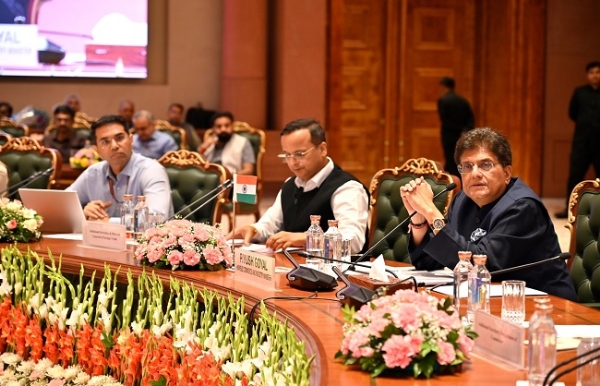
New Delhi, 28 April (H.S.): Commerce and Industry Minister Piyush Goyal has underlined India’s ambition of achieving $2 trillion in exports by 2030, calling the recently signed India–New Zealand Free Trade Agreement (FTA) a foundational step toward that goal. Speaking at a high‑level meeting with Export Promotion Councils (EPCs) and industry leaders at Bharat Mandapam in New Delhi, he urged exporters to leverage FTAs with developed economies to expand market access, boost exports and create jobs.
The minister recalled that the India–New Zealand FTA, signed earlier this month, opens preferential access to a large, fast‑growing market while also granting India virtually duty‑free entry for its key products. He emphasised that timely and effective utilisation of such agreements is “extremely important” to unlock new opportunities, especially in agriculture, pharmaceuticals, textiles, engineering goods, and services.
Goyal pointed out that the FTA‑driven export ecosystem strengthening will help India move closer to its broader “Viksit Bharat” vision, under which exports are expected to cross the $2‑trillion mark by 2030, split roughly equally between merchandise and services.
The meeting, held at Bharat Mandapam on the sidelines of the FTA‑signing ceremony, brought together 30 EPCs, top industry federations, and senior officials from the Department of Commerce and the Directorate General of Foreign Trade (DGFT). The DGFT showcased a draft framework for export‑reform measures, while industry representatives highlighted the challenges faced by MSMEs, including financing, compliance and logistics bottlenecks.
The government reiterated its commitment to enhancing trade‑facilitation, credit support, and non‑financial enablers under the “Export Promotion Mission,” promising better access to trade finance, export‑quality assistance, and market‑promotion tools. Goyal also urged EPCs to widen the base of exporters and scout for new markets, especially in the developed world, to ensure that India’s export basket becomes more diversified and resilient.
Officials explained that the $2‑trillion export target entails maintaining robust compound‑annual‑growth rates in both goods and services, with a heavy emphasis on integrating MSMEs into global value chains. The India–New Zealand FTA is seen as a template for deepening similar partnerships with other advanced economies, thereby creating a stable, tariff‑reducing architecture that supports India’s climb toward a 30‑trillion‑dollar economy by 2047.
By combining FTAs, domestic reform, and sector‑specific export‑promotion schemes, the government aims to turn India’s export ecosystem into a primary engine of jobs, innovation and inclusive growth over the next decade.
---------------
Hindusthan Samachar / Jun Sarkar

28 Apr 2026
Indian stock market ends weaker after volatile session; investors lose over ₹30,000 crore in wealth

28 Apr 2026