Biswanath, 01 April (H.S.):
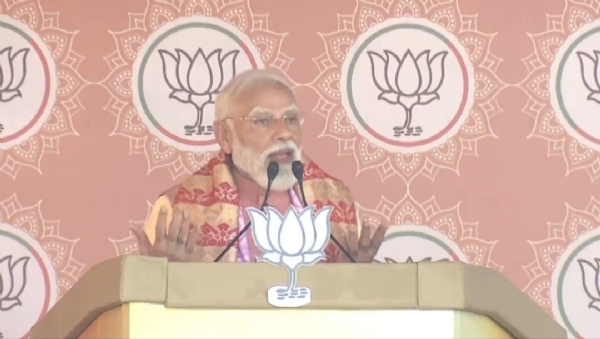
Prime Minister Narendra Modi, wrapped in the saffron‑scarfed energy of a full‑swing assembly‑polls campaign, stood on a wind‑licked stage in Biswanath on Wednesday and declared that Assam’s growth story “is visible across every district,” stitching together a narrative of development, identity and electoral inevitability before a sea of tens of thousands.
From the tea‑dominated districts of Upper Assam to the river‑cut plains of Biswanath, the Prime Minister sought to project a picture of a state shedding old labels and marching toward a “developed Assam for a developed India” under a third‑term BJP‑NDA government.
“Growth Visible in Every District”
Standing under a towering hoarding that read “India First, Assam First,”PM Modi began by taking a sweeping view of Assam’s last decade. He spoke of new roads, doubled bridges, upgraded railways, expanded air links and digitally‑linked villages, arguing that connectivity had become the backbone of the state’s transformation.
“Whether it is Dhemaji, Biswanath, Guwahati, Silchar or Kokrajhar, today you can see concrete proof of development on the ground,” he said, pointing to specific projects launched in recent months across the state’s districts.
He highlighted the inauguration of major infrastructure—new flyovers, expanded airport terminals, river‑bridge networks and 5G‑based digital centres—as evidence that the BJP‑led state government had moved beyond “rhetoric” to visible, lived‑in change.
The Prime Minister also invoked the farm sector, crediting the Pradhan Mantri Kisan Samman Nidhi, insurance cover for farmers and the expansion of irrigation schemes with giving rural Assam a sense of stability amid climate‑linked uncertainties.
A “Third‑Term Hattrick” Narrative
PM Modi then pivoted to the politics of continuity, saying the April 9 Assembly polls were not just about party vs party, but about “development versus disruption.” He framed another BJP‑NDA victory in Assam as a “third‑term hattrick,” building on the governments led first by Sarbananda Sonowal and then by current Chief Minister Himanta Biswa Sarma.
“The last 10 years have been an era of service and good governance,” he said, “and the people of Assam must now decide whether to hand over the same team the mandate to take the state to the next level.”
He accused the Opposition of “wanting to take Assam backward” by reviving old politics of identity‑based fault lines and patronage, and warned that chaos would return if the state drifted away from the BJP‑NDA formula.
The Prime Minister stressed that the BJP’s approach was to “empower the youth, invest in farmers, safeguard tribals and strengthen the middle class,” all while ensuring that neither religious minority nor indigenous community felt “neglected or threatened.”
Identity, Security and the “Infiltrator” Rhetoric
In Biswanath, as in the morning rally at Gogamukh,PM Modi intertwined security with cultural identity. He reiterated the BJP’s promise to implement the Uniform Civil Code and to protect the rights of indigenous communities under the Sixth Schedule, describing this combination as a “two‑pronged shield” for Assam’s social fabric.
Without naming specific parties, he warned that certain forces wanted to turn “the majority into a minority” and “create a permanent vote bank of infiltrators,” echoing the same narrative that had dominated the state‑level campaign since the Citizenship Amendment Act and the updated National Register of Citizens processes.
The Prime Minister argued that the BJP’s model sought to balance “compassion with legality,” saying the party would not compromise on the rule of law even as it extended welfare schemes to the poorest. He also invoked the broader northeast‑security complex, citing the easing of AFSPA in parts of Assam and the push to integrate the region with the rest of India through infrastructure and investment, so that the frontier state would no longer be seen only as a “borderland of suspicion” but as a “gateway to prosperity.”
Youth, Jobs and the Skilling Push
A sizeable section of the Biswanath crowd comprised young men and women carrying party‑sponsored youth‑welfare placards. Modi zeroed in on this segment, promising that a third‑term BJP government would aggressively expand skill‑development centres, digital‑learning hubs and entrepreneurship grants tailored to Assam’s unique demographic profile. He cited the expansion of industrial corridors, food‑processing units and startup incubators as pathways to transform Assam’s “job‑seekers into job‑creators.”
He also spoke of the state’s young population as a “demographic dividend,” comparing Assam’s youthful energy with the tech‑savvy workforce of Bengaluru or Hyderabad and arguing that the same dynamism could be harnessed locally if governance remained stable and policy‑oriented rather than volatile and populist.
Culture, Unity and the “Assam First” Chant
Winding down his address, PM Modi turned to culture, praising Assam’s tea‑garden workers, Bihu dancers, Bodo folk groups and valley‑based Assamese communities for creating a syncretic social mosaic. He cited the recent inclusion of indigenous cultural symbols into the new Parliament building and the display of the Chola‑era Sengol sceptre as proof that the BJP treated India’s civilisational heritage with reverence, while also pushing for modernisation.
The Prime Minister repeatedly asked the crowd to “keep Assam first,” blending the chorus with calls for national unity and national security. He urged women, especially tea‑garden and tribal women, to register as voters in higher numbers and to demand transparency from local leaders, positioning the BJP as the party that would “listen to the voice of the silent sections.”
A Day of Calculated Pageantry
The Biswanath rally, the second of the day following the major Gogamukh gathering, underscored the BJP’s strategy: morning, narrative‑driven speeches on identity and security; afternoon, development‑and‑governance pitches grounded in project‑launch imagery and ground‑level optics.
PM Modi’s schedule had begun with a tea‑garden selfie in Dibrugarh and moved seamlessly into the rhetoric‑fueled theatrics of Biswanath, projecting a leader oscillating between earthy connectivity and high‑pitched political messaging.
As the sun dipped behind the horizon and the saffron‑coloured crowds slowly dispersed, the dominant impression left behind was of a Prime Minister who had turned Assam into a living canvas for his broader national narrative—one where every district, every road, every school and every tea‑estate had become a testament to a decade‑long “growth story” and a plea for a “third‑term hattrick” that promises to wire Assam ever more tightly into his vision of a “developed India.”
---------------
Hindusthan Samachar / Jun Sarkar
01 Apr 2026