New Delhi, 01 April (H.S.):
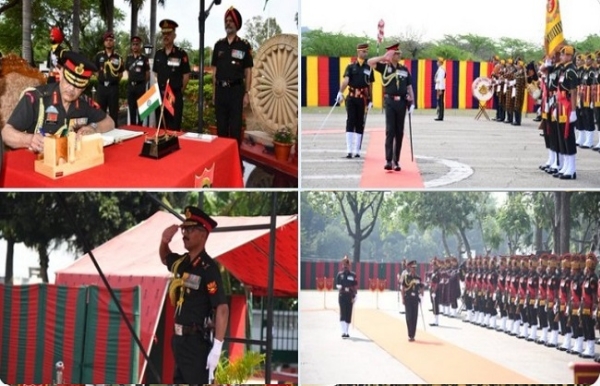
India has reshuffled its top‑level battlefield commanders on the Pakistan and China fronts, appointing two experienced three‑star generals to lead the Western Command and the Eastern Command, respectively. Both officers were formally inducted with a Guard of Honour at their headquarters, underscoring the importance of the move amid ongoing border standoffs and rising regional tensions.
New Chief for Western Command (Pakistan Front)
Lieutenant General Pushpendra Pal Singh has taken over as General Officer Commanding‑in‑Chief (GOC‑in‑C) of the Western Command, headquartered in Chandigarh, covering the sensitive Pakistan border. He replaces Lieutenant General Manoj Kumar Katihar, who retired on 31 March.
Lt Gen Singh previously served as Vice Chief of the Army Staff, a role that placed him at the heart of operational‑planning and service‑modernisation decisions. He is an officer of the Parachute Regiment (Special Forces), commissioned into the 4th PARA (SF) battalion in December 1987, and is an alumnus of the Indian Military Academy, Dehradun, and Lucknow University.
During his nearly four‑decade career, he has held a mix of command and staff appointments in high‑altitude and sensitive sectors along the northern and western borders. His operational resume includes participation in Operation Pawan and multiple anti‑terror operations on the Line of Control (LoC) and international boundary with Pakistan. As Director General of Operational Logistics at Army Headquarters, he played a key role in strengthening operational mobility, logistics integration and continuity capabilities.
At the Western Command War Memorial in Chandimandir, the new GOC‑in‑C paid homage to fallen soldiers and inspected a Guard of Honour, setting the tone for the Command’s future focus on multi‑domain operations, drones and counter‑drone systems, intelligence‑driven operations and infrastructure development along the western frontier.
New Chief for Eastern Command (China Front)
Lieutenant General VMB Krishnan has assumed the role of GOC‑in‑C of the Eastern Command, based in Kolkata, which oversees the eastern frontier with China along the Line of Actual Control (LAC). He succeeds Lieutenant General RC Tiwari, who also retired on 31 March.
Lt Gen Krishnan, commissioned on 11 June 1988, brings close to four decades of varied command, staff and directing‑staff experience, including deployments in some of the Indian Army’s most demanding operational theatres. He has commanded an infantry battalion and an infantry brigade in the high‑altitude terrain of Siachen, followed by an infantry division, and later led the elite Brahmastra Corps.
In the strategic‑staff domain, he served as Director General Information Technology at the Integrated Defence Headquarters (Ministry of Defence) and as Defence Attaché at the High Commission of India in London. Immediately before this appointment, he was the Quartermaster General at Army Headquarters, where he spearheaded critical reforms in supply‑chain management, logistics modernisation and infrastructure upgrades, enhancing the Army’s operational‑sustainment and frontline‑readiness posture.
Lt Gen Krishnan also holds the prestigious appointments of Colonel of the Dogra Regiment and the Dogra Scouts. His tenure as Commandant of the Counter‑Insurgency and Jungle Warfare School is credited with setting new benchmarks in special‑operations training and doctrinal development.
On taking charge of the Eastern Command, the Army chief paid tribute to martyrs and valiant soldiers, and directed all ranks to maintain the highest standards of operational preparedness along the China frontier, including readiness to employ advanced multi‑domain capabilities, drone and counter‑drone systems, and integrated‑battle‑management technologies.
Strategic Focus on Multi‑Domain and Technology
The leadership change is widely seen as part of the Indian Army’s broader push to integrate multi‑domain operations, emphasising jointness, sensor‑to‑shooter kill chains, and network‑centric warfare. Commanders on both the Pakistan and China fronts are expected to sharpen their formations’ ability to leverage drones, counter‑drone systems, space‑enabled surveillance, cyber tools and precision‑strike platforms, while simultaneously investing in road‑networks, helipads, shelters and logistics hubs to sustain troops in high‑altitude and remote‑border locations.
With both Western and Eastern Commands now under battle‑tested generals, the Army aims to maintain a high‑readiness posture on India’s two most sensitive borders, ensuring that the force remains prepared for any contingency in an increasingly volatile regional security environment.
---------------
Hindusthan Samachar / Jun Sarkar


01 Apr 2026