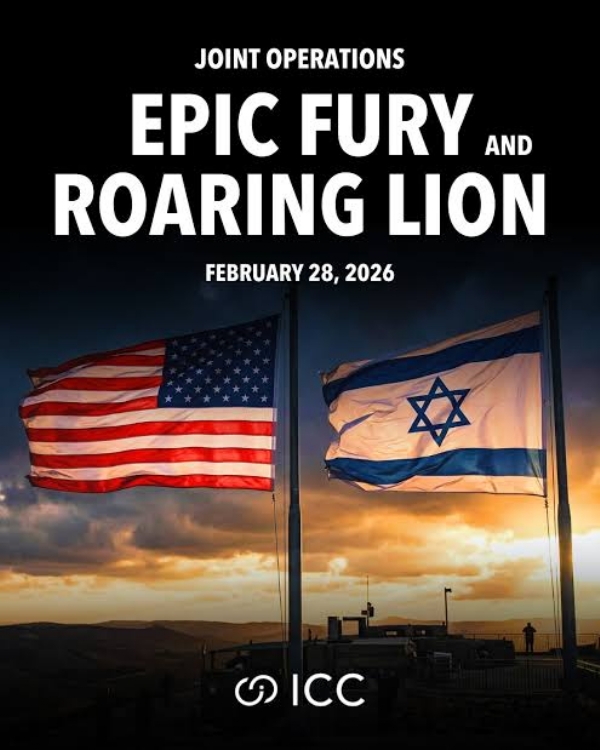
Tehran/Washington, 07 March (H.S.): The United States has indicated that its ongoing joint military campaign with Israel against Iran, codenamed Operation Epic Fury and Roaring Lion, is designed to run for roughly four to six weeks as air and missile strikes continue to pound key Iranian targets.
A senior White House official said the US has sufficient munitions and stockpiles not only to complete the stated objectives of the operation but to sustain combat beyond that timeframe if required.
According to US briefings, the central aims of the operation include the destruction of Iran’s naval capabilities and a severe degradation of its ballistic missile arsenal, which Washington accuses Tehran of using to threaten American forces and bases across West Asia.
US officials claim that dozens of Iranian naval vessels have already been sunk, rendering large parts of the country’s fleet “combat ineffective,” and that multiple missile launch sites and command facilities have been struck in successive waves.
The strikes, coordinated closely with Israel, have focused on what Western officials describe as Iran’s core military infrastructure, nuclear-related locations, and leadership compounds, including sensitive sites in and around Tehran.
Since the opening salvo on February 28, US and Israeli aircraft and missile batteries have hit hundreds of targets deep inside Iran, with long-range bombers and fighter jets used in what is being called one of the most intensive air campaigns in the region in years.
Washington has also signalled an ambition to impose de facto control over large portions of Iran’s airspace during the campaign, seeking to limit Tehran’s ability to launch or coordinate further missile and drone attacks.
American officials insist that they are “well on their way” to achieving that objective, citing repeated intercepts of Iranian projectiles over the Gulf and near Israel as evidence that Iran’s capacity to project power beyond its borders is being steadily eroded.
Politically, the rhetoric from the US leadership has hardened sharply, with the American president publicly ruling out any negotiated settlement short of what he has termed Iran’s “unconditional surrender.”
He has argued that it is in Washington’s interest for Iran to no longer be governed by what he calls a radical regime hostile to the United States and accused it of concealing ambitions to acquire a nuclear weapon.
The president has also suggested he intends to play a role in shaping the country’s future leadership once the current authorities are displaced, even floating a postwar vision of rebuilding Iran under the slogan “Make Iran Great Again.”
The war erupted into a new and dangerous phase after a joint US–Israeli strike on February 28 inside Iran killed the country’s supreme leader and several other senior figures, shattering the existing power structure in Tehran.
Iranian officials responded by activating an interim leadership mechanism and accusing Washington and Jerusalem of trying to dismantle the state, warning domestic opponents and separatist groups against exploiting the crisis.
In retaliation, Iran has launched waves of drones and ballistic missiles at American bases, Israeli targets, and infrastructure in multiple Arab states, including airports and ports in Gulf countries.
Several Gulf governments report that their air defences, often supplied or supported by the US, have intercepted large numbers of incoming projectiles, though damage to civilian facilities and disruptions to air travel and shipping have also been reported.
The closure or restriction of key maritime chokepoints has already unsettled global energy markets. Israel, for its part, has broadened the conflict beyond Iranian territory, striking targets linked to Tehran’s network of allied militias, particularly in Lebanon, where operations have expanded against Hezbollah.
Israeli officials say they are prepared for a prolonged confrontation and have warned that their attacks on Iran could intensify and potentially be paired with more extensive ground actions along the northern front.
As the conflict deepens, Western diplomats and regional actors are expressing concern that the four-to-six-week timetable for Operation Epic Fury may prove optimistic if Iran’s leadership and its allied militias continue to absorb losses while retaining the ability to fire rockets and drones.
For now, Washington maintains that its objectives are “achievable” within that window and insists it has both the military resources and political will to see the operation through, even as the risks of a broader regional conflagration continue to rise.
---------------
Hindusthan Samachar / Jun Sarkar


07 Mar 2026