New Delhi, 06 March (H.S.): Prime Minister Narendra Modi stated on Friday that rising global health awareness is fueling demand for organic and chemical-free food products, urging India to capitalize by promoting natural farming and export-oriented agriculture.
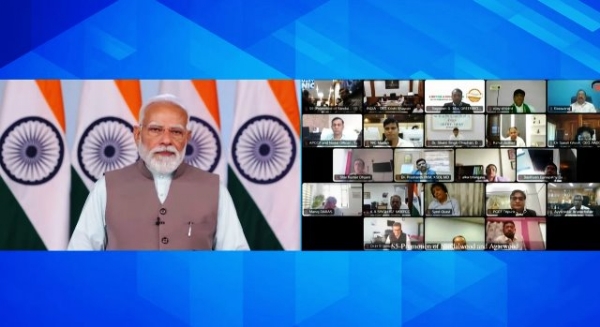
Addressing a post-budget webinar on “Agriculture and Rural Transformation” via video conferencing, PM Modi highlighted the growing global interest in organic diets, organic food, and holistic healthcare. He remarked that natural farming and chemical-free products could serve as a “highway” for Indian farmers to access international markets, with the government focusing on certification, laboratories, and infrastructure development through collaborative efforts.
PM Modi emphasized avoiding over-reliance on single crops to mitigate risks and diversify income, spotlighting initiatives like national missions for edible oils, pulses, and natural farming. He noted agriculture's role as a strategic pillar for India's long-term growth, citing over ₹4 lakh crore disbursed to nearly 10 crore farmers under PM Kisan Samman Nidhi for financial security, enhanced MSP ensuring 1.5 times cost benefits, institutional credit reaching over 75% of farmers, and ₹2 lakh crore settled under PM Fasal Bima Yojana to reduce risks and boost confidence.
India is achieving record production in grains, pulses, and oilseeds, but Modi stressed infusing new energy for the 21st century's next phase, with this year's budget offering productivity boosts and export incentives. Leveraging diverse agro-climatic zones, high-value crops like coconut, cashew, cocoa, and sandalwood will be regionally promoted—especially rejuvenating aging coconut palms in Kerala and Tamil Nadu—while Himalayan states focus on temperate nuts to create rural jobs via processing and value addition.
Livestock emerges as a rising rural pillar, with India leading global milk production and ranking second in eggs; better breeds, disease control, and scientific management are key. Modi reaffirmed commitment to rural prosperity via schemes like PM Awas Yojana, PM Gram Sadak Yojana, and ownership plans, empowering women through SHGs and targeting three crore more “Lakhpati Didis” by 2029. He called on states to prioritize agriculture, link farmers to technology and markets, foster quality, branding, and global standards for competitive Indian produce.
---------------
Hindusthan Samachar / Jun Sarkar