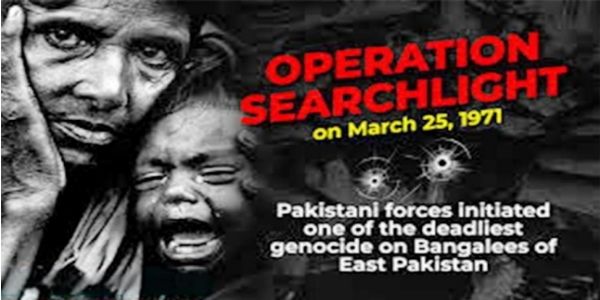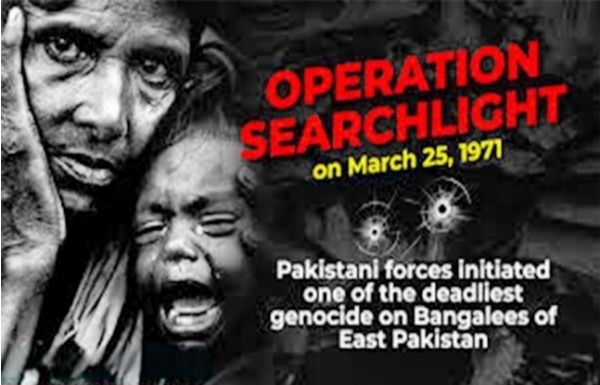
The night of March 25, 1971, marked the beginning of one of the most tragic and brutal chapters in South Asian history. On that night, the Pakistani Army launched Operation Searchlight in East Pakistan (now Bangladesh). Officially described as an operation to restore order, it quickly turned into a ruthless military crackdown aimed at suppressing the democratic aspirations of the Bengali population.
Following the electoral victory of the Awami League, when the people of East Pakistan demanded their democratic rights, the response came in the form of bullets, tanks and widespread violence. Students, intellectuals, political activists and particularly members of the Hindu community were systematically targeted. Dhaka University became a grim symbol of the atrocities, as an institution of learning was turned into a site of mass killings.
What followed was not merely political repression but a calculated assault on the identity, dignity and democratic rights of an entire population. Mass killings, widespread persecution and systematic sexual violence against women turned the episode into one of the darkest chapters in modern human history.
For Bangladesh, 1971 was not merely a political transformation but a deep national trauma. Thousands of families were torn apart, countless women suffered inhumane atrocities, villages were burned, and millions were forced to flee their homes. A new nation was born, but its birth came at the cost of immense human suffering and sacrifice.
Even after more than five decades, the wounds of that period remain unhealed. One of the key reasons is the absence of a clear, formal and unconditional apology from Pakistan. This is not just a diplomatic gap but also a moral failure.
When Bangladesh renewed its call in April 2025 for the resolution of outstanding issues related to 1971 and sought an official apology, it was not asking for a favour. It was asking for justice, truth and historical accountability.
------
History Cannot Be Suppressed
Today, the world is once again being reminded of the truth of 1971. Efforts such as United States House Resolution 1130 serve as reminders that history cannot be buried indefinitely, nor can the voices of suffering be silenced forever.
Such initiatives represent important steps toward international recognition of the atrocities committed during the Bangladesh Liberation War. They are not merely about revisiting the past but about fulfilling a global responsibility to uphold truth and justice.
The truth of 1971 continues to seek recognition, and justice still awaits accountability. Even after five decades, the scars of genocide, persecution and displacement continue to shape Bangladesh’s collective memory, politics and national identity.
-----
Concerns Over the Return of Extremist Forces
The legacy of 1971 also explains why the resurgence of extremist forces remains a matter of concern in Bangladesh. Organizations such as Jamaat-e-Islami, which opposed Bangladesh’s independence in 1971, still carry the burden of that historical association.
Whenever such groups gain political visibility or their leaders are seen engaging diplomatically with Pakistan, it naturally raises concerns within Bangladesh. For a nation born through sacrifice and struggle, such developments often reopen old wounds.
-----
India–Bangladesh Relations: Beyond Diplomacy
In this historical context, India’s role occupies a significant place in Bangladesh’s collective consciousness. At various moments of crisis, India has extended timely support, whether through vaccine assistance during the pandemic, cooperation in oxygen supply, sharing critical flood-related information, or providing fuel support during economic stress.
This has not merely been diplomatic engagement but a reflection of genuine friendship. These actions demonstrated trust, sensitivity and a commitment to standing together during difficult times.
For many Bangladeshis, such gestures revive memories of 1971, when India stood firmly beside them during their darkest hours, when lives were under threat, homes were being destroyed, women were facing violence and millions were displaced. India’s support is therefore remembered not only as strategic but also as humanitarian and emotional.
History shows that nations do not forget those who stand by them in their most difficult times.
------
The Wait for Justice Continues
Bangladesh’s quest for historical recognition is not merely a national issue, it is also a test of global moral responsibility. The fundamental question remains whether truth can be suppressed indefinitely or whether justice ultimately prevails.
The history of 1971 continues to send a powerful message: truth cannot be erased, justice may be delayed but cannot be denied, and history ultimately demands accountability.
Hindusthan Samachar / Satya Prakash Singh

02 Apr 2026
Mukesh Bhardwaj and the sacred journey of Adishakti at Pournamikkavu temple
Mukesh Bhardwaj and the sacred journey of Adishakti at Pournamikkavu temple..