By Krittika Sharma, U.S. Embassy-New Delhi
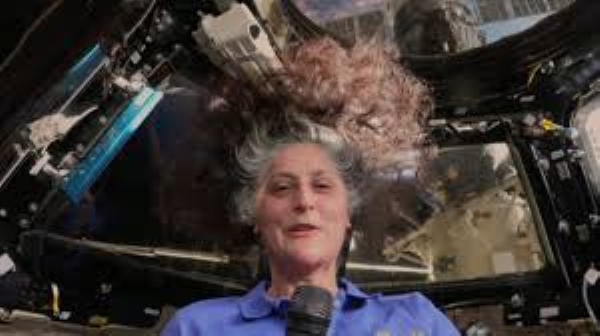
When NASA astronaut Sunita Williams speaks about spaceflight, there is little drama in her voice. She frames her extended stay on the International Space Station (ISS), which was meant to last eight days but stretched into eight months, in the context of preparation, trust, and decision-making—elements that help explain why the United States continues to lead in space science and exploration.
Williams, who engaged with audiences including students, policymakers, and industry representatives during a recent visit to New Delhi and Kozhikode, says the team knew from the start that the timeline might change. “We knew it was going to be longer than eight days, because it was the first mission of a spacecraft and we knew there was going to be something that we would learn,” she says.
A propulsion issue emerged during docking, requiring rapid coordination between the astronauts and the ground control teams with whom they had trained for years.
The solution was technical, but the confidence behind it was human. Engineers restored enough control to dock safely. At that point, the larger decision became clear. “Knowing that we had that pretty big problem, we knew we weren’t going to come back right away,” Williams says.
That call to gather more data and prioritize safety captures a defining feature of U.S. leadership in space. It is not driven by speed or spectacle, but by institutional depth.
For Williams, the most difficult part of the experience was not physical, but emotional. “It was probably more of an emotional rollercoaster for that control team, because they were so well trained and they really know what they’re doing, and some of the hardware problems were beyond their control,” she says.
That empathy toward engineers, technicians, and mission planners reflects a space program built on long-term investment in people. Astronauts train for years before a mission, Williams explains, not only to master spacecraft systems, but to understand the organizations and capabilities behind them.
This attention to detail extends beyond individual missions. It underpins the ISS, which Williams describes as a mature scientific platform after more than two decades in orbit. “The space station has the full gamut from everything a human could be involved in,” Williams says, from building and maintaining complex systems to working outside them in spacewalks. The ISS also serves as a proving ground for future commercial activity. The foundational science conducted there, she notes, can serve as the starting point for companies seeking to build their own space stations in low Earth orbit.
That movement, from public investment to private innovation, is a central reason U.S. leadership in space continues to expand. Over the past 20 years, commercial activity in low Earth orbit has grown rapidly, supported by NASA’s experience and oversight. The result is a vibrant ecosystem spanning rockets, satellites, and specialized experiments, and offering new pathways for students entering science and engineering. “That just spurs on the next generation of STEM students, because they have lots of opportunities to work at different places,” Williams says.
Looking ahead, NASA is applying lessons from the ISS to the Lunar Gateway, a planned station that will orbit the Moon. It could be more modular and capable of operating independently, allowing experiments to continue even when astronauts are not present. For Williams, the future of space exploration ultimately comes back to people. The traits she sees as essential for the next generation of astronauts are familiar but demanding: curiosity, a willingness to ask questions, and readiness for missions that have never been attempted before.
Even the flight suit she wore during her visit reflected that collective ethos. It represents not just astronauts, but the thousands of people involved in training, mission control, and spacecraft operations. “That’s a big group of people and all the programs that have been supported in the U.S. space program,” she says.
Her extended mission may not have gone according to the original schedule, but it illustrated something more enduring. The strength of the U.S. space program lies not in flawless hardware, but in systems designed to respond, adapt, and learn. In that quiet competence, American leadership in space continues to take shape—patiently and deliberately, with an eye on what comes next.
---------------
Hindusthan Samachar / Indrani Sarkar