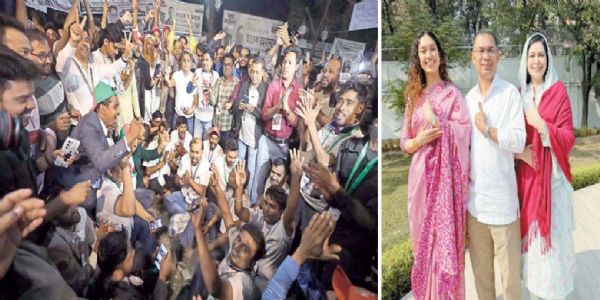
Dhaka, 13 February (H.S.): Tarique Rahman, the Bangladesh Nationalist Party (BNP) leader whose meteoric rise has captivated global attention amid the party's dominant performance in Thursday's 13th parliamentary elections, embodies a life marked by dramatic vicissitudes and inherited political legacy.
Born November 20, 1965, Rahman—son of President Ziaur Rahman and first female Prime Minister Khaleda Zia—returned from London with family on January 25 this year after nearly 17 years abroad, only to suffer his mother's death five days later, promptly assuming BNP chairmanship; his 1990s activism peaked during 2001-2006 BNP rule as a shadowy influencer dubbed the Dark Prince, followed by 2007 military-backed caretaker government arrests on corruption charges, 18 months' imprisonment, and London medical exile directing party operations remotely.
Convicted in absentia in 2018 and 2021 for graft, money laundering, and the 2004 grenade attack, barriers crumbled post-2024 Sheikh Hasina ouster with overturned verdicts paving his repatriation; wife Dr. Zubaida Rahman (born May 18, 1972, Sylhet), a Dhaka Medical College MBBS graduate joining civil service in 1995 before 2008 study leave to London—later attaining Imperial College postgraduate cardiology—faced similar 2008 Anti-Corruption Commission excess wealth charges alongside family (stayed post-Awami fall), daughter Rear Admiral Mahbub Ali Khan's progeny; daughter Zaima, a Queen Mary law graduate and Lincoln's Inn barrister practicing in London, emerges as BNP's next-generation face.
Rahman's arc—from witnessing 1971 liberation as a child POW to galvanizing BNP's grassroots resurgence—positions him as prime ministerial frontrunner pending official results.
---------------
Hindusthan Samachar / Jun Sarkar
13 Feb 2026
Tarique Rahman: From 'Dark Prince' Exile to BNP Heir Presumptive After Rollercoaster Political Odyssey
13 Feb 2026