


By, Dr. Mayank Chaturvedi
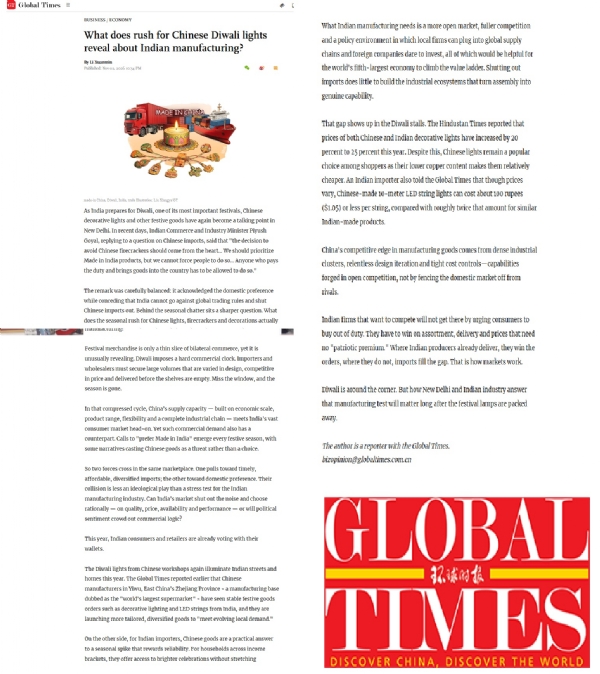
As preparations for Deepavali were under way, when Chinese decorative lights and LED strings once again flooded Indian markets, China’s state mouthpiece Global Times wrote a sharp article raising questions over both Indian manufacturing and the swadeshi spirit. The gist of the article was that customers do not stay loyal merely in the name of patriotism. Orders are won through price, variety, timely delivery and cost control. Where Indian producers deliver these, they get orders; where they do not, imports fill the gap. This is how markets work.
If one looks deeper into this comment, behind it lies the large imbalance in India-China trade, in which bilateral trade had reached about $151 billion in financial year 2025-26 and India’s trade deficit had touched a record of nearly $112 billion. India’s exports to China stood at about $19.47 billion, while imports were more than $131 billion. China has become India’s biggest trading partner. In the first nine months of calendar year 2026 as well, the deficit has crossed $105 billion, while, despite a rise of more than 40 per cent in Indian exports, the base of imports was so large that the gap is continuing to widen.
The ground picture of the market
Prices in the market rose by 20 to 25 per cent this year. Because of the increased cost of copper wire and plastic, both Indian and Chinese lights became more expensive. Even so, Chinese 10-metre LED string lights remained available for about Rs 100 or less, whereas comparable Indian products cost nearly double. Chinese lights stayed cheap because of their lower copper content. Local reports have noted that demand is divided, but Chinese products remain popular because of availability and price. Some traders say that “Made in India” lights are making space for themselves with claims of better quality and durability, but in many cases bulbs or other components come from China and are merely assembled in India. Wholesale markets such as Bhagirath Palace in Delhi continue to be flooded with Chinese goods. Many traders admit that every year there is talk of a “boycott”, but the goods get sold.
In its article, Global Times mentioned Yiwu in Zhejiang province, which is called “the world’s largest supermarket”. Manufacturers there are receiving steady orders for decorative lighting and LED strings from India. They are preparing varied, customised products in line with Indian demand. The peculiarity of seasonal goods is that time is very short. Importers and wholesalers want variety in design, competitiveness in price, and delivery before shelves run empty. If the opportunity is missed, the season is gone. In this shrunken cycle, China’s supply capacity — economies of scale, product range, flexibility and the entire industrial chain — collides with India’s large consumer market.
Piyush Goyal’s remarks and their limits
Commerce and Industry Minister Piyush Goyal, responding recently to a question on Chinese imports, especially firecrackers and festive goods, said, “The decision to avoid Chinese firecrackers should come from the heart. We should give priority to Made in India products, but people cannot be forced. Whoever brings in goods after paying tax has to be allowed. India is a democracy and follows international trade rules.” He cited the examples of Japan and South Korea, where change comes through national sentiment and consumers’ own choices. Goyal’s remark was considered balanced: domestic priority was acknowledged, but coercion, or stopping imports in violation of rules, was ruled out.
Global Times seized on precisely this point. It argued that imports are not enemies of the economy. They lower costs for distributors, give consumers more choices, and put competitive pressure on domestic producers, which makes upgrading possible. Indian companies cannot attract customers merely in the name of patriotism. They will have to win on assortment, timely delivery and at prices that carry no “patriotism premium”. The article wrote that China’s competitive edge comes from dense industrial clusters, constantly changing designs and strict cost control. These capabilities are built in open competition, not by insulating the domestic market from competitors.
The real test of manufacturing
These festive goods are a small part of bilateral trade, but they are a true test for Indian manufacturing. Schemes such as Make in India and the Production Linked Incentive (PLI) are under way in India. Electronics production has grown and assembly has increased in some sectors, but in LED lighting, decorative goods and many other categories a complete industrial chain has not yet been built. Important components such as LED chips, drivers, connectors, certain plastic and electronic parts, etc., are still imported on a large scale.
In Chinese clusters such as Yiwu, Guangdong and Zhejiang, raw material, design, production, packaging and logistics are linked with one another. There is flexibility from small orders to large volumes. Cost control is strict. Indian producers face the challenge of high costs of labour, land, electricity, taxes and the supply chain. Many small and medium manufacturers are using warehouses to stock imported goods, because domestic demand turns weak.
The Indian consumer is price-sensitive. Families want to celebrate the festival better, but without increasing their budget. When a Chinese light is available for Rs 100 and an Indian one costs double, the vote from the wallet goes in favour of price and availability. Some traders and reports say that Indian lights are improving in quality and durability and are making space in some segments, but a gap remains in scale, variety and price. Official data on Deepavali-specific imports are limited. In such a situation, the trend in imports of broader LED and decorative goods only shows that China’s dominance continues.
The gap between policy and reality
India has long been concerned about the trade deficit with China. Finance Minister Nirmala Sitharaman recently described China’s non-tariff barriers as the biggest obstacle to bilateral trade. Indian exporters find market access in China difficult, while imports keep rising. Goyal has also said that India is working towards increasing exports to China and ASEAN and expects India to become a major exporter, but the ground reality is that dependence on imports of machinery, electronics, chemicals, batteries and intermediate goods is deep. These are essential inputs for many Indian manufacturing units. Stopping imports may provide some protection in the short term, but in the long term it does not build the industrial ecosystem that turns assembly into real capability.
The Global Times article underlines that the swadeshi slogan becomes effective when domestic products are competitive in price, quality and availability. The example of Japan and Korea is often cited, where consumers give preference to domestic products, but even in those countries this preference has remained linked with the competitiveness of the product. In India, the consumer still looks at price and choice. When political sentiment and market logic collide, the market often chooses its own path. It appears to be winning. Often, even when the feeling of swadeshi is in the heart, it fails to translate into results!
In such a situation, it has become necessary that we give Indian manufacturing the open market, greater competition and the kind of policy environment that it needs, in which local firms can connect with global supply chains and foreign investment can be attracted. Attention will have to be paid to reducing costs, developing clusters, localising components, improving design and logistics, and achieving scale. Taking schemes like PLI beyond mere assembly into the deeper value chain is the need of the hour.
Deepavali is coming. Chinese lights will illuminate many homes and streets this time as well, but the question is how Indian industry and policy answer this manufacturing test. Global Times has issued a challenge; not merely in the name of patriotism, but at the level of price, variety and timely supply as well, it is telling Indians a great deal. Incidentally, this is also true: if Indian companies stand up at this level, orders will come on their own. If not, imports will continue. This rule of the market will remain in force long after the festival’s lamps have gone out!
---------------
Hindusthan Samachar / Mayank Chaturvedi