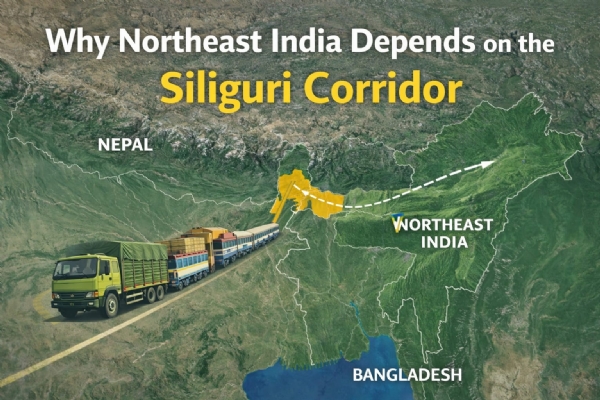
Kolkata, 02 October (H.S.) : North Bengal's narrow piece of land, scarcely 20 kilometres wide, is the sole overland link between mainland India and its eight northeastern states, serving as a critical lifeline for over 45 million citizens. Bounded by Nepal, Bhutan, Bangladesh, and China's Chumbi Valley, the Siliguri Corridor has always carried a strategic weight far beyond its modest width. Over the past year, that weight has grown considerably heavier. As geopolitical developments in Beijing, Dhaka, and along India's eastern frontier converge, New Delhi’s strategic preparedness is being simultaneously tested and fundamentally strengthened.
Partition first engineered this geographic vulnerability in 1947, and the 1962 war with China entrenched its centrality in Indian defence planning. The 2017 Doklam standoff, where Indian troops blocked a Chinese road crew from advancing toward the Bhutan-China-India tri-junction, remains the corridor's most consequential flashpoint. Satellite imagery has since confirmed a permanent Chinese military build-up near the site, serving as a stark reminder that the underlying territorial dispute is merely dormant, not resolved. Today, the threats are multifaceted. Bangladesh's recent moves to seek Chinese assistance to revive the Lalmonirhat airbase, barely a hundred kilometres from the corridor, along with Dhaka weighing the handover of the Teesta River management project to a Chinese state firm, clearly signal Beijing's infrastructure creeping closer to India's eastern periphery.
India has responded to these provocations with calibrated diplomacy rather than public rancour. Following the fall of the Awami League government in August 2024, New Delhi moved swiftly to re-establish contact. India hosted Bangladesh's first ministerial visit under the new dispensation in April 2026, where Foreign Minister Khalilur Rahman met with External Affairs Minister S. Jaishankar and National Security Advisor Ajit Doval to discuss energy cooperation, border management, and river-water sharing. However, Prime Minister Tarique Rahman's decision to make China, not India, his first overseas stop in June 2026 tested this outreach, as did continuing friction over border pushbacks, visa curbs, and the pending renewal of the Ganga Water Treaty.
Despite these hurdles, India's approach remains one of sustained engagement, keeping institutional channels like the Joint River Commission and Foreign Office Consultations open, even as it hedges its bets through firmer border management at home.
Dhaka's strategic tilt has not been confined to Beijing. Since October 2024, Bangladeshi officials have resumed training exchanges with Pakistan for the first time in over a decade, and senior Pakistani military figures have visited Dhaka, deepening a security relationship that lay dormant through the Awami League years.
Compounding this external pivot is a concerning internal political vacuum. Since 2024, previously suppressed Islamist groups, such as Jamaat-e-Islami, Hefazat-e-Islam, and smaller jihadist networks—have re-emerged, staging large public rallies and, per Indian security assessments, networking with Pakistan-based entities. Rising attacks on religious minorities and hardening rhetoric have further unsettled New Delhi, which views a radicalising eastern neighbour as a direct border security threat. India has responded with a dual approach: strengthening border coordination through BSF–BGB conferences and continued fencing inspections, while keeping diplomatic doors open to prevent pushing Dhaka entirely into Beijing’s or Islamabad’s orbit.
New Delhi has not waited for these geopolitical pressures to peak. Over the past year, the Indian Armed Forces have initiated a massive tactical overhaul in the region. The Army has raised new forward garrisons around the corridor, led by the Lachit Borphukan Military Station in Assam's Dhubri district. Built for rapid deployment and persistent surveillance, this base serves as a hub for area control and counter-infiltration.
These ground garrisons are reinforced by a layered air-defence shield comprising S-400 batteries, Akash-NG missiles, BrahMos strike systems, and Rafale fighters. The military's readiness was recently showcased during the month-long high-altitude live-firing exercise in Sikkim. Furthermore, the joint exercise Trishakti Prahar brought together the Army, Air Force, and Central Armed Police Forces in North Bengal, culminating in an integrated firepower demonstration near Siliguri that synergised Rafale jets, attack helicopters, and infantry combat vehicles. In November 2025, the Air Force conducted a week-long simultaneous exercise across the borders facing China, Bhutan, Myanmar, and Bangladesh, successfully testing rapid mobilisation and coordinated border-dominance.
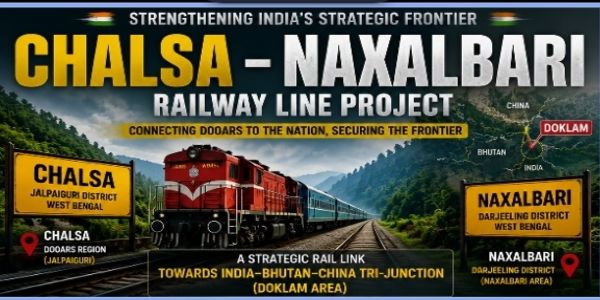
This military build-up is matched by an aggressive infrastructure push designed to make the Northeast resilient by design, actively reducing dependence on any single geographic passage. An underground rail tunnel linking Dumdangi to Bagdogra and India's first underwater twin-tube tunnel beneath the Brahmaputra are engineered to keep the Northeast connected under wartime stress. Furthermore, the Sivok-Rangpo line is set to give Sikkim its first rail access, while the Kaladan project through Myanmar, a proposed rail link via Nepal, and the eventual use of Iran's Chabahar port offer vital alternative logistical routes. Rail logistics radiating from the New Jalpaiguri junction now connect the corridor directly to forward areas in Assam and Arunachal Pradesh, while arterial highways from Guwahati extend all the way to Tawang near the Chinese border.
These developments are successfully knitting together a road, rail, and air network that enables multiple formations across West Bengal, Sikkim, and the Northeast to operate as a single, integrated force for both defensive and offensive contingencies. The Siliguri Corridor is rapidly transforming from a historic vulnerability into one of India's most heavily consolidated and diversified strategic zones. The coming years will test whether this robust garrisoning, coupled with patient diplomacy, can effectively pace a volatile and fast-shifting neighbourhood.
---------------
Hindusthan Samachar / Satya Prakash Singh