The greatest beauty of democracy is that it gives even its opponents a place to speak. Its greatest weakness is the same: some people use the freedom it grants to dig up its very roots. Article 19(1)(b) of the Constitution guarantees the right to assemble, but on a first condition: the gathering must be “peaceful” and “without arms”. Where peace ends, so does the limit of the right. The question today is how long we are prepared to tolerate roads being blocked, property being torched and crowds being assembled on the back of rumour, all in the name of protest.
To protest is one thing; to gather a mob and hold a democratic mandate hostage is quite another. The first is a citizen’s right; the second is a crime. A pattern is visible across the world: the freedom that democracy grants is used to overturn that very democracy. And, ironically, in India this freedom has often been enjoyed most by those whose own faith in the electoral process is shaky. Those who have lost at the ballot box now seek to challenge the people’s mandate from the street and from social media.
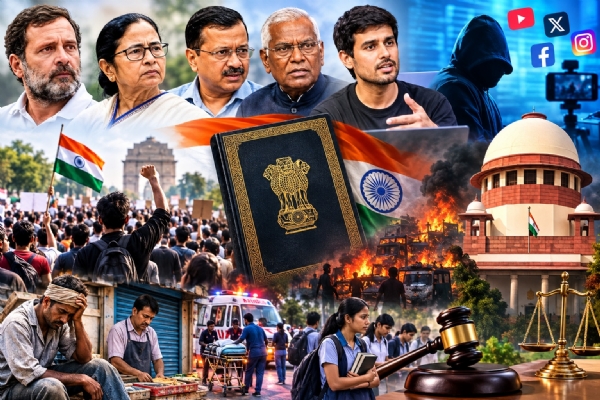
The most recent example of this climate is the uproar over the Special Intensive Revision (SIR) of the electoral rolls. Cleaning up the electoral rolls is the duty of a constitutional body, and questioning its transparency is the opposition’s right. But when leaders such as Rahul Gandhi, Mamata Banerjee and Arvind Kejriwal appear most agitated by every step that narrows the scope for bogus names and infiltration, it is natural for the public to ask whether their objection is to the process or to its outcome. Leaders such as D. Raja of the CPI have now joined the effort as well. The avenues for lodging objections, through the courts and the Election Commission, are open to them. Choosing the path of crowds and confusion instead raises questions about their intent.
Social media is the new arena for this game. Influential content creators such as Dhruv Rathee reach tens of millions of young people, making daily videos on Indian politics from abroad. Freedom of expression is their right too. But rights come with responsibilities, and when the facts in a video are weak while its influence on millions of minds is vast, the question of accountability arises. Allegations are circulating on social media about alleged coordination between platforms such as the CJP and creators of this kind, and about their funding sources and foreign links. These should not be brushed aside. It is the responsibility of the government and the investigating agencies to examine them transparently and on the basis of facts. If the truth emerges, the guilty should face stern action.
This inquiry matters all the more because the price of agitation is paid by those who have nothing to do with its organisers. A single day’s shutdown takes the bread out of a daily-wage labourer’s mouth. The small shopkeeper whose shop is burnt down rarely receives insurance or compensation. Every minute an ambulance spends stuck in a traffic jam weighs heavily on someone’s breath. The student heading to an examination and the ordinary citizen on the way to work are likewise made hostages of the same crowd. In the Delhi violence of February 2020, dozens of lives were lost and hundreds of families were ruined. On 26 January 2021, a large number of police personnel were injured at the Red Fort, and a national symbol was insulted. How many of those who incited the crowds have paid the price?
The examples from our neighbourhood are a warning. In Bangladesh in 2024, a student movement turned into violence and arson, the government fell, and there were reports of attacks on minorities (Hindus, Buddhists and Christians). In Nepal in September 2025, a youth movement that began against a social media ban escalated to the burning of Parliament and of leaders’ homes, and the government collapsed. In both places the trouble began with genuine discontent. But when the state loosened its grip in time, command of the crowd passed into the hands of people with other agendas. India must not wait to pay the price of this lesson, which is why there is a clear expectation that the government will fulfil its basic responsibility.
The resolve the government has shown against Naxalism must be visible on every front of law and order. Firmness means that those accused of rioting and arson, whatever their party or ideology, should be arrested and tried in fast-track proceedings. Losses to public property should be recovered from organisers and rioters through due legal process. Those who incite violence with inflammatory and false content should face swift action under the Bharatiya Nyaya Sanhita and the IT laws. And every allegation of foreign funding should be investigated under judicial supervision. The action taken should be such that it stands up in court and also appears legitimate in the eyes of the public.
Dissent is the strength of democracy, but violence and anarchy are no substitute for it. A society that treats those who block roads, set fires and spread lies with leniency does an injustice to its peaceable citizens. The country now wants a clear message: complete freedom to speak, but no licence to break the law, whether the offender is a street rioter, an influential face on a screen or even an aspirant to the seat of power.
---------------
Hindusthan Samachar / Mayank Chaturvedi