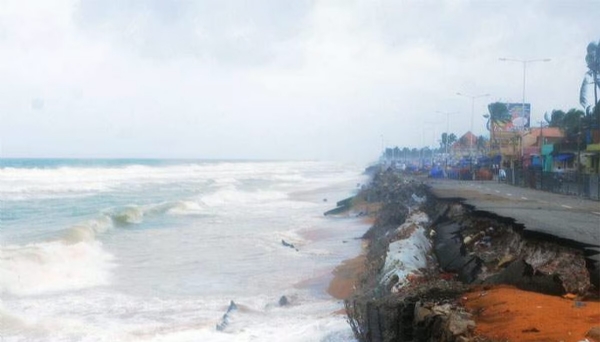
Thiruvananthapuram,31 Jan (H.S.):In a major policy decision aimed at strengthening coastal protection and disaster response, the Kerala government has officially declared sea erosion and flooding caused by tidal surges during high tide and low tide cycles as a state-specific disaster. The move will allow affected families to receive structured compensation from the State Disaster Response Fund (SDRF) for losses caused by tidal sea incursions.
As per the government order, when waves cross the high-tide line and enter inland areas, or when flooding occurs as a result of such tidal activity, the resulting damage to human life, property, livelihoods, and basic infrastructure will now be treated as a state-specific disaster. Relief and compensation will be sanctioned strictly in accordance with prescribed disaster management norms.
Until now, only sea erosion occurring during extreme events such as cyclones, severe sea turbulence, or major coastal storms was recognised as a special disaster. Other instances of sea erosion or flooding caused by routine tidal activity were classified under general natural disturbances, limiting the scope of relief to minor assistance.
Although families who lost houses to sea erosion were occasionally granted compensation of up to ₹4 lakh, such assistance depended on special Cabinet decisions rather than an assured disaster relief mechanism. The absence of a formal disaster classification often resulted in delays and uncertainty for affected coastal communities.
With the new order, damages caused by tidal waves entering land areas or the flooding that follows will automatically qualify for assistance from the SDRF. This ensures a rule-based and predictable relief system, eliminating the need for repeated Cabinet interventions and enabling faster support for victims.
The decision follows repeated concerns raised by coastal residents about the increasing frequency of tidal flooding and erosion, even in the absence of cyclones or rough sea conditions. Officials say the revised classification reflects changing coastal realities linked to climate change and rising sea levels, and will provide greater security to vulnerable coastal populations across the state.
---------------
Hindusthan Samachar / Arun Lakshman