Gorakhpur,
14 Jan (HS): In a significant initiative aimed at bridging the gap between
academic learning and large-scale infrastructure development, Prayagraj team
from Dedicated Freight Corridor Corporation of India Limited (DFCCIL) visited
Madan Mohan Malviya University of Technology (MMMUT), Gorakhpur, to share the
knowledge of advance technology and practices used in the construction and
operation of Dedicated Freight Corridors (DFCs).
This
initiative is part of a broader vision to inculcate advanced technical know-how
among students of technical institutions and universities. The decision was
taken following deliberations between the Governor of Uttar Pradesh and the Managing
Director of DFCCIL, Praveen Kumar. It was resolved that the advanced
technologies, specialised machinery, and innovative construction practices used
in the development of Dedicated Freight Corridors should be disseminated among
engineering students, enabling them to gain exposure to real-world applications
and encouraging institutions to facilitate field-level practical training.
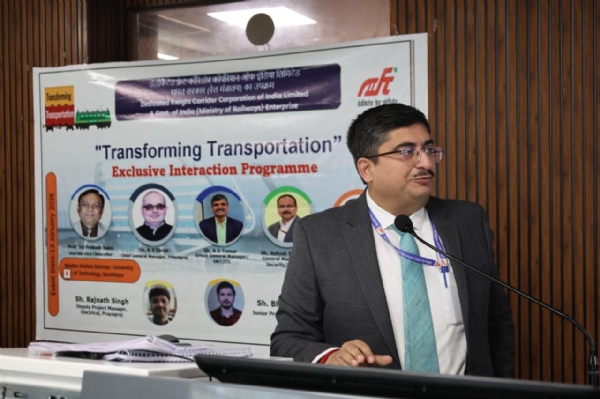
As
a first step towards implementing this vision, the DFCCIL Prayagraj team, led
by Chief General Manager A. B. Saran, organised an “Exclusive Interaction
Programme” on the theme “Transforming Transportation” at MMMUT. The programme
focused on showcasing the state-of-the-art technologies adopted by DFCCIL
across civil, electrical, signalling & telecommunication, and mechanical
engineering disciplines with its outcome results in train operations.
During
the technical deliberations, the DFCCIL team provided comprehensive insights
into civil engineering machinery and construction methodologies, including
mechanised track laying using the New Track Construction (NTC) machine,
advanced earthwork and formation technologies, and fast-paced construction
techniques. Detailed discussions were held on bridge design, special features
of DFC turnouts vis-à-vis Indian Railways turnouts, rail destressing using hydraulic
pullers, the use of Continuous Welded Rails (CWR), and the functioning of rail
handling depots.
From
the electrical engineering perspective, students were introduced to advanced
equipment and systems such as NTC (for track laying), Auger Machines (TESCAR),
Rail cum Road Vehicles (RRVs) including Palfinger and Colmar units, GEISMAR
mast grabbers, and auto-tensioning wire machines etc. The session also covered
auto fault detection systems, design of cantilevers using indigenous
components, 2×25 kV traction system and its advantages, key technical
specifications of traction substations, SCADA (Supervisory Control and Data
Acquisition) systems, OHE earth clamps, and Gas Insulated Substations (GIS).
In
the domain of Signalling and Telecommunication, the DFCCIL team elaborated on
the Train Management System integrated with Video Wall Systems, enabling
real-time monitoring and live tracking of trains with unique identification
numbers. Advanced safety and communication technologies such as Multi-Section
Digital Axle Counters, GSM-R communication, Train Protection and Warning
Systems(KAVACH), and the role of Auto Location Huts in modern signalling
architecture were also discussed in detail. From
a mechanical engineering standpoint, students were acquainted with cutting-edge
monitoring and diagnostic systems used to ensure rolling stock health and
safety. These included the Machine Vision Inspection System, Hot Axle Box
Detectors (HABD), and Wheel Impact Load Devices (WILD), highlighting their
critical role in predictive maintenance and operational reliability.
The
DFCCIL team also highlighted the transformational role of the Eastern Dedicated
Freight Corridor (EDFC) in India’s logistics and transportation landscape.
Following its successful commissioning and the transfer of nearly 100% freight
traffic to EDFC, the corridor has demonstrated remarkable operational capacity.
Notably, during the commencement of Magh Mela-2026, EDFC achieved a historic
milestone by operating 525 trains on 12 January 2026, surpassing its previous
record of 508 trains run on 30 March 2025. This achievement underscores the
corridor’s enhanced capability and scalability for future freight demand.
The
programme was conducted in the presence of distinguished faculty members,
including Prof. Vijay Kumar Dwivedi (Training & Placement Coordinator), Dr.
Anil Pal (Assistant Professor, Electrical), Dr. Vinay (Assistant Professor,
Civil Engineering), Dr. Rajan Mishra (Associate Professor, Electrical), Dr.
Pallav Gupta (Associate Professor, Mechanical Engineering), and Sukanya Pandey
(Training Coordinator). The event was ably hosted by Ajay Madhesia, a
third-year Mechanical Engineering student.
Senior
DFCCIL officials, including A. B. Saran, Chief General Manager; A. S. Tomar,
GGM/S&T/CO; Ashish Mishra, GM/Security/EDFC; Mannu Prakash Dubey,
AGM/OP&BD/EDFC; Rajnath Singh, Dy. Project Manager/Electrical/Prayagraj;
and Bhuvnesh Pandey, JPM/Civil/Prayagraj, delivered detailed presentations on
their respective domains. The session was held in the esteemed presence of
Prof. Jai Prakash Saini, Vice-Chancellor of MMMUT. The interaction programme
was highly appreciated by faculty and students alike, marking a meaningful step
toward industry–academia collaboration and inspiring future engineers to
contribute to nation-building through advanced infrastructure development. More
than 250 students participated in the event.
Hindusthan Samachar / Abhishek Awasthi