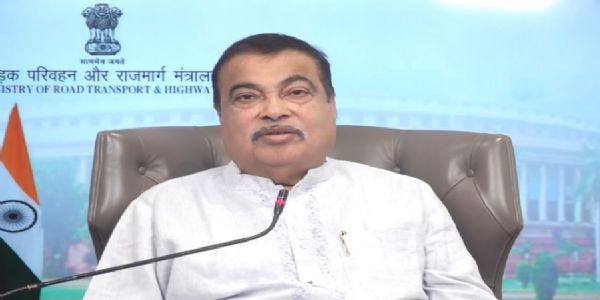
New Delhi, 12 January (H.S.): Union Minister for Road Transport and Highways Nitin Gadkari stated on Monday that under Prime Minister Narendra Modi's leadership, India advances rapidly toward global leadership in world-class highway projects and large-scale infrastructure execution.
Guinness World Records Celebration
Gadkari addressed an event online in Puttaparthi, Andhra Pradesh, marking four Guinness World Records achieved on the NH-544G Bengaluru-Kadapa-Vijayawada Economic Corridor. Attendees included Andhra Pradesh Chief Minister N. Chandrababu Naidu, NHAI Chairman Santosh Yadav, MP Parthasarathy, and senior officials. He congratulated the National Highways Authority of India (NHAI) and contractor Rajpath Infracon Private Limited, hailing the feats as symbols of India's engineering prowess, adoption of new technologies, and commitment to accelerated quality construction.
Innovation and Sustainability Focus
The minister emphasized the government's mission to reduce costs, enhance quality, and prioritize environmental protection through innovation, science, technology, and research—transforming knowledge into wealth. Political will turns the impossible into possible, he noted, praising continuous integration of advanced techniques in national highway construction without compromising standards.
Efforts ensure faster construction, lower costs, eco-friendly materials, and ecological preservation. Recent success by CRRI and CSIR scientists in producing bitumen from rice stubble has led to 15 patents granted to industries, curbing pollution while benefiting farmers.
Record-Breaking Achievements
NHAI set two records on January 6 near Puttaparthi: the longest continuous bituminous concrete laying at 28.89 lane-km (or 9.63 km of three lanes) in 24 hours, and the highest quantity of 10,655 metric tons laid continuously in 24 hours—both global firsts for six-lane projects. On January 11, two more records followed: 57,500 metric tons continuously laid and 156 lane-km (or 52 km of three lanes) paved continuously, surpassing the prior 84.4 lane-km mark. Executed in Packages 2 and 3 using 70 tippers, five hot mix plants, one paver, and 17 rollers, quality oversight involved IIT Bombay and OEMs.
Corridor Impact
This 343-km access-controlled six-lane corridor will shrink Bengaluru-Vijayawada distance from 635 km to 535 km and travel time from 12 to 8 hours, featuring 17 interchanges, 10 wayside amenities, a 5.3-km tunnel, and 21 km through forests. It bolsters connectivity to Rayalaseema, coastal/northern Andhra Pradesh, and Koparthy Industrial Node, exemplifying India's push for safe, swift modern highways.
---------------
Hindusthan Samachar / Jun Sarkar


12 Jan 2026