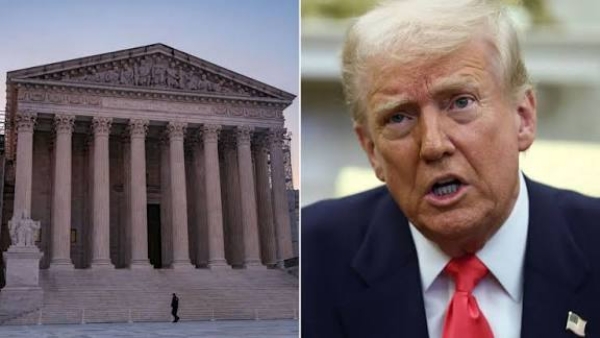
Washington, 6 December (H.S.): The United States Supreme Court has agreed to examine the constitutionality of President Donald Trump’s controversial executive order restricting birthright citizenship, igniting a landmark legal battle that could redefine one of the nation’s oldest principles of citizenship.
The order, signed by Trump on January 20—the first day of his second term—declares that children born in the United States to parents who are in the country illegally or temporarily will no longer qualify as American citizens. The measure has been struck down by several lower courts and has not taken effect nationwide.
The Supreme Court will hear arguments in the spring, with a final ruling expected by early summer.Birthright citizenship, guaranteed under the 14th Amendment since 1868, has long ensured citizenship for all individuals born on American soil, except for children of diplomats or foreign occupiers.
Legal scholars note the amendment was designed to secure citizenship rights for formerly enslaved people and their descendants. Trump’s move, they argue, challenges more than 125 years of settled constitutional understanding.
A federal judge in New Hampshire previously blocked the order in a class action lawsuit supported by the American Civil Liberties Union. “No president can change the 14th Amendment’s fundamental promise of citizenship,” said Cecillia Wang, the ACLU’s national legal director, expressing confidence that the Supreme Court would uphold precedent.
The administration’s petition, filed by Solicitor General D. John Sauer, contends that the 14th Amendment’s clause—conferring citizenship on those “subject to the jurisdiction” of the United States—does not extend to children of noncitizens. Twenty-four Republican-led states and 27 Republican lawmakers, including Senators Ted Cruz and Lindsey Graham, have endorsed Trump’s stance.
This case marks the first time one of Trump’s major immigration policies has reached the Supreme Court for a definitive ruling. It comes amid an aggressive second-term immigration crackdown featuring expanded enforcement operations and the first modern invocation of the 18th-century Alien Enemies Act.
While lower courts have consistently ruled Trump’s order unconstitutional, the high court’s decision could reshape immigration law for generations and determine whether the president has the authority to unilaterally alter constitutional citizenship rights.
---------------
Hindusthan Samachar / Jun Sarkar
06 Dec 2025
Supreme Court to Rule on Trump’s Birthright Citizenship Order, Stirring Constitutional Debate

05 Dec 2025
Putin Bids Farewell to Delhi: Lavish Vegetarian Feast and Strategic Pledges Cap Landmark India Visit
05 Dec 2025