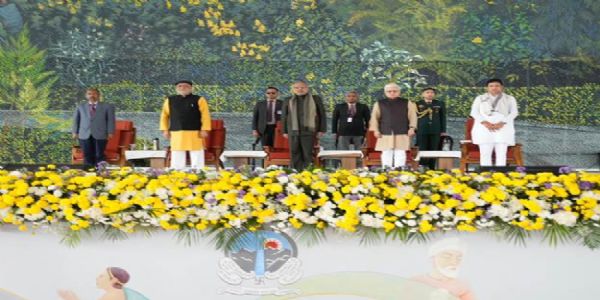
Kolkata, 21 December (H.S.): Two important national meetings on tiger and elephant conservation were held in the Sundarbans Tiger Reserve in West Bengal, chaired by Union Minister for Environment, Forest and Climate Change, Bhupender Yadav. Senior officials, scientists, wildlife experts, and representatives from various states across the country participated in these meetings. The objective was to review the progress of Project Tiger and Project Elephant and strengthen future conservation strategies.
In the 28th meeting of the National Tiger Conservation Authority (NTCA) held on Sunday, the Union Minister stated that India's tiger conservation model is appreciated worldwide. He emphasized the crucial importance of scientifically based management, landscape-level planning, participation of local communities, inter-state coordination, and international cooperation. The decisions of the previous meeting held on April 18, 2025, were confirmed, and the actions taken on them were reviewed.
The meeting discussed in detail the challenges faced by tiger reserves. Emphasis was laid on the three-tiered strategy being adopted to mitigate human-tiger conflict. The progress of the project related to the management of tigers outside the tiger reserves was also discussed. Serious concerns were raised regarding staff shortages, financial constraints, habitat loss, and invasive species in several states, and necessary instructions were given.
Tiger conservation plans were approved at the meeting. Agreement was reached on the expansion of the cheetah project and its evaluation in new areas, tiger translocation, increasing the population of prey species, landscape management plans, and training programmes related to the health management of carnivorous wildlife. The role of the NTCA in proposals submitted to the Standing Committee of the National Board for Wildlife was also reviewed.
The Union Minister informed that the sixth phase of the All India Tiger Estimation is progressing rapidly. Ground surveys have commenced since November 2025. Training programmes are being conducted in different regions. International cooperation under the cheetah project is also continuously increasing with countries like South Africa, Namibia, and Botswana. The meeting also considered recent Supreme Court orders and their implications for tiger conservation.
In this context, the 22nd Steering Committee meeting of Project Elephant was held. The actions taken on the decisions of the previous meeting were confirmed. A presentation was given on the status of the regional action plans prepared for South India and Northeast India, emphasizing the need for better coordination among the states.
The meeting reviewed the progress of the All India Coordinated Elephant Census, which was deemed crucial for scientific and evidence-based planning. The model conservation plan prepared for the Nilgiri Elephant Reserve and the DNA profiling of captive elephants were also discussed. The aim is to strengthen elephant welfare and scientific management.
A comprehensive review of the human-elephant conflict situation in the country was also conducted. The causes of the conflict, measures to mitigate it, and the status of compensation mechanisms in the states were considered. This was followed by a review of elephant population estimation methods, integrated conservation strategies in the Ripu Chirang Elephant Reserve in Assam, and future action plans.
It was also decided that a management effectiveness evaluation would be conducted in all elephant reserves, with support from the Forest Development Fund. A special study on elephant corridors, habitat use, and conflict-prone areas in the Bandhavgarh region was also proposed.
On this occasion, Union Minister Bhupender Yadav released six publications, including a book on the progress of Project Cheetah, the latest issue of the National Tiger Conservation Authority's journal, a booklet on the institutional journey of tiger conservation in India, interesting facts and stories related to the country's tiger reserves, a guide on best practices for the management of captive elephants, and the December 2025 issue of the Project Elephant quarterly magazine.
At the end of the meeting, it was reiterated that the central government is committed to ensuring a safe and sustainable future for tigers and elephants through scientific approaches, the use of technology, inter-state cooperation, and a community-centric approach.
---------------
Hindusthan Samachar / Priyanka Pandey