*By Dr. Devan
For more than a century, humanity has accepted—almost blindly—the belief that the vast oceans of petroleum beneath our feet are the compressed remains of prehistoric forests, plankton, algae, and dinosaurs. We were taught that millions of years of sedimentation, pressure, and heat converted ancient organic matter into the black gold that drives modern civilization. It is a tidy explanation. It is convenient. It feels scientific.
But is it true?
When you pause, even briefly, and examine the scale of global petroleum reserves, a profound contradiction emerges. The volume of petroleum extracted thus far, coupled with the vast reserves still untouched, is staggeringly disproportionate to the biomass that once lived on Earth. There were simply not enough fossils, not enough forests, not enough organic matter to account for the trillions of barrels of crude oil that have powered and continue to power human progress.
This discrepancy invites an uncomfortable but necessary question:
What if petroleum did not originate on Earth at all?What if the true source of petrol is extraterrestrial—specifically, the seas of Venus hurled into space during an interplanetary clash?
This provocative idea draws inspiration from the controversial but intriguing theories of Immanuel Velikovsky, whose reinterpretation of cosmic history challenged conventional geology, astronomy, and physics. Today, we revisit this possibility—not as a fringe thought, but as a scientific hypothesis worthy of exploration.
1. The Fossil Fuel Paradox: A Volume That Defies BiologyTo understand why an extraterrestrial origin of petroleum is plausible, one must first confront the paradox at the heart of the fossil fuel theory.
Humanity has extracted over 1.6 trillion barrels of oil so far. Proven reserves exceed several trillion more. When you translate this into mass, the numbers become even more astonishing—tens of billions of tons of hydrocarbons.
Now consider the biomass required to produce this much oil.
Even if Earth had been blanketed entirely with dense tropical forests for hundreds of millions of years, and even if every single organism had been perfectly preserved under ideal geological conditions (an impossibility), the organic yield would still fall short by several orders of magnitude.
Furthermore, petroleum deposits exist kilometers underground, spread across continents, oceans, and tectonic plates, with a uniformity in composition that is biologically inexplicable.
To accept the conventional fossil theory is to accept an arithmetic impossibility.
This inconsistency leads us to the provocative suggestion:
The hydrocarbon lakes of another world might have seeded Earth.
2. Venus: A Planet Once Very Different From What We See TodayModern Venus is a hellish inferno—462°C surface temperature, crushing atmospheric pressure, sulfuric acid clouds. It is easy to imagine it as perpetually hostile.
But planetary scientists increasingly agree that Venus may not always have been like this.
There is compelling evidence, based on atmospheric isotopes, terrain morphology, and climate modeling, that:
Venus likely had oceans or seas billions of years ago.Its atmosphere once supported massive quantities of hydrocarbons.Catastrophic events—possibly interplanetary—transformed it into its present state.Venus could have been a world rich in methane oceans, carbon-based seas, and volatile hydrocarbon compounds beneath a dense primordial atmosphere.
Now imagine such a hydrocarbon-rich planet passing catastrophically close to Earth.
The result would be nothing short of cosmic chaos.
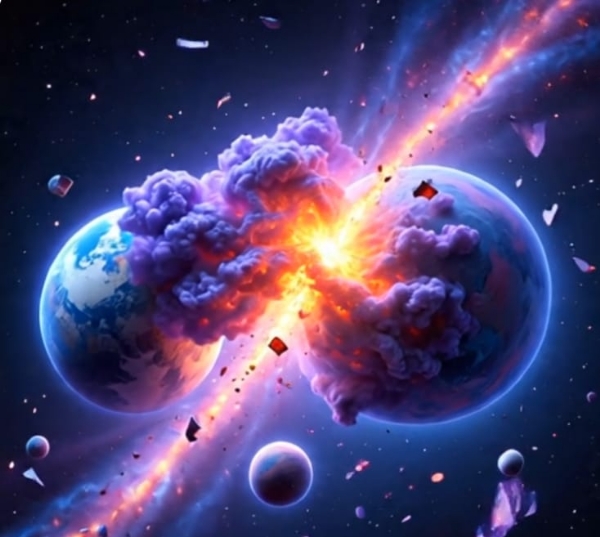
3. The Velikovsky Phenomenon: When Worlds CollideImmanuel Velikovsky proposed that planetary bodies in the solar system have interacted violently in the past—not in a static, clockwork dance, but in a dynamic, occasionally catastrophic interplay.
He suggested that:
Venus was once a comet-like bodyIt was ejected from JupiterIt passed dangerously close to EarthThe encounter altered Earth’s climate, geology, oceans, and atmosphereModern astrophysics might disagree on the specifics, but planetary close encounters are no longer dismissed outright. We know from crater evidence across the solar system that:
Entire moons have shatteredOceans of planets have vaporizedMass ejections and tidal disruptions are real phenomenaUnder such circumstances, it is entirely plausible that seas of hydrocarbons from Venus were ripped away by tidal forces, gravitational shear, and atmospheric stripping—throwing massive volumes of liquid carbon compounds into space.
Some of this material could have intersected Earth’s orbit and rained down in a deluge of extraterrestrial hydrocarbons.
This is the Velikovsky phenomenon applied to petroleum geology.
4. The Mechanics of a Cosmic Oil TransferHow could Venusian hydrocarbons reach Earth?
Let us consider the physics:
a. Gravitational Tidal StrippingAs two planets approach each other within Roche limits, their atmospheres and surface liquids can be drawn out into space. For Venus, rich in hydrocarbons, this would mean vast quantities of methane, ethane, and petroleum-like compounds being pulled away.
b. Atmospheric Jetting and Plasma DischargeVelikovsky proposed that planetary encounters could generate massive electrical discharges. Such discharges could ionize hydrocarbons and eject them at escape velocity.
c. Interplanetary Transfer and Earth CaptureOnce hydrocarbons are in space, gravitational forces determine their fate. A fraction of Venusian hydrocarbons could have been captured by Earth’s gravitational field, spiraling inward and descending into the atmosphere as oily rain.
d. Geological Absorption and Subsurface EntrapmentUpon impact with Earth:
Some hydrocarbons would be trapped in sedimentary basinsOthers would seep into porous rockStill others would be buried under tectonic shifts and continental driftThis explains why petroleum is found across all continents, including regions never known to be biologically rich.
It explains why Earth’s oil is mainly concentrated in basins formed by crustal movements, not areas of ancient biological abundance.
It also explains why petroleum deposits have a peculiar global uniformity despite being located thousands of kilometers apart.
5. Why This Theory Makes More Sense Than Fossil Fuel Origins1. The Quantity ProblemThere simply weren’t enough fossils.
2. The Location ProblemOil is often found deep underground in geological formations inconsistent with organic deposition.
3. The Uniformity ProblemOil composition is remarkably uniform worldwide—suggesting a single source, not millions of independent biological formations.
4. The Abiotic SignatureMany oil fields replenish themselves.This is incompatible with fossil theory but consistent with deeper, non-biological hydrocarbon origins.
5. The Isotope PuzzleCertain hydrocarbon isotopes found in oil are hard to reconcile with exclusively biological processes.
An extraterrestrial origin elegantly resolves these contradictions.
6. The Venusian Hydrocarbon Hypothesis: A New ParadigmIf petroleum on Earth is indeed the remnants of Venus’s ancient seas, then our understanding of planetary history must be rewritten.
This theory suggests the following:
Earth’s petroleum is not a relic of ancient life but a cosmic giftOur planet is part of a larger interplanetary chemical exchangeVenus and Earth have interacted far more dramatically than mainstream science acceptsHuman civilization is literally powered by the remains of another worldIt reframes petroleum not as “fossil fuel” but as planetary fuel, transported across space during a cataclysmic encounter.
It also explains why:
Oil exists on multiple planets and moonsHydrocarbon lakes are present on TitanMethane exists on MarsOrganic compounds are ubiquitous in cometsHydrocarbons are cosmic.Life is not the only producer of them.
7. The Psychological Barrier: Why People Resist This IdeaHumans are comfortable with simple stories.
“Dead plants turned into oil” is easy to accept.“Venus’s seas splashed onto Earth” is not.
But history shows us that truth often resides in ideas once considered outrageous:
The Earth revolves around the SunContinents driftSpace and time bendBlack holes existWater can exist on other planetsEvery scientific revolution begins as heresy.
8. Conclusion: The Cosmic Heritage of Human CivilizationIf the petrol that powers our cars, planes, factories, and economies came from Venus—if the fuel that shaped modern civilization is extraterrestrial—
then the story of humanity is far more epic than we imagined.
We are, in a very real sense, burning the seas of another world.
The Velikovsky phenomenon invites us to expand our imagination, question established doctrine, and explore the cosmos not just as distant observers but as participants in an ancient, dynamic interplay of planetary forces.
Petroleum, then, is not merely a natural resource.It is a relic of cosmic violence.A testament to the interconnectedness of celestial bodies.A reminder that Earth is not isolated, but part of a greater planetary family.
And perhaps, as we burn the hydrocarbons of Venus, we are tapping into a chapter of cosmic history long forgotten—one that shaped the destinies of two planets, and ultimately, the species that emerged to question it.
*Dr Devan is a Mangaluru-based ENT specialist and author.
Hindusthan Samachar / Manohar Yadavatti