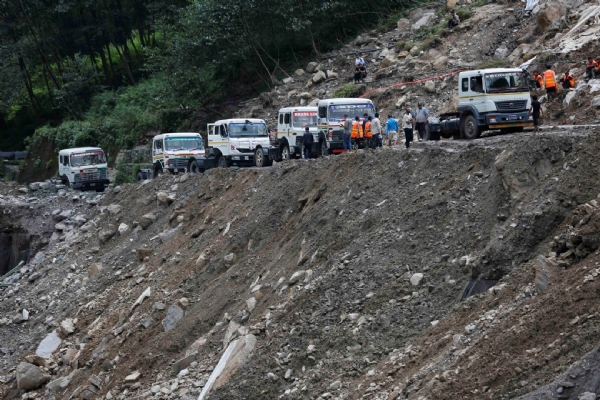
Kathmandu, 30 September (H.S.): Nepal’s overland trade with China has come to a complete standstill after three days of continuous rain and a series of natural disasters disrupted traffic at all three major northern border crossings, severely affecting supply chains ahead of the upcoming festive season.
The Tatopani–Khasa, Rasuwagadhi and Korala border crossings between Nepal and China are currently closed. Extensive damage to roads and other infrastructure leading to the border points has made large-scale movement of cargo along these routes impossible.
According to data from Nepal’s Department of Customs, the country imported goods worth more than 76.40 billion Nepalese rupees from China during the first two months of the current fiscal year alone. The disruption of all three major trade routes has therefore dealt a significant blow to bilateral overland commerce.
Tatopani and Rasuwagadhi were the first to close
China had already suspended operations at the Tatopani–Khasa crossing amid concerns over landslides. The Rasuwagadhi crossing was subsequently severely damaged by flooding in the Bhotekoshi River on August 26.
With the two major crossings closed, the Korala crossing in Mustang emerged as an alternative route for Nepal–China trade. However, flooding in the Kaligandaki River has now severed road access to Korala as well. Floodwaters have washed away approaches to several key bridges along the Kaligandaki Corridor and the Mid-Hill Highway.
Although the Korala border crossing and the customs office remain safe, damage to bridges along the Beni–Jomsom road has halted the movement of freight vehicles.
434 containers and 641 electric vehicles entered Nepal in 15 days
After the closure of Tatopani and Rasuwagadhi, pressure on the Korala crossing had increased substantially. In just 15 days, between September 10 and 25, 434 containers and 641 electric vehicles entered Nepal through Korala.
By the final week of Bhadra, the Mustang Customs Office had collected more than 2.31 billion Nepalese rupees in revenue during the current fiscal year. In the previous fiscal year, goods worth 14.41 billion Nepalese rupees and more than 3,000 electric vehicles entered Nepal through the Korala crossing.
The disruption of road connectivity has now left trade worth billions of rupees stranded.
Festive-season supplies hit
The closure of the border crossings has halted the supply of garments, footwear, bags, electronic goods and electric vehicles arriving from China. The disruption has raised concerns among both traders and consumers ahead of the festive season.
Parshuram Dahal, president of the RB Complex Business Association, said only 20 to 30 per cent of the goods ordered for the festival season had so far reached Kathmandu.
He said goods imported specifically for the festive season remain stranded along the routes. Attempts had been made to bring consignments stored in warehouses through the Korala crossing, but that route has now also been cut off.
According to Dahal, the problem is not limited to customs procedures. The rising exchange rate of the US dollar and higher transportation costs are also pushing up the prices of goods.
With roads disrupted and transportation costs rising, the prices of incoming goods could increase by 25 to 30 per cent, he said.
Efforts to bring goods through India using smaller vehicles
With large freight trucks unable to operate, some traders have begun importing goods from India using smaller vehicles. However, Dahal said Indian goods are more expensive than Chinese products, while transportation costs are also higher when smaller vehicles are used.
He said existing inventories and locally produced goods had provided some relief to the market despite the disruption to Chinese imports. However, wholesalers from outside Kathmandu are also unable to travel to the capital to collect goods because of the damaged road network.
Some traders have started accepting orders through WhatsApp and social media, but business activity remains subdued.
Dahal said roads have been damaged by rain in September for three consecutive years, repeatedly disrupting trade. He said traders have borne the brunt of the disruption each time and are once again facing the economic impact of the natural disaster.
---------------
Hindusthan Samachar / Jun Sarkar

18 Aug 2026