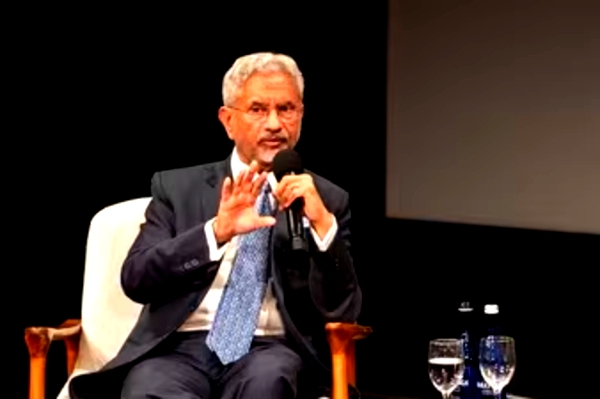
New York, 30 September (H.S.): External Affairs Minister S. Jaishankar has said the world is moving visibly towards greater multipolarity amid growing competition, interdependence and geopolitical turbulence, with countries increasingly seeking to diversify partnerships and reduce risks.
Speaking on a world in rebalancing, Jaishankar said the international system was undergoing significant change as economic and political power shifted among countries. He said this rebalancing was creating enormous churn within the international system and raising questions about whether institutions created decades ago could adjust to changing realities.
He said the current international environment was marked by a strong sense of competition coexisting with deeper interdependence. According to him, this tension was increasingly leading countries to use their economic, geographical, financial and technological leverage as choke points.
Jaishankar said the world had moved through bipolarity and a period of unipolarity and was now heading towards greater multipolarity. He pointed to changes in the approach of major powers and said countries across the world were making their own arrangements, looking at ways to de-risk, diversify and identify new partners.
He said India's approach was to maintain a balance in its relationships with the United States, Europe, Japan, China, Russia, the Gulf, ASEAN and countries of the Global South. He described this as a portfolio management approach, aimed at maintaining stability and predictability in a competitive international environment.
On the global economic impact of conflicts, Jaishankar said the Ukraine conflict and the Iran-Gulf conflict had placed considerable pressure on Global South economies. He pointed to concerns over energy supplies, food, fertilisers and finance, and said the consequences of major countries' decisions could affect countries far beyond the immediate conflict zones.
On India-US relations, Jaishankar said trade negotiations had reached an advanced stage but changes in the US tariff framework had created new issues. He also stressed that terrorism remained a primary concern for India and said greater understanding of this concern would be important for the bilateral relationship.
On India-China relations, Jaishankar said ties were better than in 2025 and had improved following the easing of the border standoff. He said the basic principle guiding India was that the state of the border determines the state of the relationship.
He also highlighted the growing India-Japan partnership, particularly in investment, supply-chain diversification, semiconductors, advanced manufacturing, defence, security and people-to-people exchanges.
Jaishankar said the international system was likely to evolve through new partnerships, negotiations and arrangements as countries responded to the changing global balance.
---------------
Hindusthan Samachar / Jun Sarkar

18 Aug 2026