By Dr Mayank Chaturvedi
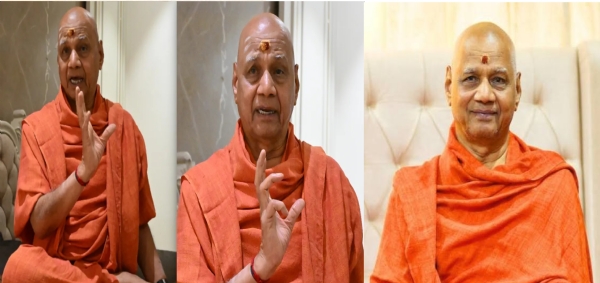
New Delhi, 30 September 30 (HS): Swami Govind Dev Giri Ji Maharaj speaks in this interview about his spiritual perspective, his experience of the Ram Temple movement, his new administrative responsibilities as General Secretary of the Shri Ram Janmabhoomi Teerth Kshetra Trust, financial transparency, coordination with the Chief Executive Officer, the future role of the Ram Temple and the broader question of nation-building.
Question: How do you view your new responsibility as General Secretary of the Shri Ram Janmabhoomi Teerth Kshetra Trust?
Answer: For me, this is not a matter of position or authority. As always, I see it as an opportunity to serve. The issue of Shri Ram Janmabhoomi is connected with the faith of millions of people. The construction of the Ram Temple was a historic phase, but organising the temple’s administration, preserving its dignity, ensuring facilities for devotees and managing the wider range of activities associated with it are equally important. I regard this as an opportunity to serve Lord Shri Ram and the nation.
Question: You were earlier serving as the Trust’s Treasurer. How will your role change as General Secretary?
Answer: As Treasurer, my responsibilities were primarily related to financial discipline, resources and financial management. As General Secretary, the scope of responsibility is considerably broader. It includes implementing the Trust’s decisions, coordinating among various committees and administrative arrangements, supervising administrative functions and giving momentum to activities associated with the temple. Our endeavour will be to ensure clarity, discipline and accountability in every aspect of the system.
Question: The Trust has strengthened its professional administrative structure by appointing former Air Marshal Jitendra Mishra as its first CEO. How do you view this decision?
Answer: The administration of such a large religious and cultural centre is extremely wide-ranging in today’s circumstances. There are large numbers of devotees, security requirements, technological systems, financial management, public facilities and numerous other administrative dimensions. It is therefore essential to combine a spiritual vision with modern administrative expertise. The appointment of a Chief Executive Officer is an important step in this direction. All of us will work within our respective responsibilities towards the same objective.
Question: Is there a need for modern management and professional administration in a religious institution?
Answer: Certainly. In the Indian tradition, religion and orderly administration have never been regarded as mutually incompatible. The concept of Ram Rajya also places emphasis on good governance, discipline, public welfare and accountability. If modern technology and management tools are used to serve the temple, facilitate the experience of devotees and strengthen transparency, they are entirely consistent with our tradition.
Question: Questions were raised over the Trust’s financial and administrative arrangements following the controversy surrounding the alleged theft of offerings in July 2026. How do you view the entire episode?
Answer: Wherever large numbers of devotees gather and substantial donations and offerings are received, extremely stringent discipline and transparency are essential. If shortcomings emerge anywhere, they must be corrected. It is not appropriate to question an individual’s intentions without facts; at the same time, it is our responsibility to address shortcomings in the system. Our objective should be to establish a system in which every process is clear, controlled and accountable.
Question: Will the new administrative structure further strengthen financial transparency?
Answer: Transparency is extremely important for any public religious institution. Millions of people have an emotional and spiritual connection with the Shri Ram Janmabhoomi Teerth Kshetra. Therefore, ensuring that funds are used for their intended purposes, that every process is properly organised and that institutional accountability is maintained will remain our priority.
Question: Your study of scriptures and your discourses began at a very young age. How do you look back on the journey from delivering your first discourse at the age of 17 to taking responsibility for the Ram Temple Trust?
Answer: When I began speaking on the Bhagavad Gita and the Srimad Bhagavata at the age of 17, I could never have imagined that life would one day give me the opportunity to serve Lord Shri Ram in this manner. For me, this journey is not a personal achievement; rather, it is a journey that reflects the strength of India’s knowledge tradition and the blessings of the saints. The more I have tried to understand the Vedas, Upanishads, Ramayana, Mahabharata and Gita, the more deeply I have realised that the fundamental message of Indian culture is connected with the welfare of society and humanity.
Question: You also founded the Maharshi Ved Vyas Pratishthan for the study and propagation of the Vedas. How relevant are the Vedas and Indian philosophy for the younger generation today?
Answer: The Vedas are not merely ancient or timeless scriptures for us. They embody a comprehensive perspective on life, nature, society and consciousness. Today’s generation is advancing alongside modern science and technology, but it is equally important for young people to remain connected with their roots. The Vedas, Upanishads and Gita offer a perspective through which a person can understand the purpose of life, duty and self-discipline. Their study is therefore as relevant today as it has been in the past.
Question: You have witnessed the long journey from the Ram Temple movement to the construction of the temple. Now that the magnificent temple stands before us, how do you remember that journey?
Answer: It has been a journey spanning generations of resolve, struggle, spiritual practice and waiting. The construction of the Ram Temple is the culmination of the sentiments of countless people who regarded it as a lifelong commitment. Therefore, more important than the grandeur of the temple is the sentiment behind it. We must remember that if a temple dedicated to Lord Ram has been built, the ideals of Lord Ram must also become established in our lives.
Question: On January 22, 2024, after the Pran Pratishtha ceremony of Ram Lalla, Prime Minister Narendra Modi ended his 11-day fast by receiving prasad from you. How do you remember that moment?
Answer: It was an immensely emotional and historic moment. The manner in which Prime Minister Modi observed an 11-day fast and maintained strict discipline before the Pran Pratishtha reflected his devotion to the occasion. When he received prasad and ended his fast, my feeling was that this was not the moment of any one individual; it was a moment of faith for millions of devotees of Lord Ram.
Question: Do you believe the Ram Temple’s influence will extend beyond Ayodhya and shape India’s social and cultural life?
Answer: In fact, your question itself is somewhat misplaced, because the influence of Lord Shri Ram has existed beyond the boundaries of Ayodhya for centuries—not only across India but in many countries around the world and, in a broader spiritual sense, throughout the universe. Lord Ram is an ideal of India’s moral and cultural life. The Ram Temple is emerging as a centre from which a continuing source of energy can flow towards service, values, culture, education and a sense of responsibility towards society. The endeavour of the saintly community is precisely that the ideals of Lord Ram should become visible in our conduct.
Question: Large numbers of devotees are arriving in Ayodhya every day. What will be the biggest administrative challenge in the years ahead?
Answer: The growing number of devotees certainly brings with it a wide range of responsibilities. Arrangements for darshan, security, cleanliness, transportation, accommodation, prasad, medical care and other facilities will have to be continually improved to the highest possible standards. At the same time, preserving the spiritual dignity of the temple and protecting Ayodhya’s cultural identity are equally important responsibilities. Our endeavour is to create an arrangement in which devotees receive not only convenience but also a meaningful spiritual experience.
Question: Is there a broader vision to develop the Ram Temple as one of the world’s leading spiritual and cultural centres?
Answer: As I said, Lord Shri Ram is not confined to the boundaries of India. He is Vishnu, pervading every particle of the universe. The traditions of the Ram Katha and the Ramayana have also existed in many countries around the world. Ayodhya should become a centre from which the world can understand India’s spiritual and cultural worldview. For this, alongside the temple, there is a need to bring greater attention to knowledge, research, culture, Indian languages and the global traditions of the Ramayana.
Question: In your view, what is the contemporary meaning of Ram Rajya?
Answer: It would not be appropriate to confine the meaning of Ram Rajya to any particular political system. Its essence is that there should be justice in governance, trust in society, a sense of duty in individuals and concern for the welfare of the most vulnerable. Even while occupying the centre of political authority, Lord Ram placed public welfare above all else.
As Sant Tulsidas says in the Ramcharitmanas: “There is no religion greater than doing good to others, and no sin greater than causing pain to others.”
If we speak of Ram Rajya today, we must bring these fundamental values into both our public and personal lives.
The Ramcharitmanas further describes an ideal society in which people are free from physical, divine and material suffering; people live with mutual affection and follow their duties in accordance with righteous principles. It also envisions a society in which dharma is firmly established, people remain devoted to Lord Ram, and all are regarded as worthy of the highest spiritual attainment.
The text describes such a society as one in which there is no premature death, illness, poverty, helplessness or ignorance; men and women are virtuous, wise, capable and free from deceit, and people recognise and appreciate the good done by others.
In the modern sense—and indeed in any future age that considers itself modern—the essence of Ram Rajya would remain the creation of a society resembling the ideals described by Sant Tulsidas in the Ramcharitmanas and by Maharshi Valmiki in the Ramayana.
Question: You chose the path of renunciation. How challenging is such a major administrative responsibility for a monk?
Answer: Renunciation does not mean withdrawal from the world. In the Indian tradition, renunciation also means dedication to the larger society. When a responsibility arises in the service of dharma and society, turning away from it is not consistent with the spirit of renunciation. It is certainly a challenge, but more than a challenge, I regard it as an opportunity to serve. In this context, one can also study the life of Adi Shankaracharya as one of the finest examples.
Question: What is your most important message for today’s youth?
Answer: Young people should advance in modern education, science and technology while remaining connected to their cultural roots. The Gita teaches us about action, discipline and self-confidence. If young people incorporate knowledge, character, hard work and a sense of responsibility towards the nation into their lives, India’s strength will increase many times over.
India then means “Vasudhaiva Kutumbakam”—the world is one family. India means “Sarve Bhavantu Sukhinah”—may all be happy. India means peace, coexistence and harmony. India means “Ahimsa Paramo Dharma”—non-violence is the highest duty. India means strength tempered by compassion and restraint. India means knowledge, science and human welfare. India means a life lived in balance with nature. India means unity in diversity. India means respect for cultures and freedom of thought. India means “Charaiveti, Charaiveti”—the resolve to keep moving forward. India means a nation that remains rooted in its heritage while moving towards modernity. India means “Sarvajan Hitaya, Sarvajan Sukhaya”—the welfare and happiness of all. And India means a Sanatan consciousness that regards the whole of humanity as one family.
Question: After the construction of the Ram Temple, what do you see as the next major goal?
Answer: The construction of the temple is a great achievement, but the journey does not end here. The temple is a living spiritual, cultural and social centre. Providing the best possible facilities for devotees, preserving India’s knowledge tradition, expanding service activities and continuing to shoulder the responsibility of connecting the ideals of Lord Ram with the life of society—that is the continuity of the journey.
As for the question of the ultimate goal, the Lord has brought us this far and He will take us wherever He wishes to take us next. We are merely servants of the Lord. Whatever He wishes to accomplish through this body, may He continue to accomplish it.
Question: Finally, what will be your priorities as General Secretary?
Answer: My priorities are clear: preserving the dignity of the Ram Temple, maintaining discipline and transparency in the Trust’s administration, ensuring the convenience of devotees and providing service in accordance with the ideals of Lord Shri Ram.
The Ram Temple is a symbol of the faith of millions of people. Protecting that faith is a collective responsibility. The temple has been built on a grand scale; our next objective should be to establish an equally high standard of administration and service.
Our endeavour will be that every person who visits Ayodhya does not return merely with a memory of darshan, but carries back inspiration drawn from the life and values of Lord Shri Ram.
---------------
Hindusthan Samachar / Jun Sarkar