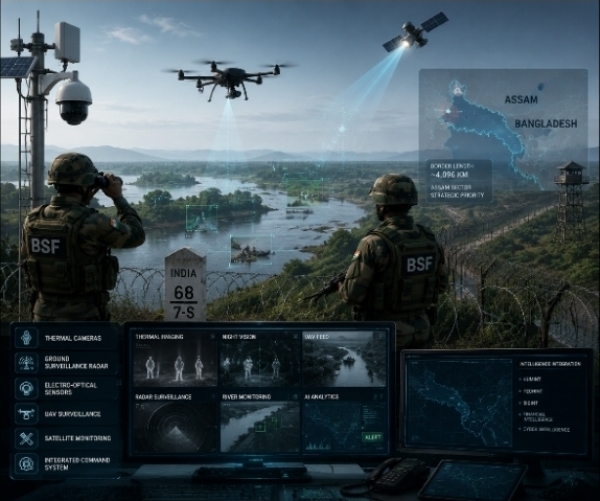
Kolkata, 03 September (H.S.): The west-Bengal, Assam sector of the India-Bangladesh border is emerging as an increasingly important security frontier, where organised crime, illegal cross-border networks, technological challenges and regional stability intersect. Its strategic significance is heightened by Assam’s complex riverine terrain, sensitive border areas adjoining Bangladesh and its direct connection with the wider security architecture of Northeast India.
The nature of border security challenges has changed significantly in recent years. Illegal crossings and conventional smuggling remain concerns, but the threat landscape has expanded into a more complex, interconnected ecosystem involving organised criminal networks, human trafficking groups, illicit trade channels and financial networks.
These networks increasingly exploit difficult terrain, surveillance gaps and socio-economic vulnerabilities to facilitate their activities. As a result, border management can no longer rely solely on conventional patrolling and physical barriers. It requires an integrated approach combining intelligence, technology, infrastructure and inter-agency coordination.
------
The Riverine Challenge
One of the biggest challenges to effective border management in Assam is its geography. The Brahmaputra river system, flood-prone areas, wetlands, erosion zones and constantly shifting river channels make continuous surveillance particularly difficult.
Unlike a conventional land border, a riverine frontier requires specialised surveillance capabilities and flexible deployment strategies. Floods and erosion can alter the terrain, create new channels and disrupt established security arrangements, making permanent surveillance infrastructure difficult to maintain.
This environment increases the importance of mobile surveillance platforms, aerial monitoring, advanced sensors and real-time intelligence sharing among security agencies.
------
Smuggling Networks Becoming More Complex
Cross-border smuggling has also evolved into a multidimensional security challenge. Narcotics, human trafficking, illegal trade and other prohibited activities are often supported by wider logistical and financial networks.
The movement of a consignment or the arrest of an individual carrier represents only one part of the problem. Behind such operations can be a network involving financiers, suppliers, transporters, local facilitators and other key operators.
Therefore, the strategic objective of border security must extend beyond intercepting consignments. Agencies need to identify and dismantle the wider ecosystem that enables these networks to function.
-----
Technology as a Force Multiplier
Modern technology can significantly strengthen the surveillance capabilities of security forces deployed along difficult border terrain.
Thermal imaging cameras, ground-surveillance radars, electro-optical sensors, night-vision equipment, unmanned aerial vehicles and satellite-based surveillance can provide security agencies with enhanced situational awareness, particularly in areas where conventional surveillance is difficult.
Integrated command-and-control centres can further improve the ability to collect, analyse and disseminate information in real time.
Artificial Intelligence-based data analysis could also become an important component of future border management. By processing large volumes of surveillance information, AI-enabled systems can assist agencies in identifying unusual movement patterns, detecting potential threats and improving predictive assessments.
However, technology should be viewed as a force multiplier rather than a substitute for human intelligence.
------
Integrating HUMINT and TECHINT
An effective border-security architecture requires close integration between Human Intelligence (HUMINT) and Technical Intelligence (TECHINT).
Border communities and local information networks can provide valuable ground-level inputs, while technical surveillance systems can help verify, track and analyse suspicious activities. The combination can strengthen early-warning mechanisms and allow security forces to move from reactive responses towards proactive threat prevention.
This intelligence-led approach is particularly important in areas where terrain and weather conditions can limit conventional surveillance.
A major component of tackling organised cross-border crime is targeting the financial infrastructure supporting these networks.
Intercepting a consignment or arresting a carrier may disrupt an individual operation, but the larger strategic objective should be to identify the sources of financing, supply chains and leadership structures behind such activities.
This requires closer coordination between the Border Security Force (BSF), Assam Police, intelligence agencies, customs authorities and financial investigation bodies.
Financial intelligence, investigation of suspicious transactions and coordinated intelligence operations can help expose the economic foundations of organised criminal networks. Targeting these financial structures can potentially have a greater long-term impact than focusing solely on individual couriers or consignments.
-----
The Importance of India-Bangladesh Cooperation
The international nature of cross-border crime also makes cooperation between India and Bangladesh essential.
Criminal networks can exploit international boundaries, differences in legal jurisdictions and gaps in coordination between agencies. Effective intelligence sharing, operational coordination and preventive mechanisms can therefore play an important role in disrupting such networks.
Future border management will need to focus increasingly on identifying threats before they develop into major security incidents. This requires sustained cooperation between agencies on both sides of the border, supported by timely intelligence exchange and coordinated action.
-----
Towards a Smart and Resilient Frontier
India’s future border-security strategy needs to move beyond conventional surveillance and adopt an intelligent, technology-enabled and network-centric model.
A multi-layered security architecture should combine physical infrastructure, advanced surveillance systems, intelligence integration, financial investigation and diplomatic coordination. Border roads, communication networks and the mobility of security forces also need to be strengthened alongside technological capabilities.
The objective should not simply be to create an impenetrable border. Instead, India needs to develop a smart, resilient and secure border ecosystem in which legitimate movement, trade and connectivity can continue while illegal networks face increasing operational pressure.
For West Bengal, Assam and the wider Northeast, strengthening the India-Bangladesh frontier is therefore more than a border-management requirement. It is a strategic necessity for protecting regional security, maintaining stability and creating the conditions for long-term economic development and connectivity.
Hindusthan Samachar / Satya Prakash Singh