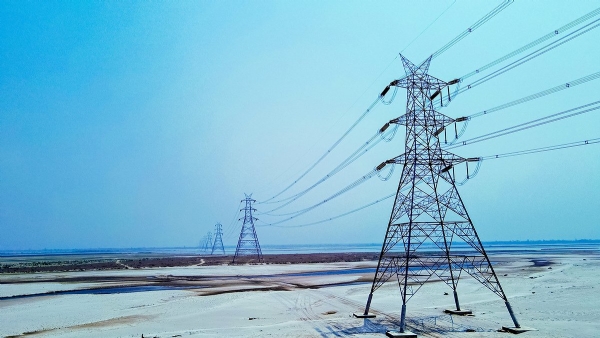
Kathmandu, 27 September (H.S.): Nepal’s electricity transmission and distribution systems have been disrupted in several parts of the country following floods and landslides triggered by continuous rainfall. Power supply has been interrupted in several areas due to faults in transmission lines caused by flooding, as well as damage to equipment at power generation plants and substations.
According to the Ministry of Energy, Water Resources and Irrigation, the power systems in the Pokhara, Butwal, Hetauda and Kathmandu areas have been significantly affected. Disruptions involving various transmission lines, power generation facilities and loads have cumulatively affected around 1,303 MW of capacity. However, this is not the figure for a simultaneous power outage; rather, it represents the combined total of line, generation and load disruptions recorded at different times and locations.
The Pokhara region has been the worst affected by the floods. A fault in the Kushma–New Butwal 220 kV transmission line affected around 200 MW of power. Similarly, problems in the Raughat–Dana Line-1 and Line-2 affected approximately 155 MW. Flooding has disrupted power generation and supply from several hydropower projects, including Kaligandaki, Upper Madi, Super Madi, Sikles–Namrjung, Seti River–Karuvaset, Upper Dordi and Modi. More than 400 MW of capacity has been affected across various projects in the Pokhara region alone.
In the Raughat area, a fault in the New Butwal–Kushma 220 kV line affected around 110 MW. The line was expected to be restored by 9:50 a.m. In the Butwal area, a fault occurred on the New Bharatpur–New Butwal 220 kV transmission line after a tree fell on it. According to the report, the line was charged at 9:51 a.m. Load shedding was carried out at the Kawasoti substation for about an hour after the Chapar–Pathlaiya 132 kV line was taken out of service.
The Hetauda region was also affected by flooding. Around 32 MW of power was affected at the Mandu 66 kV facility due to flooding. Power supply was disrupted at the Bharatpur substation under the Kawasoti–Bharatpur 132 kV line after a CVT was damaged by fire. In addition, around 20 MW was affected at the Simara substation, while power supply to industries in Amlekhgunj, Parwanipur and Birgunj was affected by around 80 MW. Another 25 MW of supply was affected at the Kamane substation and associated industries.
Power supply was also disrupted briefly in the Patan and Teku areas of Kathmandu. At the Patan substation, the disruption lasted from 9:00 a.m. to 9:10 a.m., with a similar interruption reported in Teku during the same period. The problem in the Patan area arose after the Pathlaiya line and the KL-1 Syuchatar 66 kV line became overloaded simultaneously. After regular supply was affected by the flooding, emergency supply from the MRS was used.
The major causes of the disruptions in Nepal’s power system include damage to transmission lines and power generation facilities caused by flooding, line faults, equipment failures at substations and the subsequent overloads. In particular, disruptions along the Pokhara–Butwal 220 kV transmission corridor and the 132 kV transmission network around Pathlaiya have had a significant impact on electricity supply across western and central Nepal.
---------------
Hindusthan Samachar / Jun Sarkar

18 Aug 2026