Kathmandu, 25 September (H.S.): Nepal Foreign Minister Shishir Khanal has said that amid Asia’s growing economic and strategic influence, Nepal must turn its geographical position from a challenge into an opportunity. He emphasised the need to develop Nepal as Asia’s economic, digital and strategic “bridge”.
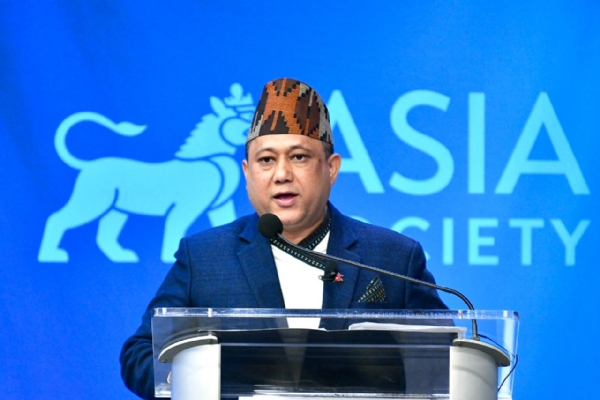
Addressing the “Steering Nepal’s Future in Asia’s Rising Century” programme organised by Asia Society in New York, Khanal said Nepal should not regard its geographical position as a limitation on its national aspirations.
Foreign Minister Khanal stressed the need to move beyond the traditional perception of Nepal as a “small country”. He said, “Nepal is not small. Nepal is strategically well placed. The size of our neighbours is a geographical reality, but it should never become a limit to our ambition.” Referring to comparisons between Nepal’s geography and population and those of other countries, he said Nepal should not be understood merely on the basis of its size.
Referring to the devastating floods that struck recently, Khanal described them as a “Himalayan tsunami”. He said Nepal has long faced natural disasters, challenging geography and structural difficulties. Khanal said the recent disaster had delivered a clear message that climate change must become a strategic priority of Nepal’s foreign policy. He called for prioritising effective early-warning systems, the exchange of water-related data, predictable grant-based climate finance and practical cooperation with neighbouring countries and the international community.
Describing Asia’s rise as a significant opportunity for Nepal, Khanal said nearly 60 per cent of the world’s population lives in Asia and that the continent also makes a substantial contribution to the global economy. He highlighted the potential to develop Kathmandu as an important centre of Asia’s economic and social transformation. He said, “Our question is no longer how Nepal will survive between two large neighbours. Our question is how Nepal will create value between them and beyond them.”
Referring to Lumbini, the birthplace of Gautama Buddha, and historical figures such as Araniko and Bhrikuti, Khanal said these legacies have established Nepal as an important point of contact for Asian civilisation and culture. He said, “Our ancestors understood one clear truth — connectivity creates prosperity, while isolation deepens poverty.”
The Foreign Minister also spoke about linking Nepal’s hydropower potential with regional economic transformation. He noted that clean electricity generated in Nepal is being exported to Bangladesh through India. He said production could be expanded in special economic zones along the border to connect global supply chains with Nepal. Stressing the need to advance cooperation with China on a practical, commercial and long-term basis, Khanal called for the development of multidimensional trans-Himalayan connectivity, including roads, tunnels, dry ports, air services, digital connectivity and cross-border rail links.
Khanal said Nepal’s future must ultimately be determined by the Nepali people themselves, but international partnerships are also important for achieving that objective. He invited the United States, Europe, ASEAN, Latin America and other partners to invest in Nepal and explore opportunities for cooperation and partnership.
---------------
Hindusthan Samachar / Jun Sarkar

18 Aug 2026