Guwahati, 25 September (HS): A former thermal power station site at Chandrapur, once associated with Assam’s conventional energy infrastructure, is set to acquire a new strategic role as India strengthens its ability to monitor the increasingly crowded space around Earth.
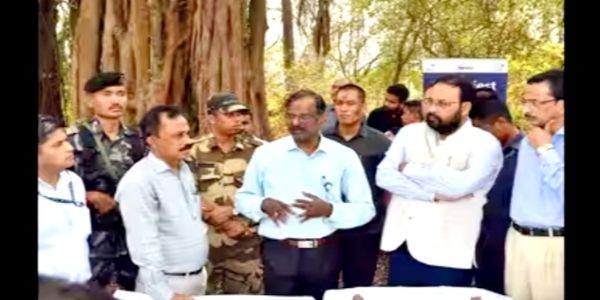
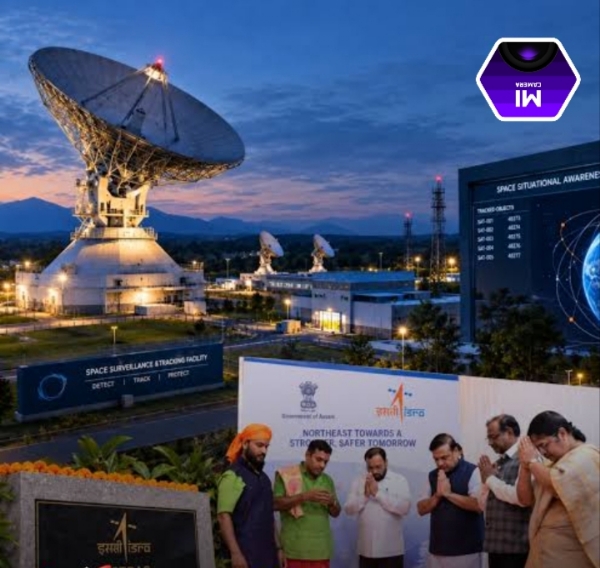
The Indian Space Research Organisation (ISRO) is establishing an Advanced Radar Research Facility at Chandrapur near Guwahati under its Telemetry, Tracking and Command Network (ISTRAC), with Chief Minister Himanta Biswa Sarma laying the foundation stone for the facility this week.
The project is part of Project NETRA (Network for Space Object Tracking and Analysis), India’s indigenous space situational awareness programme designed to detect, track and catalogue objects in space. Its importance extends beyond scientific research, as the ability to continuously monitor space objects is increasingly linked to the protection and uninterrupted operation of critical satellites.
The facility is coming up on about 67 acres of land at the former Chandrapur thermal power station site in Kamrup Metropolitan district. The Assam government has described the land parcel as approximately 200 bighas.
At the heart of the facility will be advanced radar capabilities capable of tracking space debris, satellites and near-Earth objects over distances running into thousands of kilometres. Such tracking is crucial as the number of satellites and other objects orbiting Earth continues to increase, creating greater requirements for precise monitoring and identification.
For India, the facility will strengthen the infrastructure needed to maintain a comprehensive picture of objects moving through near-Earth space. Tracking such objects can help identify potential threats to operational satellites and provide critical data for collision avoidance and other space-safety measures.
The project also has a direct national-security dimension. India’s growing dependence on satellites for communication, navigation, weather forecasting, disaster management, earth observation and strategic applications makes the protection of space assets an increasingly important requirement.
The Chandrapur facility is also expected to have applications beyond space-object tracking. ISRO officials have indicated that an initial cloud radar is planned for commissioning to track weather systems and rainfall, with additional tracking radars expected to be installed over the subsequent 18 months.
This would give the project a dual significance for Assam — strengthening the state’s high-end scientific infrastructure while adding advanced capabilities for weather and atmospheric observation.
The location is particularly significant for the Northeast, a region where weather systems, heavy rainfall and extreme weather events can have major implications for transport, agriculture, infrastructure and disaster management. Advanced radar-based observations could contribute to more precise monitoring of such systems.
The facility also places Assam within a growing national network of specialised space infrastructure. From the state’s emerging semiconductor and electronics ecosystem to advanced scientific and technological projects, the Chandrapur installation adds another high-technology dimension to Assam’s development.
What is emerging at Chandrapur, therefore, is more than another radar installation. A site once associated with generating electricity is being transformed into infrastructure designed to watch the skies — tracking objects thousands of kilometres away, supporting weather observation and contributing to the protection of India’s expanding presence in space.
As Project NETRA expands, the Chandrapur facility could become an important node in India’s long-term effort to make space operations safer, more predictable and more secure.------------
Hindusthan Samachar / Sriprakash