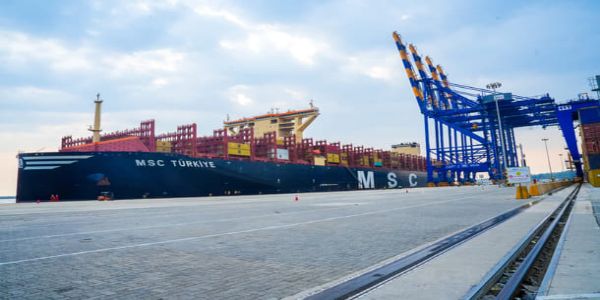
MUMBAI, 24 September (H.S.): A major piece of India's next-generation maritime infrastructure is taking shape on Maharashtra's Palghar coast, where the ₹76,220-crore Vadhavan Port is being developed as a deep-draft gateway designed to handle some of the world's largest container vessels and strengthen India's links with global shipping routes.
The project has entered an important construction phase, with the largest of its three major development packages moving through the tender process. The ₹22,323.47-crore package covers dredging, offshore reclamation and construction of an offshore protection bund. The latest government e-procurement schedule shows that bids closed on September 23 and were scheduled to be opened on September 24.
Building a Port at a New Scale
The Union Cabinet approved Vadhavan Port in June 2024 at an estimated cost of ₹76,220 crore, including land acquisition. The project is being implemented by Vadhavan Port Project Ltd, a special purpose vehicle of the Jawaharlal Nehru Port Authority and Maharashtra Maritime Board, with stakes of 74 per cent and 26 per cent respectively.
The planned port will have an overall cargo-handling capacity of 298 million tonnes per annum, including around 23.2 million TEUs of container-handling capacity. It is designed as an all-weather, deep-draft major port capable of handling large mainline vessels operating on international routes.
The container capacity is particularly significant. The port is planned to operate in two phases, with the first phase expected to provide 15 million TEUs of container capacity and targeted for operation by 2030.
Three Major Construction Components
The Vadhavan development is being advanced through three principal infrastructure packages.
The near-shore reclamation and associated infrastructure package, valued at around ₹1,648 crore, was awarded in December 2024. It provides the port-linked facility near the shore that will support activities connected with the offshore development.
The second major component is a 10.14-km offshore breakwater. The contract for this package has been awarded to Afcons Infrastructure for around ₹5,301 crore. The breakwater is intended to protect the harbour from wave action.
The third and largest component is the ₹22,323.47-crore offshore dredging, reclamation and protection-bund package. The work involves creating land offshore in two phases and is being implemented under a public-private partnership through the Hybrid Annuity Mode.
Recent industry reports said DP World and a Boskalis-NMDC Dredging & Marine joint venture had submitted bids for the offshore package. The procurement process is still at the bid-opening/evaluation stage, and the package should not be described as awarded.
Connectivity Being Built Around the Port
Vadhavan is not being developed as an isolated port terminal. Road and rail connectivity form a major part of the wider infrastructure plan.
The National Highways Authority of India has awarded a ₹2,360-crore contract for a 32.1-km, four-lane access-controlled expressway connecting the port to Tawa village on NH-48. The project includes an 800-metre twin-tube tunnel and can be expanded to eight lanes in the future.
The road link is intended to connect the port more efficiently with the wider highway network, including the Delhi-Mumbai Expressway and NH-48.
Rail connectivity is also part of the project. The plan includes a rail link to the existing network and the upcoming Dedicated Freight Corridor, providing another channel for moving cargo to and from the port.
Together, these links are intended to create a wider logistics network around Vadhavan rather than treating the port as a stand-alone maritime facility.
A Gateway for Global Trade
The strategic importance of Vadhavan comes partly from its location and planned ability to accommodate large vessels.
The project has been designed with a natural draft of around 20 metres, allowing it to handle mainline mega-vessels on international shipping routes. Its planned infrastructure includes container terminals, multipurpose berths, liquid cargo berths, a Ro-Ro berth and other cargo-handling facilities.
The government has also linked the port to India's participation in major international trade corridors, including the India-Middle East-Europe Economic Corridor and the International North-South Transportation Corridor.
That gives Vadhavan a role beyond Maharashtra's own cargo requirements. Its intended function is to provide additional capacity for India's expanding export-import trade while enabling larger vessels to call directly at an Indian deep-draft port.
From Port Infrastructure to a Wider Logistics Economy
The scale of Vadhavan also has implications for the wider logistics and industrial economy.
A large container gateway requires supporting infrastructure ranging from road and rail networks to storage, freight movement, cargo handling and other logistics services. The project is therefore being developed alongside connectivity infrastructure rather than waiting for the port to become operational before building those links.
The government has projected that the completed port will contribute to maritime infrastructure, trade competitiveness, logistics efficiency and industrial development in Maharashtra.
For India, the larger objective is to increase domestic capacity to handle growing cargo volumes while improving the country's position in international maritime trade.
From Approval to Construction
Vadhavan's significance today is less about the original announcement of a large port and more about the transition from project approval to physical infrastructure creation.
The near-shore works have already been awarded. The major breakwater contract has moved ahead. The road connection has been awarded. And the largest offshore package has reached the bid-opening stage.
The sequence matters because an offshore deep-draft port requires several pieces of infrastructure to progress together: reclaimed land, protection structures, connectivity and eventually the cargo terminals themselves.
India's Next Maritime Gateway
When completed, Vadhavan is planned to add 298 million tonnes of annual cargo capacity, including 23.2 million TEUs of container capacity, making it one of the largest additions to India's maritime infrastructure.
Its development represents a broader shift in India's port strategy - from expanding individual terminals to creating large-scale maritime gateways connected to highways, rail networks and international trade corridors.
For Maharashtra, Vadhavan adds another major maritime node to its already important western coastline. For India, its significance lies in the capacity to connect large-scale infrastructure investment with the country's growing role in global trade.
---------------
Hindusthan Samachar / Indrani Sarkar