New York, 24 September (H.S.): US Secretary of State Marco Rubio has said that any agreement with Iran would require Tehran to abandon its nuclear weapons ambitions. He said President Donald Trump was prepared to reach a peace agreement with Iran, but only on one condition: that Tehran give up its pursuit of nuclear weapons. If Iran does so, Rubio said, a deal could be reached that would enable the country to become “a great and prosperous nation.”
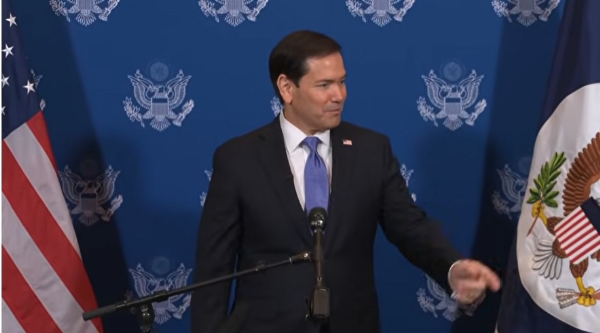
Rubio made the remarks on September 23 at a packed press conference at the Lotte New York Palace in New York, where he responded to questions on Iran as well as a range of other international issues. The US Department of State also shared the video of the question-and-answer session on its website.
As the press conference began, Rubio invited questions from reporters. The first question concerned Iran and the discussions held with Iranian representatives the previous day. A reporter asked what demands the United States had put forward and whether there had been any discussion about returning to an agreement or whether Washington’s conditions had changed.
Rubio said the previous day’s discussions had taken place with some of the intermediaries involved in the process.
“Look, the talks yesterday were with some of the intermediaries involved in the process. I don’t want to characterise them in any particular direction. I think the understanding is very clear. Remember, the central issue here—which the President emphasised to the world in his speech yesterday—is that Iran can never have a nuclear weapon. Everything revolves around that,” Rubio said.
He also addressed the Strait of Hormuz, saying the southern route through the strategic waterway remained open and that increasing quantities of oil were passing through it each day.
“We understand that the Strait of Hormuz is an issue. The southern route is open. More and more barrels of oil are passing through there every day. That route is open because of the efforts of the US military,” he said.
Rubio said US forces were also protecting vessels and had been clearing mines, adding that those efforts would continue. He said Washington remained committed to keeping the Strait of Hormuz open and alleged that Iran had continued attacking ships.
“The main issue is that Iran can never have a nuclear weapon. We make that point in every conversation,” Rubio said.
He declined to disclose details of the meetings, saying any agreement with Iran would not be negotiated at a press conference and would take time to conclude. Intermediaries, he added, would also play a role in the process.
“The President has said he is willing to make a deal that would allow Iran to become a great and prosperous country. If Iran remains determined to pursue nuclear weapons, that will not be good for Iran,” Rubio said.
Rubio also described Iran as the world’s leading state sponsor of terrorism and said President Trump had several options available, including a military option. He declined to speculate on what course of action the administration might ultimately take.
On Cuba, Rubio said the country would become free and that it had an opportunity to pursue political and economic change. Responding to several follow-up questions, he said the Cuban revolution had failed and that the question now was what would happen next.
“I think Cuba has an opportunity to change. That includes both political and economic freedom. We are prepared to take further steps that could begin that process of change,” Rubio said.
He cautioned that the process would not be easy or immediate, pointing to Cuba’s decades-long political and economic problems.
“We have seen these kinds of changes throughout history and around the world. They do not happen overnight. No one can fix more than 60 years of mismanagement, corruption and incompetence in six months,” he said.
Asked whether something similar to the situation in Venezuela could occur in Cuba, Rubio said the United States would put its national security interests first.
“If there is a threat to the national security of the United States from Cuba, the President has both the authority and the responsibility to deal with it,” he said, while declining to speculate further.
Rubio said Cuba, its leaders and those currently running the government had an opportunity to begin a process of lasting and positive change. He also said there were individuals within the Cuban government with whom Washington could not work because, in his words, “their hands are stained with blood.”
A reporter then asked about Trump’s earlier statement that he believed the United States could reach an agreement with Iran after the midterm elections. The reporter asked what signals Washington had received from Tehran suggesting that such an agreement might be possible.
Rubio said he believed Iranian officials had misunderstood the US political system and might be under the impression that Democrats would win in November and that Trump would subsequently be unable to take action against Iran.
“I think the Iranians have a misunderstanding that Democrats will win in November and that the President won’t be able to take action against them. When it comes to national security, sanctions or the use of military force, the President has extraordinary powers,” Rubio said.
He added that Trump had made clear that he did not regard the Iran issue as a political matter.
“I think the President made it clear yesterday that, for him, the Iran issue is not a political issue. Every American president and, frankly, most countries around the world agree that Iran should never have a nuclear weapon,” Rubio said.
Asked about French President Emmanuel Macron’s remarks concerning the return of “the law of the jungle”, Rubio initially responded in a light-hearted manner.
“Are you having to hold your own microphone? Oh, man, we’re going to have to get that fixed,” he said.
Rubio then addressed the broader issue of the United Nations, saying he had not heard Macron’s speech but agreeing that the world body had significant potential that it was not fully living up to.
“I think a lot of leaders share that view. Some people are saying that the United Nations has moved away from its original purpose. Yes, it needs to return to its proper role,” Rubio said.
He cited several international crises where, he said, the United Nations could play a role, including the fighting between Thailand and Cambodia, the possibility of a confrontation between India and Pakistan, developments involving the Democratic Republic of the Congo and Rwanda, the situation in Sudan and the tensions surrounding the Strait of Hormuz and Iran.
The issue of Iran remained a dominant theme throughout the press conference. Rubio said he believed there was broad agreement that the Strait of Hormuz should remain open, that there should be peace in the area and that attacks should cease.
He also said there was broad agreement that the activities of the Houthis and the situation in Yemen represented a major problem. He noted that measures against them included economic sanctions as well as aviation-related restrictions.
Rubio also fielded questions about Serbia’s changing role and the war between Russia and Ukraine. On the conflict, he said the United States wanted the war to end and stressed that it would ultimately have to be resolved through dialogue and an agreement rather than solely on the battlefield.
“We all want this war to end. One thing I would say about Russia and Ukraine is that the war is not going to end on the battlefield. The war will end through dialogue and through a deal. President Trump wants that as well,” Rubio said.
---------------
Hindusthan Samachar / Jun Sarkar

18 Aug 2026