- He Gave Up His Dream of Becoming a Doctor: Sagar’s Aakash Chaurasia Turns Farming into a Model of Innovation
Bhopal, 24 September (H.S.): At a time when shrinking farmland, water scarcity, declining soil health and rising input costs are emerging as major challenges for agriculture, a young farmer from Sagar has attempted to find solutions within the crisis itself. An idea inspired by multi-storey buildings in cities made its way into the fields, leading to experiments in growing crops at several levels on the same piece of land. The results have been striking, with as many as 40 to 45 different crops being grown together in a single field.
In fact, Aakash Chaurasia’s “Multilayer Agriculture Technique” from Sagar has now become a subject of discussion among farmers. According to him, this method has the potential to reduce water consumption by 70 to 80 per cent. Aakash’s journey reflects an approach aimed at transforming farmers into self-reliant agricultural entrepreneurs who make the maximum possible use of their land, water, seeds and other resources.
From Hospitals to Fields: A Change in the Direction of Life
Coming from a family involved in betel cultivation, Aakash had wanted to become a doctor during his childhood. While engaging with the medical field, he observed the growing number of illnesses and patients in hospitals, which prompted him to ask why attention should not be given to the causes of disease alongside its treatment. His understanding of the relationship between food and health changed the direction of his thinking, and in 2009 he chose the path of farming.
A saying he heard in Bundelkhand- “As is the food you eat, so is the mind; as is the mind, so is the body”, became the guiding principle of his agricultural journey. He made chemical-free food and natural farming the foundation of his experiments.
An Idea Inspired by Multi-Storey Buildings
After seeing multi-storey buildings in cities, Aakash asked himself: if several floors can be used to make greater use of limited space, why cannot different heights and levels of farmland be utilised in the same way?
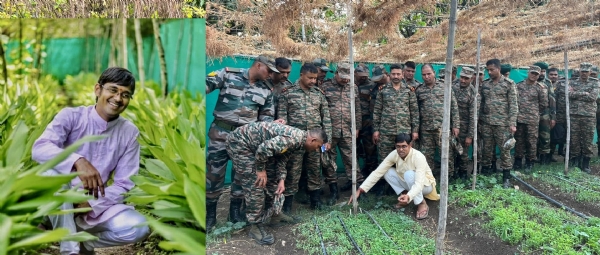
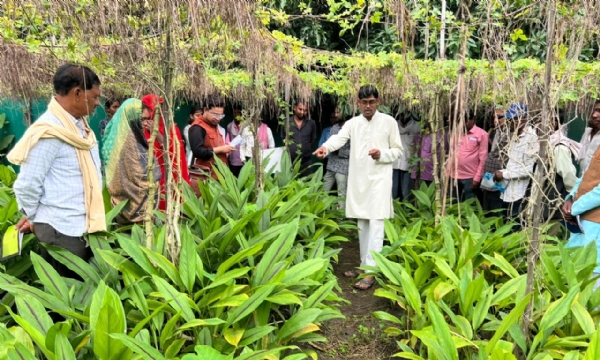
This was where the idea of multilayer farming was born. After four to five years of experimentation, he developed the model in 2014. Today, according to him, as many as 40 to 45 types of crops, including coriander, spinach, fenugreek, beetroot, onions, garlic, papaya, carrots, radishes and drumsticks, are being grown on the same farm.
The system attempts to utilise every part of the field and the available resources at different levels. The objective is to reduce dependence on a single crop and obtain a diverse range of agricultural produce from the same piece of land.
From Saving Water to Conserving Seeds
Alongside this, Aakash is currently working in six technical areas, including water recharge, soil conservation, natural fertiliser production and the conservation of indigenous seeds. He says that he has preserved 105 varieties of indigenous seeds and has supplied indigenous seeds to more than 250,000 farmers.
Claims have also been made of improvements of 15 to 20 per cent in crop production, 15 per cent in milk production and 25 per cent in earthworm efficiency. Soil health is another major area of focus. He says that the use of around 10 tonnes of cow-dung compost per acre can help increase carbon levels in the soil. Where sufficient manure is not available, he suggests crops such as black gram and green gram as useful alternatives.
A Centre of Knowledge Alongside the Farm
In Sagar, he has also established the Bharatiya Krishi Darshan Kisan Library, which is said to have a collection of more than 5,000 books. Connecting farming with study and training alongside practical experimentation forms an important part of his efforts.
According to the available material, more than 780 practical training sessions on natural farming and agricultural practices have been conducted, with successful efforts to bring around 90,000 acres of land under natural farming. Inspired by his work, 10,500 people have taken up cow rearing. So far, he has delivered lectures on cow-based farming at 25 universities.
A 25-Acre Farm and Business Worth Millions
In Sagar, Aakash practises natural farming across approximately 25 acres spread over three agricultural farms. According to him, his normal annual turnover remains between Rs 4 million and Rs 5 million. Creating opportunities for income through diverse production and different crops on limited land is among the key features of this model. The farm in Sagar is now also functioning as a training centre.
Ramesh Gaira, an electrical engineer from Noida, travelled to Sagar to learn multilayer farming after gaining extensive experience in the corporate sector. Young talents such as Pranati Jain are looking at agriculture as a means of linking environmental conservation with food security.
Opportunities for Young People and Women
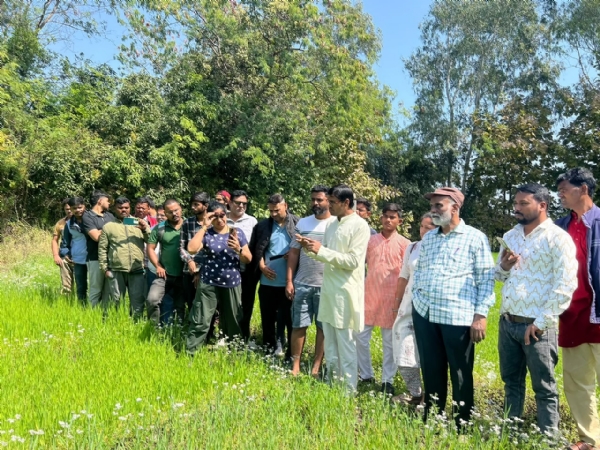
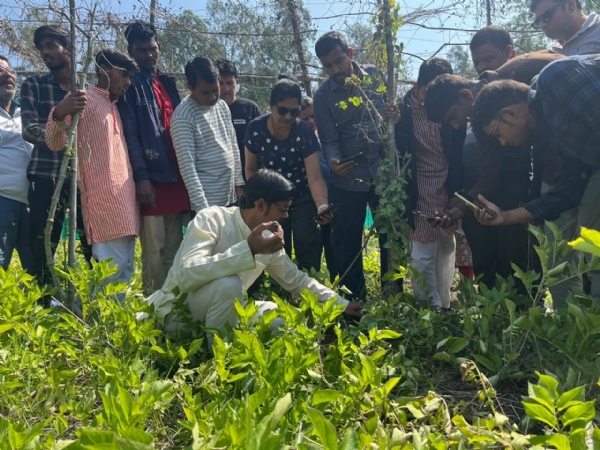
The participation of young people and women is also visible in multilayer farming training programmes. Pranati Jain said that her interest in organic farming had developed from her school days. According to her, new experiments in agriculture are necessary for environmental conservation and food security. She wants to learn multilayer farming and do something new in agriculture, which is why she travelled to Sagar for training.
Satakumari Jaiswal from Singrauli is also working in the field of organic farming. She believes that training camps are providing a new foundation for agricultural experimentation and helping connect the long-standing role of women in agriculture with modern agricultural innovations.
Nikhil, who has also come from Singrauli, draws attention to another major challenge faced by farmers. According to him, farmers are concerned not only about production but also about receiving a fair price for their produce. He sees multilayer farming as a potential option in agriculture. He shared his own experience of spending around Rs 200,000 on an experiment on one acre and earning profits of up to Rs 900,000 to Rs 1 million from different crops.
Rajeev, who travelled from Vidisha for training, said that watching Aakash practise farming increased his own interest in agriculture. During the training, he learnt about the possibilities of achieving reasonable profits at low cost and about using wooden structures for multilayer farming.
According to him, once the structure has been prepared, it can be used for three to five years. Rajeev believes that the participation of young people is important for the development of agriculture. In his view, just as young people are bringing innovation to other sectors, greater participation by young people in agriculture could also bring new technologies and experiments to farming.
Recognition and an Expanding Field of Experimentation
The available material mentions several honours received by Aakash for his agricultural work. These include the title of ‘Yuva Gram Mitra’ from Prime Minister Narendra Modi, the description of him as ‘Krishi Ratna’ by former Vice-President M. Venkaiah Naidu, the ‘Krishi Gaurav’ honour from Swami Ramdev, the ‘Yuva Samriddhi’ honour from Anand Mahindra, and recognition from Naveen Jindal.
He has also received the Organic India Award as well as honours from JCI India and JCI Japan. For now, the experiment emerging from the fields of Sagar leaves farmers with an important question: when land is limited, does the solution lie in increasing the amount of land, or in finding new ways to maximise the potential of the land already available? Aakash has attempted to answer this question through experimentation. Farmers from different parts of the country are now travelling to Sagar to see the experiment with their own eyes and explore its possibilities for their own fields.
---------------
Hindusthan Samachar / Mayank Chaturvedi