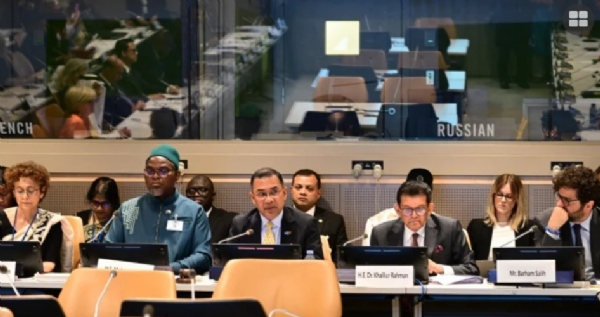
New York, 24 September (H.S.): Bangladesh Prime Minister Tarique Rahman on Wednesday drew global attention to the country’s protracted Rohingya crisis at a high-level event held at the United Nations Headquarters in New York. Speaking at the side event titled “The Rohingya Crisis: A Renewed Call for a Durable Solution from Protracted Displacement, with Justice and Accountability,” held on the sidelines of the United Nations General Assembly, he put forward a five-point proposal and called for a clear and credible roadmap for the safe, voluntary, dignified and sustainable repatriation of Rohingyas to Myanmar.
According to The Dhaka Tribune, Tarique Rahman said the time had come to move beyond managing displacement and work towards ending it. “The time has come to move from empathy to a search for root causes and their solutions, from promises to action and from managing displacement to ending it,” he said.
The Prime Minister made the proposal while highlighting the plight of more than 1.2 million Rohingyas currently sheltered in Bangladesh. He urged the international community to shoulder its responsibility with conviction and help create the necessary conditions for their safe and dignified return to their homeland.
“Bangladesh does not want the Rohingyas to remain displaced forever. We want them to return to their homes in Myanmar safely, voluntarily and with dignity, with their rights protected,” Tarique Rahman said. He added that Bangladesh had fulfilled its humanitarian responsibility and would continue to facilitate their return if the necessary conditions were created.
The event was jointly convened by Bangladesh and The Gambia, with the European Union and other partners supporting the initiative. Representatives of several countries and international organisations participated in the high-level meeting. The event sought to maintain international attention on the Rohingya crisis, address its root causes and strengthen international pressure on Myanmar to facilitate the return of the displaced Rohingyas.
Tarique Rahman called for an end to violence against civilians, including Rohingyas, in Myanmar. He stressed that the fundamental rights and security of Rohingyas must be guaranteed in their homeland to rebuild the confidence necessary for their eventual return.
He also emphasised the importance of justice and accountability in ensuring sustainable repatriation and praised The Gambia’s role in pursuing accountability before the International Court of Justice in connection with the Rohingya crisis.
“The crisis originated in Myanmar. Its solution lies in Myanmar,” Tarique Rahman said, pointing to the continuing instability in Rakhine State. He said Rohingyas there continued to face serious violations and abuses. He further alleged that both the Myanmar military and the Arakan Army had committed serious violations, making conditions for a safe and dignified return increasingly difficult.
The Prime Minister said Bangladesh had been hosting Rohingyas for more than nine years and continued to provide food, healthcare and education through nearly 6,000 learning centres based on Myanmar’s curriculum. Bangladesh is also providing Rohingya youths with capacity-building and skills-development training.
“Humanitarian generosity cannot become an excuse for political inaction. Nor can Bangladesh be expected to shoulder this responsibility indefinitely,” Rahman said. He warned that prolonged displacement was creating new security challenges, including human trafficking, migrant smuggling, drug trafficking and other forms of transnational crime.
“A crisis left unresolved in one country can become a security challenge for the entire region,” he said.
Rahman’s five-point proposal included establishing a clear and credible roadmap for early, safe, voluntary, dignified and sustainable repatriation; ending violence against civilians and guaranteeing fundamental rights and security; ensuring adequate and predictable humanitarian assistance; strengthening justice and accountability; and enhancing regional and international cooperation against trafficking, illegal arms, digital scams, the narco-economy and other transnational crimes.
---------------
Hindusthan Samachar / Jun Sarkar

18 Aug 2026