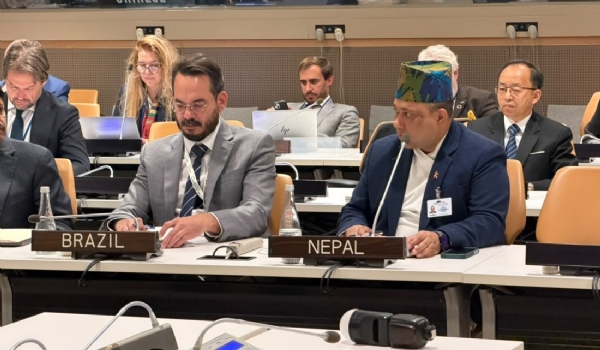
Kathmandu, 24 September (H.S.): Nepal’s Foreign Minister Shishir Khanal has stressed the need for long-term international support for the rehabilitation and reconstruction of the country in the wake of climate-induced disasters.
Addressing the G7 Development Ministers’ Meeting held on the sidelines of the 81st session of the United Nations General Assembly, Khanal highlighted the situation following the recent climate-induced disaster in Nepal and called for sustained international cooperation. He urged the G7 to strengthen its support and partnership in the rehabilitation of affected communities, climate finance, disaster preparedness, multilateral financial cooperation and issues concerning the Himalayan region.
Representing Nepal, Khanal expressed gratitude, on behalf of the government and people of Nepal, to the G7 member states and other friendly countries for their solidarity and support during the country’s difficult circumstances following the climate disaster.
“Nepal highly appreciates the G7’s leadership in advancing international cooperation in the areas of climate change, sustainable development, resilience and disaster risk reduction,” he said. He also thanked France, which currently holds the G7 presidency, for hosting the meeting.
More Than $5 Billion Needed for Reconstruction
Foreign Minister Khanal said the recent climate-induced disaster had caused extensive human and physical damage across Nepal. Flooding damaged homes, roads, bridges, schools, health facilities and hydropower infrastructure, disrupting livelihoods as well as essential services.
He said preliminary assessments indicated that more than $5 billion would be required for rehabilitation and reconstruction.
Khanal said scientific studies into the disaster were still under way. According to preliminary findings, the disaster may have been triggered by complex interactions among snow, rock, water and unstable geological formations in a rapidly warming Himalayan environment. He said a detailed assessment was ongoing.
The government has constituted an expert committee to study the geological, glacial and hydrological factors associated with the disaster, along with the impacts of climate change.
‘Climate Change Is No Longer a Distant Threat’
“Climate change is no longer a distant threat for Nepal. It is our present reality, and both the intensity and frequency of its impacts are increasing,” Khanal said.
He noted that climate change was not only causing loss of life, property and livelihoods but was also undermining development gains achieved through years of sustained effort. He said the Himalayas, rivers, communities and critical infrastructure were facing growing risks from floods, landslides, glacial hazards and other climate-induced disasters.
Khanal pointed out that Nepal’s contribution to global greenhouse gas emissions is extremely small, yet the country continues to bear disproportionate impacts of climate change.
“Nepal’s contribution to global emissions is extremely small. Yet we are disproportionately bearing the impacts of climate-induced disasters, from devastating floods and landslides to the melting of glaciers,” he said, calling on the international community to provide greater support to Nepal.
Nepal Outlines Five Key Priorities
Presenting five key priorities for rehabilitation and reconstruction, Khanal first stressed the need for partnerships to support long-term recovery.
Expressing gratitude for the assistance and goodwill extended by friendly countries during the humanitarian response, he said coordinated international efforts, including grants and concessional financing, were essential for long-term rehabilitation and reconstruction.
As the second priority, he called for easier and more accessible access to climate finance. Financial support for adaptation as well as for addressing climate-related loss and damage, he said, should reach developing and climate-vulnerable countries through faster, simpler and more accessible mechanisms.
Khanal said Nepal had already requested financial arrangements under the Loss and Damage Fund and was awaiting a positive response.
Call for Greater Investment in Early Warning Systems
Khanal also called for increased investment in disaster prevention and preparedness. He urged the international community to prioritise early warning systems, climate information, water and weather services, climate-resilient infrastructure and community-based disaster preparedness programmes.
He appealed to the G7 and other partner countries to increase investment in these areas to address the growing severity of climate-induced disasters. He also stressed the need for multilateral financial institutions to make financial resources available rapidly, at lower costs and through more accessible mechanisms.
“Timely access to financial resources is not merely a financial instrument; it is a lifeline for vulnerable countries repeatedly exposed to climate-induced shocks,” Khanal said.
He urged G7 member states to use their influence and coordinating capacity, in cooperation with multilateral development banks and international financial institutions, to mobilise the financial resources required by vulnerable countries.
Call for the Himalayas to Be Prioritised on the Global Climate Agenda
Khanal emphasised the need to give greater priority to the Himalayan region on the global climate agenda. He said the future of glaciers, the Himalayas and water systems was directly linked to regional and global climate security.
“Changes taking place in the Himalayas do not remain confined to the Himalayas. They affect South Asia and beyond through monsoon systems, riverine areas, agricultural systems and the lives of millions of people,” he said.
Khanal expressed Nepal’s readiness to work with the G7 to protect Himalayan ecosystems and strengthen shared climate resilience.
Bhotekoshi Disaster Carries a Serious Global Message
Foreign Minister Khanal urged the international community not to view the Bhotekoshi disaster merely as a tragedy confined to Nepal. He described it as a serious message from the Himalayas to the world.
He stressed the need to transform international solidarity into concrete action, risk into resilience, and shared responsibility into climate justice.
“Nepal stands ready to work with the G7 and all international partners to build a safer, more resilient and sustainable world,” Khanal said.
---------------
Hindusthan Samachar / Jun Sarkar

18 Aug 2026