China and Iran have steadily transformed their long-standing diplomatic relationship into a pragmatic strategic partnership driven by energy security, economic interests, geopolitical calculations and a shared opposition to unilateral US pressure. They are not formal allies, nor does their relationship amount to a mutual-defence pact. Yet cooperation in energy, infrastructure, diplomacy, trade, technology and limited defence-related areas has given the partnership increasing strategic significance, particularly for India.
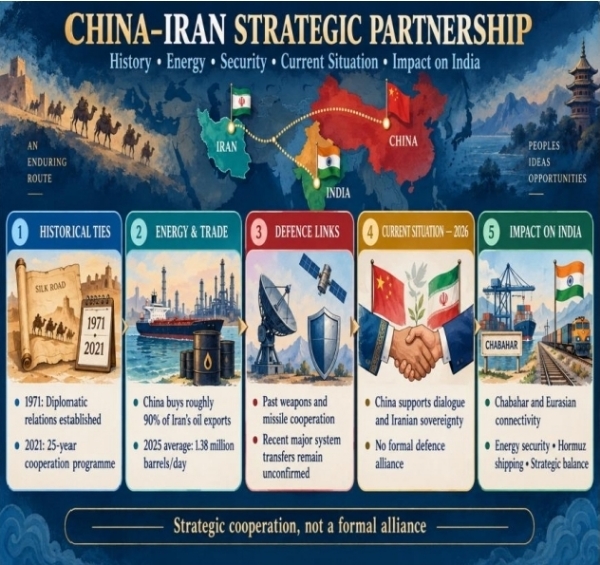
Formal diplomatic relations between China and Iran were established on 16 August 1971. Ties expanded considerably after Iran’s Islamic Revolution in 1979 and acquired greater strategic depth as both countries sought to navigate an international environment dominated by US influence and sanctions. The relationship reached a new level in January 2016, when Beijing and Tehran established a comprehensive strategic partnership.
The US withdrawal from the Iran nuclear agreement in May 2018 further strengthened the basis for Chinese-Iranian cooperation. While Washington reimposed sanctions on Tehran, China opposed unilateral sanctions and continued purchasing Iranian oil. On 27 March 2021, the two countries signed a 25-year cooperation programme covering energy, infrastructure, transportation, telecommunications and industry. The frequently cited figure of $400 billion should not, however, be treated as an officially guaranteed Chinese investment commitment. The agreement is better understood as a broad, long-term framework for economic cooperation.
Energy remains the foundation of the relationship. China is the world's largest crude-oil importer, while Iran possesses approximately 12 percent of the world's proved oil reserves, according to the US Energy Information Administration. US sanctions have sharply restricted Iran's access to conventional international markets, making China its principal petroleum customer.
The scale of this dependence is substantial. The US–China Economic and Security Review Commission estimated in March 2026 that Chinese purchases accounted for roughly 90 percent of Iran's oil exports. Kpler data cited by Reuters put China's average Iranian oil purchases in 2025 at approximately 1.38 million barrels per day.
Independent Chinese refiners, particularly smaller “teapot” refineries, have played an important role in purchasing discounted Iranian crude. Tehran has also relied on tankers, intermediary companies, ship-to-ship transfers and changes in documentation to obscure the origin of cargoes. Payments can be routed through yuan-based accounts and other non-dollar channels. The United States has repeatedly imposed sanctions on Chinese refineries, brokers, shipping companies and vessels accused of facilitating these transactions.
Defence cooperation presents a more complicated picture. China supplied Iran with conventional weapons and missile-related technology in earlier decades, but publicly verifiable evidence of major recent Chinese weapons deliveries remains limited. Chinese companies and individuals have faced US sanctions over alleged transfers of dual-use components and chemicals linked to Iran's missile programme.
Reports in 2025 and 2026 suggested that Iran had sought Chinese HQ-9 air-defence systems, YLC-series radars and J-10C fighter aircraft. Beijing has denied some reported transfers, and there is no reliable public evidence confirming that these major systems have entered Iranian military service. Such reports should therefore be viewed as indications of possible negotiations or Iranian interest rather than evidence of completed acquisitions.
Satellite navigation represents another potential area of cooperation. Iran has expressed interest in reducing its dependence on the US-controlled GPS system by using China's BeiDou satellite-navigation network. However, available public evidence does not establish that Iran has received encrypted Chinese military services or real-time targeting assistance through BeiDou.
Institutional cooperation, by contrast, is more clearly established. Iran became a full member of the Shanghai Cooperation Organisation in July 2023 and joined BRICS in January 2024. China, Iran and Russia have also conducted the Maritime Security Belt naval exercises since 2019, primarily in waters around the Gulf of Oman. These exercises demonstrate diplomatic solidarity and a degree of maritime coordination, but they do not create a mutual-defence obligation.
China's position becomes particularly significant during periods of heightened tension between Iran and the United States. Beijing has criticised sanctions, emphasised Iranian sovereignty and repeatedly called for negotiations and regional de-escalation. At the same time, Reuters has reported that China did not openly provide military assistance during periods of renewed military confrontation.
This reflects the fundamental pragmatism of Beijing's approach. China has a strong interest in keeping Iran politically stable, economically functional and commercially connected, but it has little incentive to enter a direct military confrontation with the United States on Tehran's behalf. Beijing must also protect its expanding relationships with Saudi Arabia, the United Arab Emirates and other Gulf states, all of which are important to China's energy security and broader economic interests.
For India, the implications are particularly significant.
Iran occupies an important position in India's connectivity strategy towards Afghanistan, Central Asia and the wider Eurasian region. The Chabahar Port is central to this strategy, providing India with an alternative route that bypasses Pakistan. In May 2024, India Ports Global Limited signed a 10-year contract to operate the Shahid Beheshti terminal at Chabahar.
A growing Chinese role in Iranian infrastructure, ports, telecommunications and digital networks could nevertheless reduce India's strategic space. The issue becomes more consequential when viewed alongside China's close relationship with Pakistan and its investments in Pakistan's Gwadar Port. The emerging strategic geography of Chabahar and Gwadar therefore has implications extending beyond commercial port operations to the broader balance of influence across the Arabian Sea and Eurasia.
Yet Iran is unlikely to simply replace India with China. Tehran has traditionally sought to maintain relationships with multiple external powers rather than become completely dependent on any single partner. India, meanwhile, retains historical, commercial and connectivity interests in Iran that cannot easily be displaced.
For New Delhi, however, maintaining this relationship requires careful balancing. India's ties with the United States, Israel and the Gulf Arab states are also strategically important. At the same time, instability around the Strait of Hormuz presents a direct economic risk. Disruptions in one of the world's most important energy corridors can raise oil prices, freight charges and insurance costs for India, which imports more than four-fifths of the crude oil it consumes.
The larger picture is therefore one of strategic convergence without a formal alliance. Iran obtains a crucial market for its oil, diplomatic backing and access to selected Chinese goods and technologies. China gains discounted energy supplies, greater influence in West Asia and a partner that shares its opposition to unilateral US pressure. But Beijing has so far shown little willingness to provide Iran with a binding security guarantee.
China–Iran relations are consequently best understood as asymmetric strategic cooperation rather than a formal alliance. The partnership is likely to remain important because it serves clear interests on both sides, but its limits are equally important. China's economic stakes in the Gulf and its broader relationship with the United States constrain how far Beijing is likely to go in defending Tehran.
For India, the challenge is not to view China–Iran cooperation solely through the prism of strategic competition, but to preserve its own room for manoeuvre. Sustaining the relevance of Chabahar, maintaining access to Iran and Central Asia, protecting maritime trade routes and strengthening connectivity with Eurasia will remain important components of India's regional strategy.
The evolution of China–Iran ties thus carries a clear message for New Delhi: the strategic landscape around the Arabian Sea is becoming increasingly interconnected. China's expanding presence in Iran, its partnership with Pakistan and its wider economic interests in the Gulf are creating a more complex regional environment. India's response will depend on its ability to protect its connectivity interests while maintaining productive relationships with Iran and its other major regional and global partners.
Hindusthan Samachar / Satya Prakash Singh