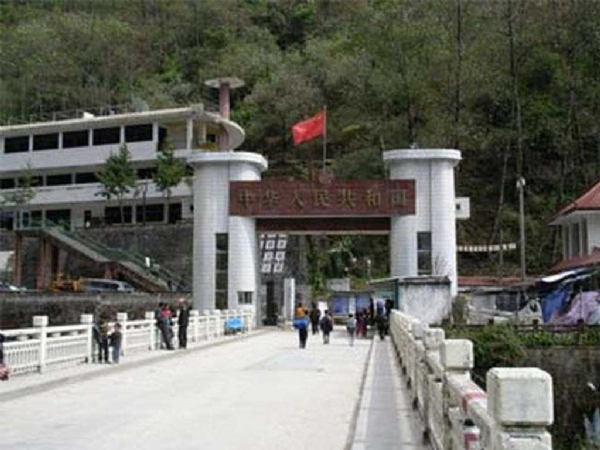
Kathmandu, 16 September (H.S.): As flooding continues to disrupt the Rasuwagadhi–Kerung border crossing, one of the major trade routes between Nepal and China, another important border point, Tatopani, has also been closed. Nepal has not been informed when the Chinese side will reopen the crossing.
Soon after the Rasuwagadhi–Kerung border point was closed, China sent a letter to Nepal informing it that the Tatopani crossing would also be temporarily closed. However, the Chinese side has not clarified the reason for the closure.
Laxmi Prasad Niraula, Nepal’s Consul General in Lhasa, said he had not been informed of either the reason for the closure of the Tatopani crossing or the date on which it would reopen. He said Nepal had requested China to facilitate the return of Nepali tourists and cargo containers stranded in Kerung through the Tatopani and Korala border points after the Rasuwagadhi crossing was closed. Tourists were permitted to return through Tatopani, but permission was not granted for cargo containers.
According to Niraula, if both the Tatopani and Korala crossings could be used while the Rasuwagadhi crossing remains closed, it would significantly facilitate Nepal-China trade. A formal request has been submitted to China in this regard, but no response has yet been received concerning the reopening of Tatopani.
China sent a letter on August 31 informing Nepal that the Tatopani crossing would be temporarily closed. Meanwhile, on September 4, China Daily reported that China was planning to modify border inspection and customs arrangements at Zhangmu, a major land-based trade crossing with Nepal.
According to the local government, the border inspection system is being modified to strengthen security arrangements in the high-altitude region and ensure the safety of travellers and their belongings. The Zhangmu crossing is located in Nyalam County of the Xizang Autonomous Region, under Shigatse.
Under the new arrangements, travellers crossing the Nepal-China border will be permitted to move only along designated routes. They will not be allowed to leave the designated areas, and restrictions will also apply to getting on or off vehicles at will or interacting with people other than those at designated locations along the route.
Vehicles will not be permitted to stop on controlled road sections without authorisation, pick up or drop off passengers, or load or unload goods. People and vehicles unrelated to the border area will also not be allowed to enter the designated zone.
Deependra Prakash Giri, chief of the Tatopani Customs Office, said cargo containers had not undergone customs clearance through the Tatopani crossing since September 8. Passenger vehicles, however, continue to be allowed to travel through the crossing. He also said the exact reason for the closure had not been clearly communicated.
Following the disruption of the Rasuwagadhi crossing and the closure of Tatopani, the Korala border point in Mustang is currently being used for Nepal-China overland trade.
However, Korala is considerably farther from Kathmandu than both Rasuwagadhi and Tatopani. The distance between Korala and Kathmandu is approximately 481 kilometres, while Kathmandu is around 124 kilometres from Tatopani and approximately 160 kilometres from Rasuwagadhi. In addition, the distance between Korala and Kerung is approximately 600 kilometres.
Bhakta Parajuli, secretary of the Nepal Himal Trans-Himalayan Commerce Association, said Tatopani was more convenient for trade with China than Korala because of several factors, including distance, cost, time and infrastructure.
He said it takes around a day just to travel from Kerung to Korala. Due to inadequate infrastructure and manpower, customs procedures cannot be completed within a single day. After that, road conditions and vehicle-related constraints mean it takes approximately another three days for goods to reach Kathmandu, increasing transportation costs.
Transporting goods to Kathmandu through the Korala crossing can take around a week, whereas when Tatopani is operational, goods can travel from Khasa in China to Kathmandu in approximately one day.
China has constructed a modern customs office on its side of the Korala crossing, but the necessary infrastructure on the Nepal side is not yet fully developed. Nepal’s customs office is located at Nechung, approximately 10–12 kilometres from the Korala crossing. At present, customs officials complete the day’s procedures in a temporary facility and return to Nechung in the evening.
---------------
Hindusthan Samachar / Jun Sarkar

18 Aug 2026