Dhaka, 16 September (H.S.):
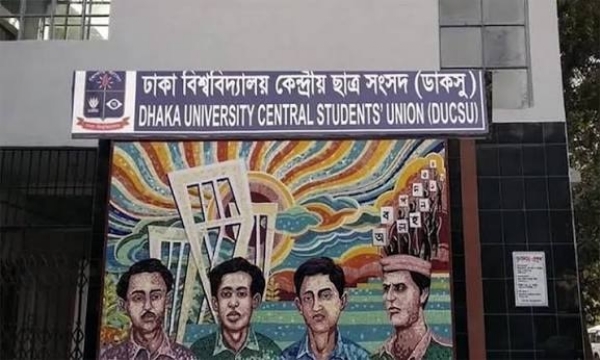
A controversy has intensified over the display of portraits of Pakistan’s founder Muhammad Ali Jinnah at the renovated museum/archive of the Dhaka University Central Students’ Union (DUCSU). Student organisations protested against the display. During the demonstration, one of Jinnah’s portraits and a newspaper clipping related to him were torn down and destroyed. Subsequently, activists of the Bangladesh Students’ Federation placed at the same location a photograph showing former Jamaat-e-Islami ameer Ghulam Azam being beaten in 1981.
DUCSU reopened the museum on Sunday following renovation. Three new items related to Jinnah had been added to the exhibition. These included a photograph of Jinnah delivering his speech at the Racecourse Ground in Dhaka on March 21, 1948, a photograph from the 1940 Lahore session, and a clipping from the newspaper Dawn relating to the 1970 elections. In his 1948 speech, Jinnah declared that Urdu would be the sole state language of Pakistan.
The museum did not feature a separate or prominent portrait of Bangabandhu Sheikh Mujibur Rahman. However, a photograph relating to the weddings of his sons in 1974 and three newspaper clippings published about Sheikh Mujib were included in the exhibition.
On Monday, Dhaka University Urdu Department student Mohammad Abu Tayyab, also known as Habilder, arrived at the museum and removed one of Jinnah’s portraits from its frame and destroyed it. He questioned whether the DUCSU manifesto called for portraying Jinnah as a hero and referred to the history of the Language Movement and the 1971 Liberation War.
Activists from the Dhaka University unit of the Bangladesh Students’ Federation placed a photograph showing Ghulam Azam being beaten outside Baitul Mukarram in 1981 at the location where Jinnah’s portrait had been displayed.
Arko Barua, organising secretary of the federation, said that DUCSU was not the personal property of any individual and that history should not be presented in a one-sided manner. He said that just as Fatima Tasnim Zuma, DUCSU’s secretary for Liberation War and Democratic Movement Affairs, had placed Jinnah’s portrait according to her own wishes, they had placed a photograph of Ghulam Azam in the same manner.
Fatima Tasnim Zuma, secretary for Liberation War and Democratic Movement Affairs at DUCSU, said the portraits of Jinnah had not been displayed to honour him. According to her, the photographs were presented with informative captions to help explain the history of Dhaka University from 1905 to 1971.
DUCSU General Secretary S.M. Farhad also supported this argument, saying that the inclusion of Jinnah’s 1948 speech was intended to illustrate his position against Bangladesh, rather than glorify him. He argued that concealing any part of history would not help people understand it.
The Bangladesh Jatiyatabadi Chhatra Dal (JCD) also opposed the display of Jinnah’s portrait. The organisation alleged that such a display was inconsistent with the history of the Language Movement and the Liberation War. It demanded that the portrait be removed and that DUCSU not be turned into a platform for promoting any particular political ideology.
A faction of the Bangladesh Students’ Union also objected to the display of Jinnah’s portraits and demanded that Sheikh Mujibur Rahman’s portrait be displayed again. The organisation said that removing the portrait of a prominent leader of the Liberation War affected the presentation of history.
Amid the controversy, the Dhaka University administration said that several recent activities by DUCSU had not been conducted in accordance with the university’s rules and administrative framework.
According to the administration, these activities included installing a ‘Nirbhik July’ memorial near the DUCSU building without approval from the university syndicate or vice-chancellor, displaying portraits of Jinnah and former student leader Abdul Malik in the museum, and launching a separate website for evaluating teachers.
The university said that DUCSU was an important representative body for students but must function within the framework of the university’s existing laws, rules, policies and administrative structure. The administration warned that it would oppose any attempt to create a “parallel administrative structure” and would take action in cases of violations of university rules.
Vice-Chancellor Dr. A.B.M. Obaidul Islam also said that DUCSU had acted in violation of university rules.
Meanwhile, following the destruction of Jinnah’s portraits, members of the University Teachers Network also visited the DUCSU archive. Separately, various factions of the Bangladesh Students’ Union issued statements objecting to the display of Jinnah’s portraits and put forward their demands concerning the presentation of history in the museum.
---------------
Hindusthan Samachar / Jun Sarkar

18 Aug 2026