Kathmandu, 14 September (H.S.): Eighteen days after devastating floods struck Nepal, thousands of people remain missing. Families who have been waiting for their loved ones have received neither confirmation that they are alive nor information about their remains. Many of the bodies recovered from the floods are in such poor condition that identification has become extremely difficult. As a result, DNA testing has emerged as the last remaining hope for families searching for missing relatives.
As of 10 a.m. on Monday, 1,388 bodies had been recovered from flood-affected areas. Only 103 of them had been identified and handed over to their families, while 1,285 unidentified bodies had been buried.
According to Nepal Police spokesperson Avinarayan Kafle, police have uploaded photographs of 1,334 bodies on their official website to assist with identification. Previously, several families had identified the remains of their relatives after viewing photographs posted online.
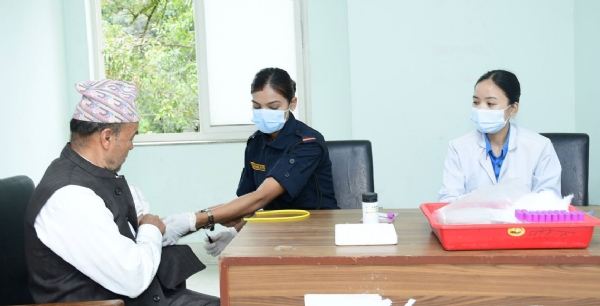
More than 5,000 people have been reported missing following the floods. Families who have still received no information about their loved ones are now awaiting the results of DNA testing. Police said blood samples have so far been collected from 1,779 relatives for DNA matching, and the number continues to increase.
The unidentified bodies have been temporarily buried. Officials said that once a DNA match is established, arrangements will be made to exhume the remains and hand them over to the respective families.
After prolonged uncertainty, some families have abandoned hope of finding their relatives alive and have performed last rites using symbolic bodies made from kusha grass. However, many other families are waiting for DNA identification before performing the final rites for their loved ones.
According to Nepal Police spokesperson Kafle, DNA reports for around 400 bodies have been completed so far. Samples collected from the remains are being analysed at the Nepal Police Forensic Science Laboratory in Samakhushi, Kathmandu, the National Forensic Science Laboratory and the laboratory of the Nepal Academy of Science and Technology (NAST).
Nirajan Thapa, head of the National Forensic Science Laboratory and a DNA expert, said that at the current testing capacity, it could take around two and a half months to complete DNA analysis of all the bodies. He said DNA testing is still required for approximately 1,200 to 1,300 bodies.
NAST and the National Forensic Science Laboratory are jointly processing samples from around 250 bodies and 400 relatives each week. However, some DNA samples do not produce conclusive results, requiring them to undergo additional testing through different procedures.
Thapa said the time required to complete the process will also depend on how many additional testing machines become available in the coming days and how effectively they operate.
Nepal has received assistance from several countries because of its limited capacity for DNA testing. Four DNA testing machines provided by South Korea have already become operational at the police laboratory. However, some of the other equipment has yet to be installed.
Earlier, China provided three machines to Nepal’s National Forensic Science Laboratory. However, those machines could not be used for DNA testing of the recovered bodies. After the equipment failed to function, a team of Chinese experts ordered replacement machines, but the new equipment has not yet arrived in Nepal.
The identification of bodies recovered from the floods and the efforts to provide answers to thousands of grieving families are therefore increasingly dependent on Nepal’s DNA-testing capacity and the availability of functional laboratory equipment.
---------------
Hindusthan Samachar / Jun Sarkar

18 Aug 2026