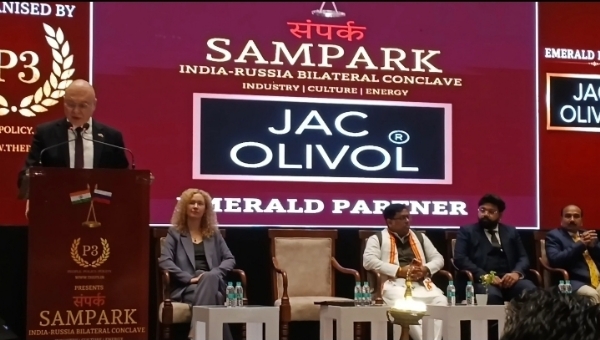
Kolkata, 01 September (H.S.): India-Russia relations, built over decades on strategic trust, defence cooperation and strong people-to-people ties, are entering a new phase with both sides seeking to expand the partnership into technology, innovation, trade, education, energy and industrial cooperation.
Speakers at the SAMPARK – India-Russia Bilateral Conference 2026 in Kolkata underlined that the future of the relationship cannot depend only on traditional areas of cooperation. Instead, the partnership must increasingly focus on joint development, investment, technology localisation, research and stronger commercial links between institutions and businesses.
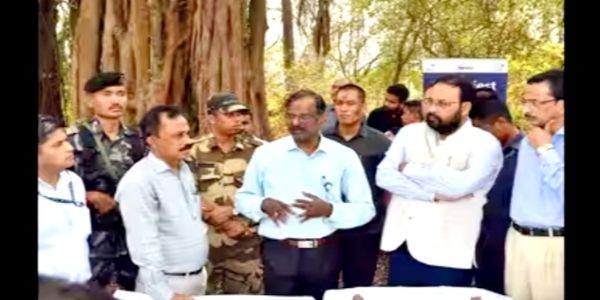
Union Minister of State for Education and Development of North Eastern Region Sukanta Majumdar said the longstanding trust between India and Russia provides a strong foundation for expanding bilateral cooperation in emerging areas. He highlighted manufacturing, railways, aviation, mining, technology, research, innovation, energy and education as sectors with significant potential.
Majumdar said the partnership, which has historically contributed to India's development in areas such as defence, science, technology and space, now needs to be aligned with the opportunities and challenges of the 21st century. He also stressed greater participation of universities, researchers, entrepreneurs and young innovators in strengthening bilateral relations.
Russian Consul General in Kolkata Maxim V. Kozlov described India-Russia relations as being rooted not merely in diplomacy and strategic interests but also in centuries-old cultural exchanges and people-to-people connections. He said Kolkata and eastern India could play a larger role in taking the relationship forward.
Kozlov pointed to an ambitious target of raising bilateral trade to $100 billion by 2030, while stressing the need to diversify trade and increase the presence of Indian products in the Russian market. He also called for faster progress on negotiations for a free trade agreement between India and the Eurasian Economic Union and for mechanisms that can make bilateral payments and trade more efficient.
Connectivity, he said, will be critical to achieving these goals. The International North-South Transport Corridor and the Northern Sea Route could help reduce transportation time and costs, strengthen supply chains and open new avenues for trade and investment.
The next phase of the strategic partnership is also expected to be technology-driven. Kozlov identified artificial intelligence, data centres, advanced technologies, quantum computing, robotics, biotechnology, cybersecurity and critical minerals as emerging areas where the two countries could work together.
Debjit Chakraborty, Chief Executive Officer and Executive Director of the India-Russia Innopraktika Technology Hub, argued that the relationship should move beyond the traditional technology-transfer model towards an equal partnership based on co-development, localisation and joint research.
He said Russian technologies should not simply be imported into India. Instead, Indian companies, universities and research institutions should participate in adapting, developing and commercialising technologies according to local requirements. Such an approach, he said, could create value in both countries and eventually generate products capable of competing in global markets.
The defence relationship remains an important pillar of this broader strategic partnership. Retired Colonel R.K. Srivastava, former Director of Military Intelligence, said India-Russia defence cooperation has evolved from equipment purchases to technology transfer, training, production and the development of domestic industrial capabilities.
He noted that Russian-origin platforms have played an important role in the evolution of India's defence capabilities, while technology transfer and industrial cooperation have helped India build technical expertise and trained manpower. Going forward, he advocated greater emphasis on joint research, joint development and joint production rather than a buyer-seller relationship.
Education and human-resource development are another emerging dimension of the partnership. Vladimir Gonchar said stronger links between universities, students, technical institutions and businesses could create new opportunities for young people in both countries.
He noted that more than 1,000 Indian students are currently studying in Russia, with many pursuing medical education, while Indian students also have opportunities in engineering and other technical fields. He called for greater two-way student mobility and stronger connections between academic research and industry.
Tea trade also emerged as an area where practical improvements could strengthen economic ties. Arunita Phukan Yadav, Executive Director of the Tea Board of India's North-East Regional Office, stressed the need to improve transportation links, simplify certification and regulatory procedures and address shipping, insurance and logistics challenges affecting exporters.
Ram Krishna Jaiswal, Honorary Consul of the Republic of Maldives in Kolkata, emphasised that dialogue, trust, sensitivity and mutual respect remain essential to sustaining any long-term partnership. He said stronger interaction among institutions, businesses, investors, universities and people could help transform existing goodwill into new opportunities.
The discussions in Kolkata highlighted a common message: India-Russia relations have strong historical foundations, but their future will depend on how effectively that trust is translated into new economic, technological and institutional partnerships.
From defence and nuclear energy to artificial intelligence, education, critical minerals, manufacturing, trade and connectivity, the relationship is gradually broadening beyond its traditional framework. The challenge now is to convert political goodwill and decades of strategic cooperation into concrete projects, joint innovation and mutually beneficial economic outcomes.
The Kolkata conference thus reflected an evolving India-Russia partnership—one that seeks to preserve its traditional strengths while building a more diversified, technology-driven and people-centric strategic relationship for the future.
Hindusthan Samachar / Satya Prakash Singh