Islamabad, 30 August (H.S.): Thirteen Pakistani soldiers were killed in an attack on an army convoy in Balochistan, with the Balochistan Liberation Army (BLA) claiming responsibility for the incident.
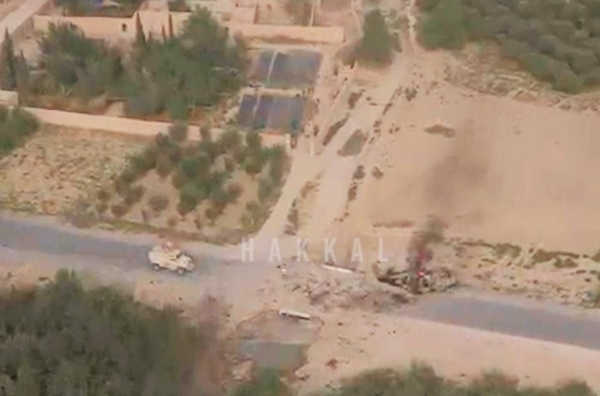
The BLA’s official channel, Hakal, released a one-minute-and-38-second video purportedly showing an attack targeting Pakistani military armoured vehicles. The Balochistan Liberation Army has claimed responsibility for the assault.
According to a report by The Balochistan Post, citing Hakal Media, BLA commanders targeted a Pakistani Army convoy in the Khadkocha area of Mastung. The report said an improvised explosive device (IED) destroyed one armoured vehicle, while another armoured vehicle and other vehicles travelling with the convoy were subsequently targeted in an ambush.
The BLA claimed that 13 soldiers were killed and more than 10 others were injured in the attack. A spokesperson for the group said its Special Tactical Operations Squad (STOS), also known as the Fateh Squad, participated in the operation.
The video purportedly shows BLA operatives preparing explosives before the convoy arrives, followed by an explosion that destroys one of the vehicles. It also contains aerial footage reportedly recorded after the attack.
The BLA is an armed separatist organisation operating in Balochistan. On March 11, the group hijacked the Jaffar Express train in Balochistan’s Bolan district and held more than 180 people hostage. The attack was carried out by the BLA’s Majeed Brigade, with the group’s Special Tactical Operations Squad, also referred to as the Fateh Squad, reportedly playing a supporting role.
The Balochistan Liberation Army was established in 2000 with the stated objective of seeking independence for Balochistan from Pakistan. The group has carried out attacks against Pakistani security personnel and government installations, as well as targets linked to the China-Pakistan Economic Corridor (CPEC) and Chinese-backed projects.
The BLA has organised several of its operations through specialised units, including the Majeed Brigade and other armed squads. These units have been associated with guerrilla-style attacks and militant operations.
The Majeed Brigade was established in 2011 and is described as a specialised wing of the BLA. It has been associated primarily with suicide attacks. The brigade was named after Abdul Majeed Baloch, who reportedly attempted to assassinate then-Pakistan Prime Minister Zulfikar Ali Bhutto in 1974. The group has subsequently been linked to several major attacks in Pakistan.
The Fateh Squad has primarily been associated with guerrilla operations against Pakistani military patrols in the mountainous areas of Balochistan. In 2024, during what the BLA called Operation Herof, the Fateh Squad and other units reportedly carried out coordinated attacks and blockades at 14 locations across Balochistan, in which the group claimed that 62 Pakistani soldiers were killed.
The Special Tactical Operations Squad is described as an elite unit of the Balochistan Liberation Army. It has reportedly been involved in intelligence gathering, surveillance and targeted attacks. The group has also claimed that STOS, under Bashir Zeb Baloch, has played a role in identifying Pakistani military personnel and their local associates.
The roots of the Balochistan conflict can be traced back to the period surrounding the partition of British India in 1947. Following Britain’s announcement of its withdrawal from the subcontinent, the princely state of Kalat declared independence. Much of present-day Balochistan was then part of the Kalat state, whose political status subsequently became disputed.
Pakistan held negotiations with the Khan of Kalat and sent troops into Balochistan in March 1948. The development triggered resistance in the region and was followed by several armed uprisings over the decades.
Apart from the insurgency of 1948, major periods of unrest occurred in 1958-59, 1973-77 and from 2004 onwards. Baloch nationalist groups have accused Pakistan’s federal government of exploiting the province’s natural resources and have demanded greater control over those resources, political autonomy and a larger share in the region’s economic benefits.
The Pakistani government has repeatedly sought to suppress the insurgency with the assistance of the military. Pakistan’s security forces have also faced recurring allegations of human rights violations in the province, while authorities have maintained that military operations are necessary to counter armed militancy and maintain security.
---------------
Hindusthan Samachar / Jun Sarkar

18 Aug 2026