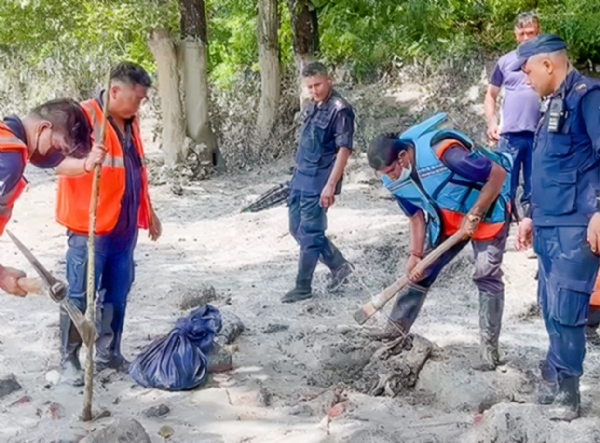
Kathmandu, 30 August (H.S.): As many as 724 bodies have been recovered following devastating floods in Nepal’s Bhotekoshi and Trishuli rivers, but only 22 of them have been identified so far. According to Nepal Police, difficulties in identifying the victims have complicated the management of the bodies. With hospitals lacking adequate facilities to preserve such a large number of bodies, the government has begun placing unidentified bodies in airtight bags and burying them underground at a designated site in a forested area near Devghat.
Police have created a dedicated portal to help identify the victims and have uploaded photographs of the recovered bodies. Many of the bodies are severely damaged and difficult to identify.
Police spokesperson Avinarayan Kafle said the 22 bodies that have been identified were handed over to their families. Given the low identification rate, authorities have now decided to use DNA testing to establish the identities of the remaining victims. DNA samples are being collected from all unidentified bodies before they are buried.
Kafle said the bodies are being placed in airtight bags and buried underground in accordance with provisions governing the management of unidentified and unclaimed bodies, following decisions taken by the district security committees.
According to Kafle, underground burial will ensure that the bodies remain preserved and can be exhumed and handed over to their families if their identities are established at a later stage. Each unidentified body has been assigned a unique identification mark or code number.
Police said that while burying the bodies respectfully and securely at designated locations, the identification mark or code assigned to each body is being recorded both above and below ground. Authorities are also documenting the GPS coordinates, photographs, maps and other detailed information relating to each burial site.
Once a DNA match is established with samples provided by the victim’s relatives and the required legal procedures are completed, arrangements will be made to exhume the body and hand it over to the family.
Kafle said some people might find the decision to bury unidentified bodies difficult to understand, but described it as a safe method accepted internationally. He said all relevant records were being preserved so that families could recover the remains if a DNA match establishes the victim’s identity in the future.
Preparations Underway to Manage Unidentified Bodies in Nawalparasi East
Similar preparations are also underway in Nawalparasi East to bury unidentified bodies in a forested area. According to Superintendent of Police Yuvraj Khadka, the collection of samples for DNA testing has already begun, while two locations have been identified for the management of the bodies.
At present, bodies recovered in Nawalparasi are being kept at hospitals in Nawalparasi East, Nawalparasi West, Pokhara, Rupandehi and Kapilvastu districts.
Police chiefs of the two Nawalparasi districts said that a total of 223 bodies had been recovered by Saturday evening.
According to Nawalparasi West Superintendent of Police Ram Bahadur KC, 54 intact bodies were recovered from the district. In addition, 25 human body parts were also found.
In Nawalparasi East, 169 bodies had been recovered by Saturday evening, of which four had been identified. Superintendent of Police Yuvraj Khadka said three of those bodies had already been handed over to their families, while the process of handing over the fourth body was underway.
He said 41 bodies had been transported to Pokhara, while the remaining bodies were being kept at two hospitals in the district.
Nepal Seeks Mobile Freezers and Refrigerated Trucks From International Community
Meanwhile, Foreign Minister Shishir Khanal said the government had asked the international community to provide mobile freezers, refrigerated trucks and equipment for rapid forensic and DNA testing to help preserve and identify the bodies.
“There is a risk that the bodies could deteriorate quickly. Therefore, discussions are underway with the international community through neighbouring countries and diplomatic missions to arrange refrigerated trucks,” he said.
Authorities are continuing efforts to preserve the recovered remains, establish the identities of the victims through forensic and DNA procedures, and ensure that unidentified bodies can be returned to their families if their identities are confirmed later.
---------------
Hindusthan Samachar / Jun Sarkar

18 Aug 2026