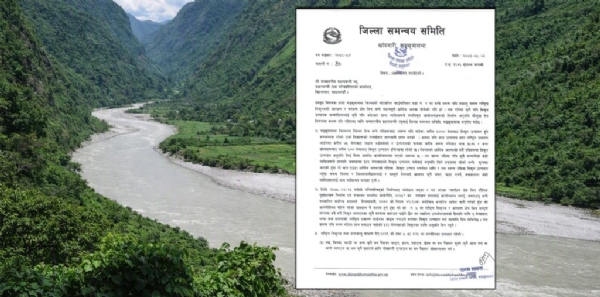
Kathmandu, 26 August (H.S.): Opposition has emerged in Nepal to a proposed hydropower project on the Barun River, which holds considerable religious and mythological significance. The District Coordination Committee of Khandbari and Sankhuwasabha has urged the Office of the Prime Minister and Council of Ministers not to permit construction of the hydropower project on the river, citing its religious and cultural importance.
The proposed project is to be developed on the Barun River at Syaksila in Bhote Khola Rural Municipality of Sankhuwasabha district, within the Makalu-Barun National Park and its conservation area.
The committee has requested that permission not be granted for the 132-megawatt Lower Barun Khola Hydropower Project. District Coordination Committee chief Suman Shakya said the Barun River is an important centre of religious and cultural faith and that its preservation is essential.
According to the committee, the 13th executive meeting of Bhote Khola Rural Municipality had also decided to preserve the Barun River, which falls under Ward No. 4, as religious heritage and to prevent hydropower construction within the Makalu-Barun National Park and conservation area. Supporting the rural municipality’s decision, the District Coordination Committee has urged the concerned authorities to take note of the issue.
The committee said Sankhuwasabha has the potential to generate around 6,000 megawatts of electricity from various rivers, excluding the Arun River. At present, around 75 megawatts of electricity generated in the district has been connected to the national transmission grid, while projects with a combined generation capacity of around 3,576 megawatts are under development along the Arun River.
Expressing concern that construction of the project on the Barun River could adversely affect religious sentiments, the environment and the wider region, the committee has urged the authorities to deny permission for the project in accordance with the legal provisions, including the National Parks and Wildlife Conservation Act, as well as policies governing protected areas.
It has also called upon the concerned agencies to implement provisions of the guidelines governing the construction of physical infrastructure within protected areas.
The Barun River is regarded as religiously and culturally significant by both Hindus and Buddhists. According to local residents, several mythological beliefs are associated with the river. The annual Makar Mela, held along the banks of the Barun River on the first day of the Nepali month of Magh, also serves as an important occasion for residents of the Bhote region and the lower areas to meet and interact.
Local residents have long demanded that no hydropower project be constructed on the Barun River because of concerns that such development could alter its natural character and undermine its religious significance. Earlier too, local communities had called for a halt to hydropower projects proposed on the river.
---------------
Hindusthan Samachar / Jun Sarkar

18 Aug 2026