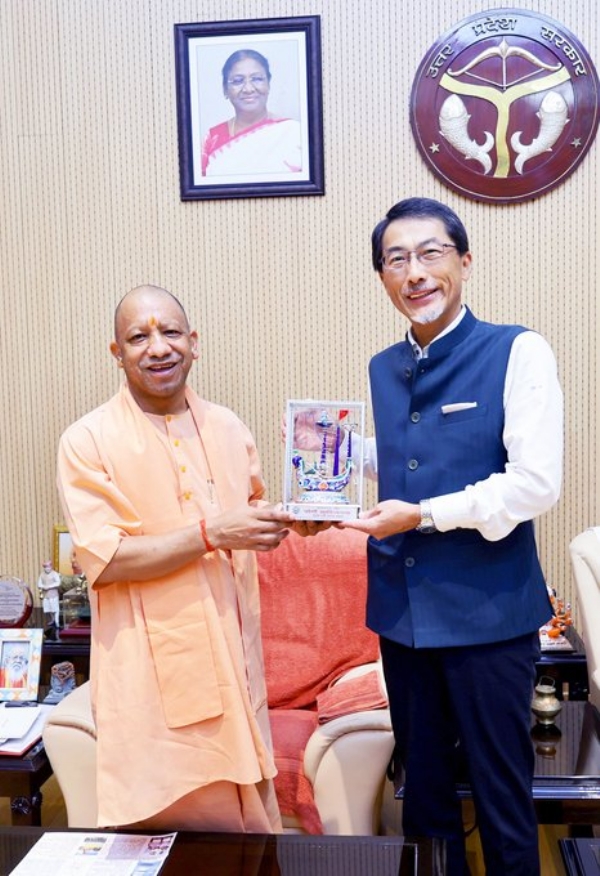
Lucknow, 23 Aug (HS): Uttar Pradesh has seen significant
development in recent years. Previously, the state was notorious for its
insufficient healthcare services, failing hospitals, and residents who had to
go elsewhere for medical treatment. Uttar Pradesh is currently authoring a new
chapter of growth in accordance with the aspirations of 'Viksit Bharat 2047'.
One of the most striking examples of this transition is the growing 'UP-Japan
Healthcare and Healthcare Economy Partnership'. This is not just a regular
arrangement. It offers a potentially revolutionary strategic plan aimed at
establishing the framework for world-class healthcare services in Uttar
Pradesh. The agreement might not only enhance access to treatment for
individuals in the state, but it could also reinforce UP's status as a major
medical tourism destination, providing high-quality healthcare that meets
worldwide standards at rock bottom rates. Quality healthcare accessible in UP,
sans having the need to lossen strings of purses. Simultaneously, the
relationship might help Uttar Pradesh grow as a major manufacturing base for
modern medical gadgets and equipment.
Let's look at how the healthcare industry, along with
Japanese innovation and technology, may help lay the groundwork for 'Viksit
Uttar Pradesh 2047'. Historical Background: The Rise of the UP-Japan
Partnership and a Major Deal - This substantial healthcare collaboration began
with the three-day UP-Japan Investors Meeting, which included sectoral
discussions. The sessions, which ran from Wednesday to Friday, featured many
rounds of rigorous discussions with officials, Japanese representatives, and
senior healthcare sector executives. As a result of this ongoing collaboration,
healthcare and the healthcare sector have emerged as critical pillars of cooperation
between the two parties.
Driven by the Yogi government's proactive attitude, there is
growing consensus on collaboration in a variety of sectors, including
technology transfer, cooperative research, human resource exchange, and digital
health system development. The alliance focuses on critical industries like as
medical equipment production, nursing and geriatric care, pharmaceutical
development, AI-powered patient monitoring, and AYUSH-based natural healthcare.
The institutional MoUs and policy efforts linked with these areas demonstrate
UP's desire to go beyond agreements and focus on successful implementation on
the ground.
Demographic Complementarity: Japan's Aging Population and UP's Large Young
Workforce -- When two complementing qualities combine in the global economy,
they can form a robust growth model. Japan is one of the world's fastest-aging
societies, with more than 29% of the population aged 65 and over.
This demographic transition has resulted in an increased
need for professional caregivers and nurses who can care for the country's
elderly. Uttar Pradesh, on the other hand, has a large population and more than
56% of the working-age population, resulting in a massive reservoir of youthful
talent. Chief Minister Yogi Adityanath has identified this demographic
complementarity as a significant opportunity. Every year, thousands of nursing,
paramedical, and related healthcare workers graduate from Uttar Pradesh.
Through this collaboration, the state's youthful workforce has the potential to
act as a critical link in meeting Japan's expanding demand for qualified
healthcare and caregiving personnel. This might provide Japan with a
dependable, competent workforce while also providing possibilities for Uttar
Pradesh's young to pursue safe, well-paying occupations that meet international
standards.
'Kaigo' and SSW Training: A Path to International Careers
for UP Students - The Yogi government is taking a disciplined, skill-oriented
approach to turning this global cooperation into tangible opportunity. In
Japan, there is a specialist profession of aged care called as 'Kaigo' that
incorporates standardized procedures for the physical and mental care of senior
individuals. Under the suggested strategy, nursing and paramedical students
from Uttar Pradesh will not only receive training in this specific profession.
They would also learn about Japanese language and culture. This might assist
open doors for qualified individuals through Japan's Specified Skilled Worker
(SSW) and Technical Intern Training Program, allowing skilled youngsters to
pursue overseas work prospects. To overcome linguistic and cultural
difficulties, specific Japanese language training facilities are being
established at the state's main colleges.
Efforts will also be made to improve synchronization between
healthcare certificates and professional standards in both nations. Such
collaboration might assist UP's talent achieve worldwide standards while also
strengthening the state's image as a dependable global manpower center.
YEIDA Medical Device Park: A new mega ecosystem for global manufacturing and
'Make in India'. The goal of 'Viksit Uttar Pradesh 2047' would not be achieved
if the state continues to be a consumer. It must also become a significant
manufacturer and manufacturing hub. With this long-term aim, the Yogi
government is constructing a sophisticated 'Medical Device Park in the Yamuna
Expressway Industrial Development Authority (YEIDA)' region, as well as a
growing network of pharmaceutical manufacturing facilities. Japan is recognized
across the world for its accuracy, quality, and cutting-edge medical
technology.
Meanwhile, Uttar Pradesh is attempting to create the
environment necessary for Japanese corporations to construct sophisticated
manufacturing plants in the state. This comprises plug-and-play infrastructure,
single-window clearance, and efficient logistics. Increased Japanese investment
might spur local production of medical gadgets, diagnostic equipment, and other
modern healthcare technology. This will minimize reliance on imports, enhance
the 'Make in India' drive, and position Uttar Pradesh as one of the world's
growing cost-competitive manufacturing hubs. Such an ecosystem might play an
essential role in increasing India's self-reliance in healthcare manufacturing.
The high-tech future of UP's medical infrastructure includes digital
healthcare, AI, and robotics. Today's healthcare is increasingly molded not
just by pharmaceuticals, but also by artificial intelligence and modern
technology.
Japan is one of the countries that is developing technology
such as AI-based patient monitoring systems and nursing robots for healthcare
and elder care. Integrating such technology into Uttar Pradesh's healthcare
ecosystem has the potential to greatly improve medical services in the state.
Uttar Pradesh's expanding IT ecosystem and 'Invest UP' program might create
opportunity for Japanese AI-driven healthcare firms to enter and expand in the
enormous healthcare industry. As automated patient monitoring systems and advanced
assistive technologies grow more prevalent in hospitals, they may help decrease
the stress on physicians and nursing staff, enhance efficiency, and enable
improved clinical care. Adopting such technology may make Uttar Pradesh's
healthcare system more intelligent, efficient, and future-ready.
AYUSH and Wellness Tourism Convergence: UP as a New Global Healthcare
Destination --
Globally, healthcare is shifting away from treating sickness
and toward preventative and holistic wellbeing. Japan has also seen an increase
in interest in healthy lifestyles and wellness-oriented care. In this context,
Uttar Pradesh's diverse AYUSH ecosystem, which includes Ayurveda, Yoga, and
Unani, has the potential to generate new possibilities in conjunction with
Japan's wellness industry. The Yogi government aims to strengthen the
foundation for global wellness and medical tourism by combining traditional
Indian healthcare expertise with modern research and innovation. This has the
potential to attract people from Japan and other industrialized countries
seeking physical, mental, and holistic health experiences in Uttar Pradesh. At
the same time, it has the potential to help establish a substantial and
self-sustaining medical and wellness tourism business, producing new revenue
streams and local employment while exposing India's ancient knowledge systems
to a larger global audience.
Chief Minister Yogi Adityanath has also stated that Uttar
Pradesh and Japan are ideal complements in terms of technological competence
and demographic balance. This vision guides the state government's continued
exploration of new paths of collaboration.
Strong Foundation for 'Viksit UP 2047': Whatever Uttar Pradesh's past, its
present and future are being determined by Chief Minister Yogi Adityanath's
ambitious development goal. UP-Japan Healthcare and Healthcare Economy
Partnership goes beyond agreement. It reflects a deliberate endeavor to advance
the larger goal of 'Viksit Bharat and Viksit Uttar Pradesh 2047'. When Japan's
globally known accuracy, quality standards, and technical competence are
combined with Uttar Pradesh's massive scale, youthful talent, increasing
infrastructure, and policy ecology, the alliance has the potential to usher in
a new era of progress.
The state's policy strategy is aimed at transforming pledges
into tangible results. As this plan takes form, Uttar Pradesh has the potential
to greatly improve access to cheap, high-quality healthcare for its 25 million
people while also developing as a recognized destination for medical tourism
and sophisticated healthcare manufacturing. In many ways, this new chapter—bringing
together the 'Land of the Rising Sun' and the land of an ancient civilization
and living cultural heritage—has the potential to become an important example
of economic, technological, and human cooperation, not only for Uttar Pradesh
and India, but also for the larger Indo-Pacific region.
Hindusthan Samachar / Abhishek Awasthi