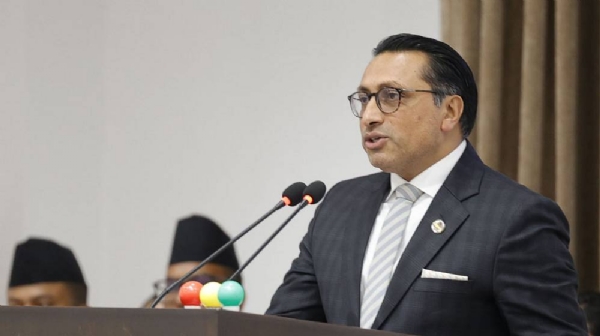
Kathmandu, 21 August (H.S.): Nepal’s Finance Minister Dr. Swarnim Wagle has expressed concern over the continuous decline in foreign assistance to the country. Speaking at a meeting of the Parliamentary Public Accounts Committee, he said that sources of grants and concessional loans have been steadily shrinking in recent years. With foreign assistance decreasing, Nepal is now being compelled to seek alternative sources of financing through private capital.
He said, “The window for highly concessional loans carrying interest rates of 1 to 1.5 percent, with repayment holidays extending up to eight years and repayment periods of up to 40 years, is gradually closing. Today, as Finance Minister, I am concerned that these windows and doors are steadily shutting.”
Wagle noted that since the presentation of Nepal’s first national budget, expenditures not covered by domestic revenue have largely been financed through foreign aid and loans. However, as the size of the national budget has expanded, the share of foreign grants in the overall budget has steadily declined. According to Wagle, Nepal has targeted approximately NPR 212 billion in foreign borrowing in the current fiscal budget, while foreign grants are projected to amount to around NPR 62 billion.
He explained that in previous years, budgets had estimated foreign grants of between NPR 48 billion and NPR 52 billion annually, but the actual inflow generally remained limited to only NPR 10 billion to NPR 15 billion. He added that assistance received through international non-governmental organizations (INGOs) has also been declining, and its contribution has become relatively insignificant compared to the size of Nepal’s economy and budget.
Wagle said that concessional resources that could be used for major infrastructure projects and institutional restructuring are now available only under stricter conditions. Interest rates are rising, grace periods and loan maturities are becoming shorter, and competition for limited resources is intensifying. He described this as an extremely challenging phase for Nepal.
The Finance Minister noted that Nepal has historically received bilateral grants from countries including India, China, the United Kingdom, Japan, and the United States. In addition, concessional financing from multilateral development partners has remained a crucial source of development funding. He said loans from the Asian Development Bank (ADB) and the World Bank have traditionally offered long repayment periods, low interest rates, and grace periods. However, such concessional funding sources are now gradually becoming more limited.
Wagle also acknowledged that Nepal had not effectively utilized the concessional resources available in the past. According to him, despite the availability of assistance, weak spending capacity, procurement-related challenges, and other administrative constraints prevented the country from achieving expected levels of capital expenditure. He said, “Even the funds that were available could not be fully spent. The money was there and ready to be disbursed, but due to our capacity limitations, procurement processes, and other factors, we failed to achieve the desired level of capital expenditure.”
He emphasized that nearly all of Nepal’s major infrastructure projects have been built using such concessional loans. However, in recent years, private-sector investment has increasingly flowed into large infrastructure and hydropower projects. As traditional sources of foreign assistance continue to diminish, Nepal is now turning toward new forms of private capital.
Wagle said the government has introduced several mechanisms to mobilize private and alternative sources of financing in response to the shrinking availability of foreign aid. These include the Hybrid Annuity Model, offshore bonds, diaspora investment schemes, and arrangements related to alternative development finance.
He further stated that pathways have been opened to raise capital from international markets through institutions such as the Asian Development Bank and the International Finance Corporation (IFC), enabling Nepali banks to channel financing to the private sector. According to Wagle, existing legal and regulatory barriers have also been removed to facilitate investment by Non-Resident Nepalis (NRNs). In addition, legislation related to alternative development finance has already been passed by Parliament.
---------------
Hindusthan Samachar / Jun Sarkar

18 Aug 2026